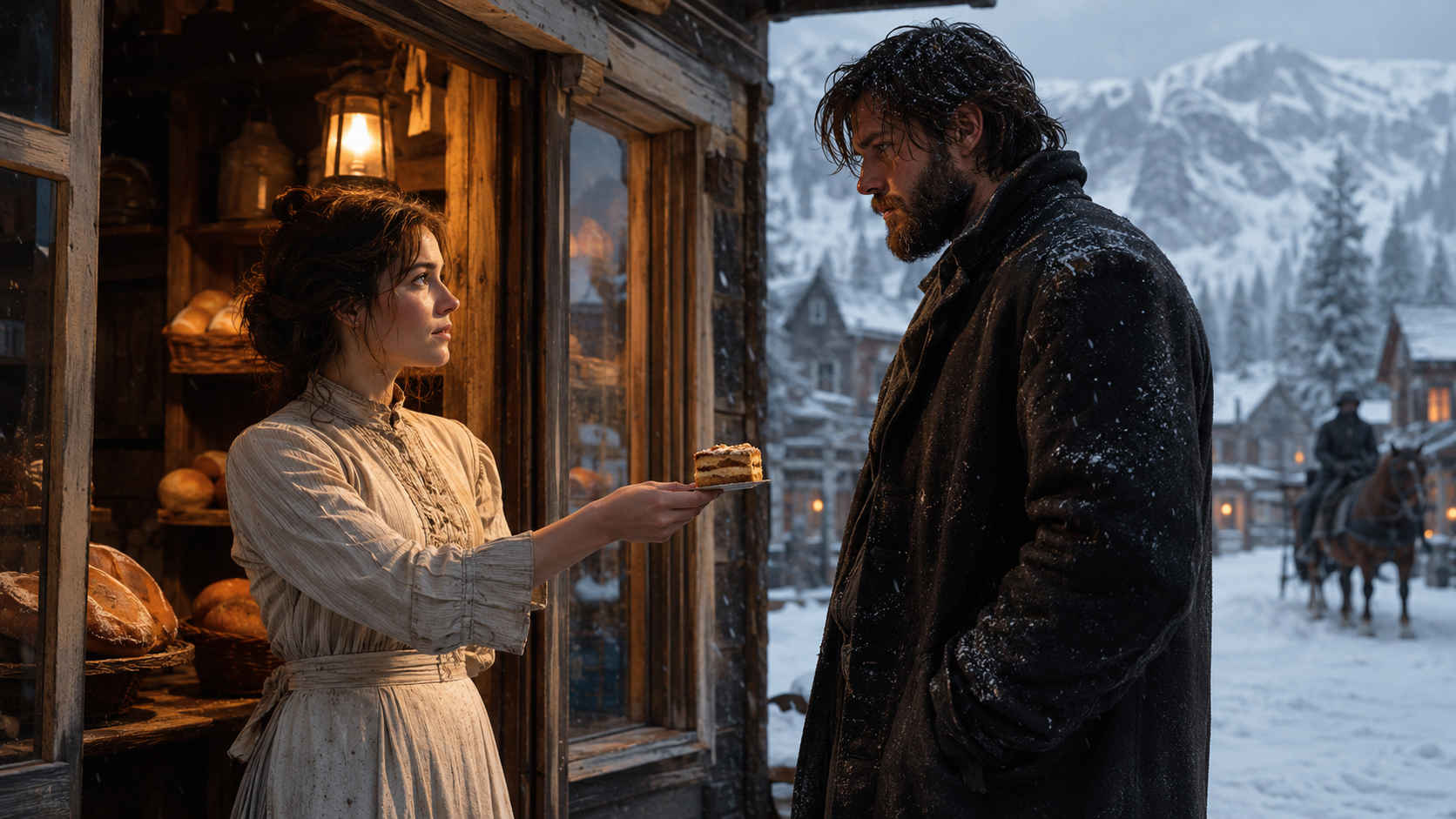
By noon the whole bakehouse smelled like childhood.
By dusk, Lydia wrapped the cake in linen, tied it with string, and placed it on the back step where the rabbits had been.
She almost wrote a note.
Instead, she said aloud, “Fair trade.”
In the morning, the cake was gone.
Three days later, Rowan brought venison.
Not to the front door like a normal person.
To the back step before dawn, like some enormous wounded cat leaving offerings.
Lydia answered with bread.
He answered with trout.
She answered with plum preserves.
He answered with firewood stacked so neatly against the wall she knew he had spent too long doing it.
By the second week of December, the whole town had noticed.
Briar Hollow noticed everything.
At the general store, Mrs. Bell said, “A man does not bring split oak unless he means to stay warm near the woman he gives it to.”
At the church steps, young Mercy Vale whispered, “He looked at her window for ten whole seconds.”
At the livery, Jonas Pike said, “Halloway won’t court. He’s more likely to marry a pine tree.”
Lydia heard all of it and pretended she did not.
Rowan heard all of it and looked exactly the same, which was to say carved from winter and disapproval.
The first real conversation they had after the roof board happened because Lydia burned a batch of rolls.
Not badly. Just enough to curse.
She was standing in the back kitchen, holding a smoking tray, when Rowan appeared in the open doorway with a sack of coffee over one shoulder.
“You burned something,” he said.
Lydia turned. “Do you always announce disasters, or only mine?”
His gaze moved to the tray. “Those are rolls.”
“They were rolls.”
“Now?”
“Evidence.”
Something moved at the corner of his mouth. Not quite a smile. More like the memory of one testing whether it still fit.
Lydia noticed and felt an absurd little triumph.
She set the tray down. “Since you’re here, you may as well come in.”
He shifted his weight.
“You brought coffee,” she added.
“For trade.”
“And I brewed coffee. Also for trade.”
His eyes narrowed slightly. “You argue like a lawyer.”
“I bake like one too. Ruthless with measurements.”
He looked past her into the kitchen.
The room was warm. Golden. Flour dusted the worktable. A kettle hissed softly on the stove. Honey cooled in a crock near the window. It was the kind of room that asked a person to sit down and remember being human.
Rowan looked as if the room had struck him.
Lydia saw him begin to retreat.
So she did the one thing her mother had always done when fear tried to win.
She pushed.
“Rowan Halloway,” she said, folding her arms, “I dare you to drink one cup of coffee without running back to your mountain.”
His eyes came back to hers.
“No one dares me.”
“I just did.”
“That was foolish.”
“I’ve done worse before breakfast.”
He stared at her for so long that Lydia’s courage started to tremble around the edges.
Then he stepped inside.
They drank coffee at the worktable.
He did not take sugar.
She did not offer it.
For ten minutes, they said almost nothing. Yet the silence was not empty. It had shape. It rested between them like dough rising under cloth.
At last, Rowan looked toward the recipe book on the shelf.
“Your mother wrote that?”
Lydia followed his gaze. “Most of it.”
“She knew Maeve.”
The name dropped into the room like a coal from the fire.
Lydia stilled. “Maeve?”
His jaw tightened. “My wife.”
Lydia had heard the name only in whispers. Maeve Halloway. Dead six winters. Lost with her little son when snow broke loose above the north pass and buried half a cabin, a goat shed, and the road beneath it.
“My mother knew many people,” Lydia said carefully.
Rowan stood so abruptly his chair scraped the floor.
“I should go.”
“Rowan—”
But he was already at the door.
He paused only once, hand on the frame.
“Don’t make honeycake for me again.”
Then he left.
Lydia stood in the warm kitchen, feeling the chill he had carried out and left behind.
Two days later, Victor Cale came to collect what he called business.
He arrived after closing, when Lydia was sweeping flour from the front room and her father, Amos Marrow, sat at the corner table with his hands shaking from drink he claimed not to have taken.
Victor removed his gloves finger by finger.
“Miss Marrow,” he said smoothly. “You look tired.”
“Then don’t stay long.”
Amos flinched.
Victor smiled. “That sharp tongue will cost you one day.”
“It’s one of the few things I still own outright.”
“Are you certain?”
He laid a folded paper on the counter.
Lydia looked at it, and every warm thing in her went cold.
“What is that?”
“A note of debt. Signed by your father. Secured against this property.”
“My father does not own this bakehouse.”
Amos stared at the table.
Victor’s smile softened, which made it worse. “The county ledger says otherwise.”