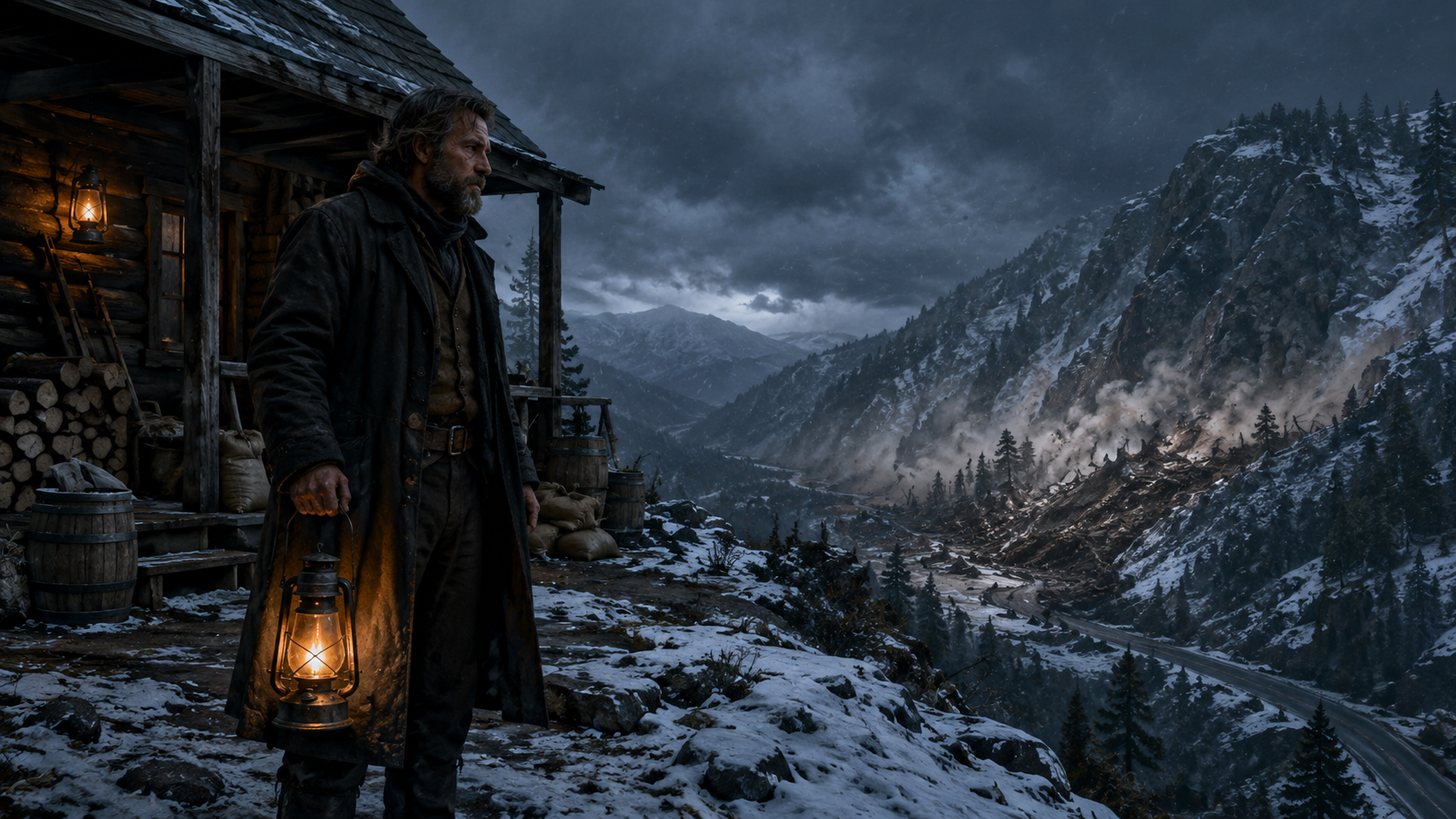
They took his keys, seized his hidden flour, opened his locked smoke cellar, and found enough provisions to keep half the town alive for weeks. They locked him in his own storage room under guard until the pass reopened and law could be brought from Mercy Crossing.
It was not mercy exactly.
It was restraint.
The next morning, Nathaniel saw people climbing the ridge.
At first, he reached for his rifle.
Then he saw Amos Bell at the front, carrying a sack of beans.
Behind him came Delia Pratt with a jar of peaches she had hidden for her twins. Two ranch hands carried ham. Dr. Holt carried medicine. Reverend Peale carried candles and shame. Others brought meal, turnips, dried peas, onions, blankets, soap, and one cracked violin because someone thought children might need music as much as bread.
Amos set his sack on Nathaniel’s porch.
“I called you mad,” he said.
Nathaniel said nothing.
“I laughed at you.”
Nathaniel waited.
“I told people you were hoarding while we starved.”
“You did.”
Amos swallowed. “My nephew died up here.”
“Yes.”
“I don’t know how to carry that.”
Nathaniel looked at the man’s shaking hands.
“Carry wood first,” he said. “Guilt later.”
Amos stared at him.
Nathaniel pointed toward the ruined smokehouse.
“If you came to be forgiven, you will be disappointed. If you came to work, start there.”
Amos nodded once and turned toward the burned stones.
That was how Briar Hollow began changing.
Not with speeches.
With work.
Men rebuilt the smokehouse in stone thick enough to outlast malice. Women learned to dry apples in winter sun and pack roots in sand. Children learned to identify edible greens, read animal movement, twist cordage, stack wood so it breathed but did not rot, and keep an inventory without sneaking bites.
Dr. Holt wrote everything down.
“Smoke slows decay,” she said one afternoon, examining a strip of fish.
“My father said smoke teaches meat to remember fire,” Nathaniel replied.
“That is less scientific.”
“It worked before science found its boots.”
Miriam smiled. “Fair.”
By March, everyone was thin.
By April, everyone was thinner.
But the fires still burned.
That was the difference between tragedy and survival. Not plenty. Not comfort. A small flame refusing to die.
Then Ruth fell ill.
It began with a cough. Then fever. Then the wet, rattling breath Nathaniel knew too well.
Dr. Holt listened to the girl’s chest and closed her eyes.
“I have no proper medicine left.”
Juniper stood beside Ruth’s bed, holding the child’s hand.
“Papa,” she whispered.
Nathaniel knew what she was asking.
In the locked chest beneath his bed were the last of his strongest remedies: willow bark, wild cherry, elderflower, dried yarrow, horehound, and one small jar of honey Clara had sealed years before. Enough for one child. Maybe enough.
If Juniper fell ill later, there would be nothing.
The shed door rose in his memory.
Juniper crying.
Clara burning with fever.
Keep her alive.
Nathaniel took out the herbs.
Juniper watched him.
He brewed the medicine slowly, carefully, with hands that did not shake until the kettle was off the fire. He sweetened the first dose with Clara’s honey.
For two nights, he fed Ruth by the spoonful.
Juniper stayed awake until sleep pulled her head down and jerked it up again.
Tommy kept the fire steady.
Birch lay against the bed and would not move.
At dawn on the third morning, Ruth’s fever broke.
She opened her eyes and whispered, “Is there still soup?”
Juniper laughed and cried at the same time.
Nathaniel turned away before anyone saw his face.
Spring came on April 19.
It came as dripping from eaves. As mud under snow. As the creek loosening its hard white mouth. As a birdcall so bright that little Lottie burst into tears because she had forgotten the world could make sounds other than wind.
Nathaniel walked to the garden patch and pressed his fingers into the soil.
“Soft enough,” he said.
The whole valley planted that day.
Beans. Corn. potatoes. squash. onions. herbs. Anything with a chance.
When the pass finally reopened in late May, the first wagon from Mercy Crossing came loaded with flour, medicine, shovels, and coffins.
The driver looked at Briar Hollow in confusion.
He had expected silence.
Instead, he found children hauling water, women spreading sliced apples on racks, men building a common storehouse beside the church, and Nathaniel Crowe standing on a scaffold teaching Amos Bell how to lay smokehouse stone.
“How did you people make it?” the driver asked.
Amos looked up toward Wolfpine Ridge.
“We laughed at the man who listened,” he said. “Then, when our children knocked, he opened the door.”
Years passed.
Briar Hollow never became rich. Mountain towns rarely do. But it became wiser.