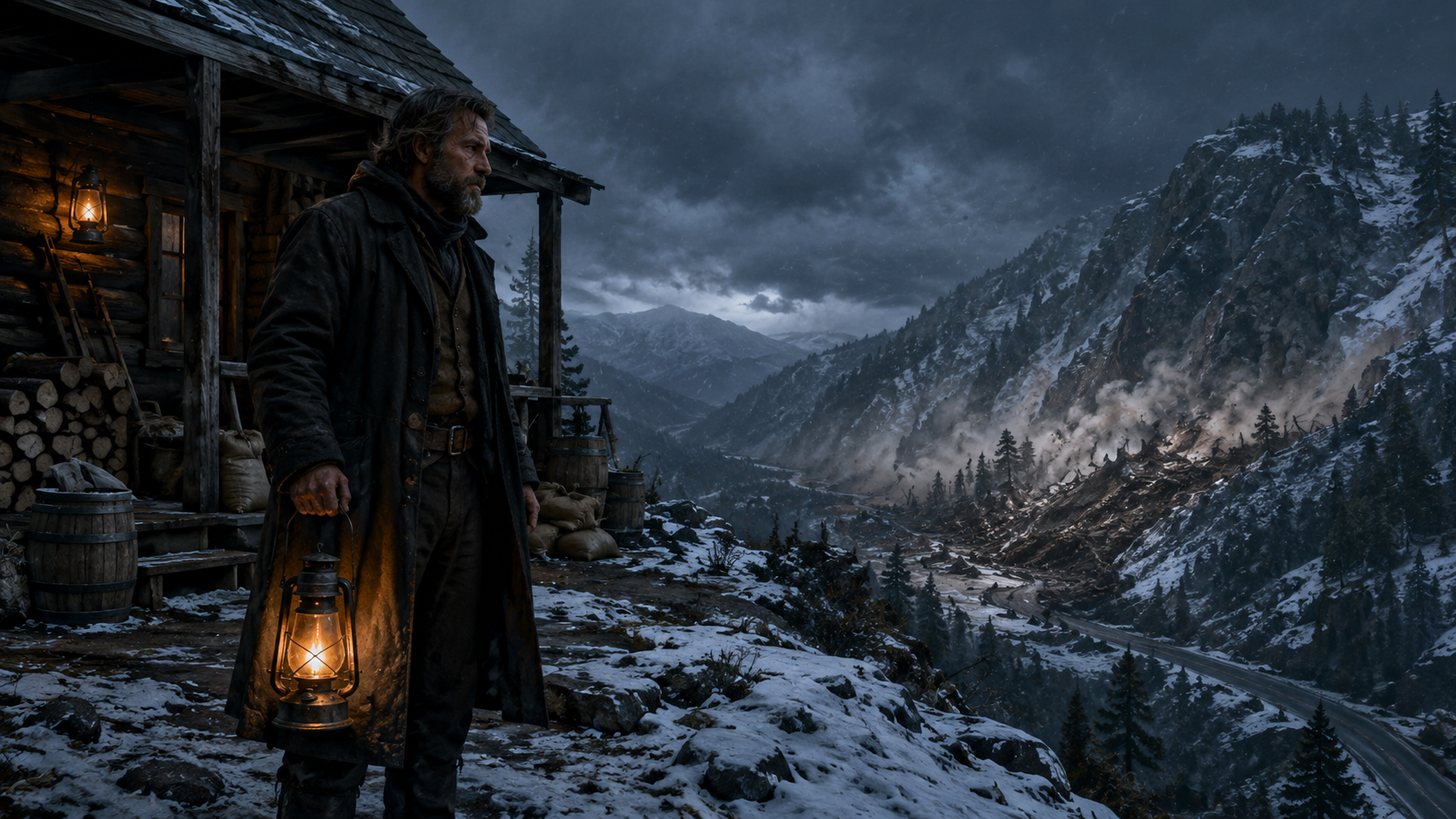
Every autumn, each household brought a share to the common storehouse. Every child learned preservation before penmanship and weather signs before politics. Every spring, the western slope was inspected by people who no longer believed titles made a man smarter than mud.
Juniper became a teacher. She taught reading, arithmetic, seed saving, first aid, and the difference between fear and preparation.
Tommy Rusk grew into a broad-shouldered farmer who never let a neighbor’s cellar sit empty. Ruth and Lottie stayed close to the ridge and called Nathaniel “Uncle Crowe” long after they were grown.
Dr. Miriam Holt wrote a paper years later about the winter Briar Hollow survived, though Nathaniel refused to let her make him the center of it.
“Write what keeps people alive,” he told her. “Names don’t fill bowls.”
“Sometimes names help people listen.”
“Then write the children’s names.”
Elias Vane was taken away when the pass opened. Some said he died in prison. Some said he bought his way into another town under another name. Nathaniel never asked. Revenge had once tempted him, but he had learned that revenge was a fire that consumed the hand holding it first.
Birch died old, gray, and fat beside the stove.
Nathaniel buried him on the sunny side of the cabin where spring touched the ridge first.
“You guarded what was left of me,” he said over the grave. “Rest easy.”
When Nathaniel Crowe died in 1914, Juniper sat beside his bed holding one hand, and Tommy held the other. Ruth and Lottie stood near the window. Dr. Holt, older now and slower, rested a palm against the bedpost.
Near the end, Nathaniel opened his eyes.
“June,” he whispered.
“I’m here, Papa.”
“The shed.”
Tears filled her eyes. “I remember.”
“I hated the door.”
“I know.”
“Your mama said—”
“You kept me alive,” Juniper whispered. “You kept all of us alive.”
Nathaniel’s gaze drifted toward the window, toward the ridge, toward something no one else could see.
For a moment, his face softened.
Maybe he saw Clara.
Maybe his sons.
Maybe Peter Bell.
Maybe every child who had slept on his floor and woken to another morning because a mocked man had prepared for a storm before it had a name.
“I opened it,” he said.
Those were his last words.
The whole valley climbed Wolfpine Ridge to bury him.
Amos Bell, now old and bent, gave the eulogy with his hat in both hands.
“My generation called Nathaniel Crowe mad because he prepared while we laughed. We called him selfish because he counted food. We called him cruel because he demanded work from desperate people. Then the mountain took our road, hunger took our pride, and our children climbed to his door.”
His voice broke.
“And he opened it. That is the measure of the man. Not that he was right. Not that we were wrong. But that when the laughter stopped and the begging began, he did not become small enough to enjoy our shame. He fed the children first.”
Every year after, on the anniversary of the landslide, families walked to the ridge.
They left flowers for Clara, for Nathaniel, for Peter, and for Birch, the good dog who watched the door.
They showed their children the stone smokehouse.
They taught them how to stack wood, how to listen to birds, how to smell rain changing, how to store roots, how to share without wasting, and how to prepare without becoming hard.
Most of all, they taught what Wolfpine Ridge had taught them.
Prepare while the sky is clear.
Listen when the land speaks.
Never confuse laughter with wisdom.
And when winter comes, when the road is buried, when the proud knock like beggars and the hungry bring their children to your door, remember this:
Survival without mercy is only another kind of death.
Nathaniel Crowe survived because he prepared.
Briar Hollow survived because he prepared for more than himself.
And because of that, a valley lived.