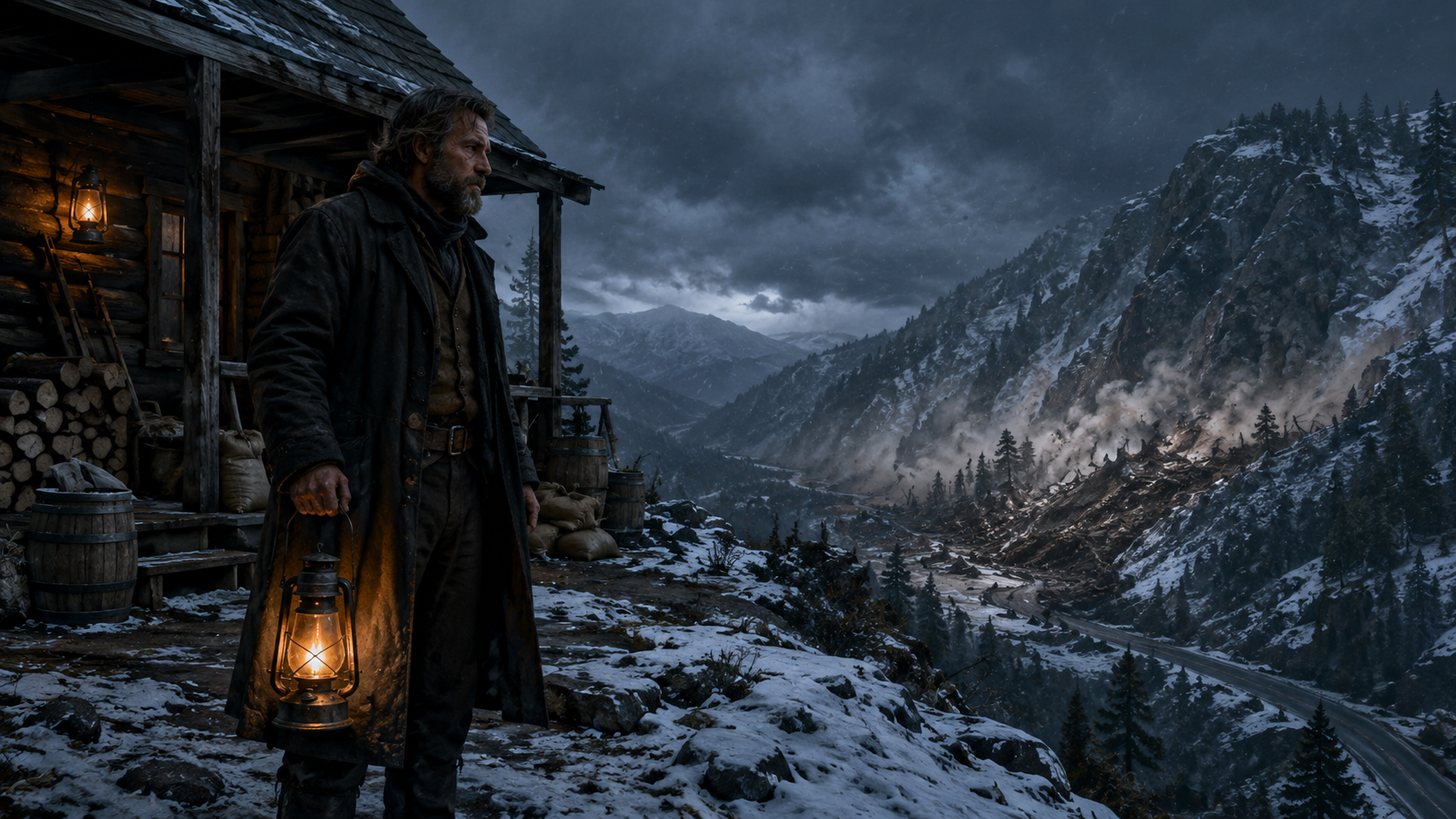
Flame climbed fast.
Orange light filled the window.
Then the first shot struck the cabin wall.
Children cried out below the floorboards. Juniper crawled down last, then reached up to pull the hatch.
Nathaniel stopped her.
“Leave it open one inch.”
Her eyes widened.
“One inch,” he repeated.
She obeyed.
Tommy took his place at the rear window, pale and trembling.
Outside, the smokehouse burned bright enough to show three men moving between the trees. They had expected darkness to hide them.
Fire made them targets.
Nathaniel fired once.
A man cried out and fell behind a stump.
A second shot cracked from outside. Splinters burst from the doorframe near Nathaniel’s cheek.
Tommy gasped.
“Breathe,” Nathaniel said.
“I can’t.”
“Yes, you can. In. Out. Love what’s behind you more than you fear what’s ahead.”
Tommy fired.
His bullet struck the tree above one attacker, showering bark.
The man cursed and ducked back.
Birch launched himself at the door with a roar, but Nathaniel caught his collar.
“Not yet.”
Another bottle flew. It broke against the porch rail and flared.
Nathaniel pulled a bucket from beside the stove and kicked the door open just wide enough to throw water over the flames. A bullet tore through his sleeve. Heat bit his hand. Smoke flooded the room.
From below the floor, Lottie whimpered.
Juniper whispered, “Quiet as snow. Quiet as snow.”
The attack lasted less than ten minutes.
Cowards want victims, not battles.
When one brother was wounded and another heard bells ringing from the trapline behind him, they dragged themselves back into the trees, shouting curses they did not have the courage to finish.
At dawn, the smokehouse was gone.
The stone walls remained, black and cracked, but the roof had collapsed. Meat lay ruined in ash. The children stood in the snow, staring at the destruction like they were looking at the future being taken from them.
Tommy’s voice broke.
“That was food.”
Nathaniel stared at the burned beams.
“Yes.”
“We needed it.”
“Yes.”
“What do we do?”
Nathaniel let the silence stretch until panic began to settle.
Then he went inside, lifted the floor planks, and opened the hidden chamber.
The children gathered around.
Below lay barrels, sacks, sealed jars, bundles wrapped in oilcloth, smoked fish packed in crocks, dried apples, beans, cornmeal, roots buried in sand, and herbs hanging from old mine supports.
Tommy looked at him as if seeing a different man.
“You moved it.”
“I moved enough.”
“When?”
“When I learned who wanted it burned.”
Juniper let out a shaky breath.
Little Lottie hugged Nathaniel’s leg.
He looked down at her.
“We are not safe,” he said gently. “But we are not finished.”
The Brant brothers did not make it far.
One, Miles Brant, was found two days later in the church vestibule with a fevered wound and frost-blackened fingers. Dr. Holt treated him because doctors did not get to choose only decent patients.
The whole town crowded outside, hungry for the truth and afraid of it.
Mayor Vane arrived in a fur-lined coat, face stern with manufactured concern.
“This is what comes,” he announced, “when desperate men are led to believe one hoarder’s stores matter more than the town.”
Miles laughed blood onto his collar.
“You paid us,” he rasped.
Vane froze.
Someone gasped.
Miles lifted his head. “You said burn the madman out. Said folks would cheer when his food came down the hill. Said the claim would be ours once he was dead.”
“That is a lie,” Vane said.
Agnes Vale stepped forward from the crowd.
Everyone moved aside for her, partly from respect and partly because she looked capable of striking her own son with her cane.
“No,” she said. “It is not.”
Vane’s face changed. “Mother, go home.”
“I did go home. Years ago. When I finally understood what kind of man I raised.”
He took a step toward her. “You are confused.”
“I am old. That is not the same thing.”
From under her shawl, she pulled a packet wrapped in waxed cloth.
“Your ledger,” she said. “Payments to blasting men in August. Powder. Fuses. Night labor above the Silver Hook cut. And three payments to Miles and Oren Brant after the slide.”
The town erupted.
Vane tried to speak, but the room had shifted away from him. Power survives only while people agree to pretend it is natural. That morning, hunger stripped away the pretending.
Amos Bell pushed through the crowd, face gray.
“My nephew is dead,” he said.
Vane lifted his chin. “Because Crowe gathered children into a target.”
“No,” Dr. Holt said, quiet enough that the room had to lean in. “Because you made a target of the only door that opened.”
A woman began to cry.
A man who owed Vane money stepped forward.
Then another.
Then another.
They did not hang Elias Vane. Briar Hollow had already buried too many.