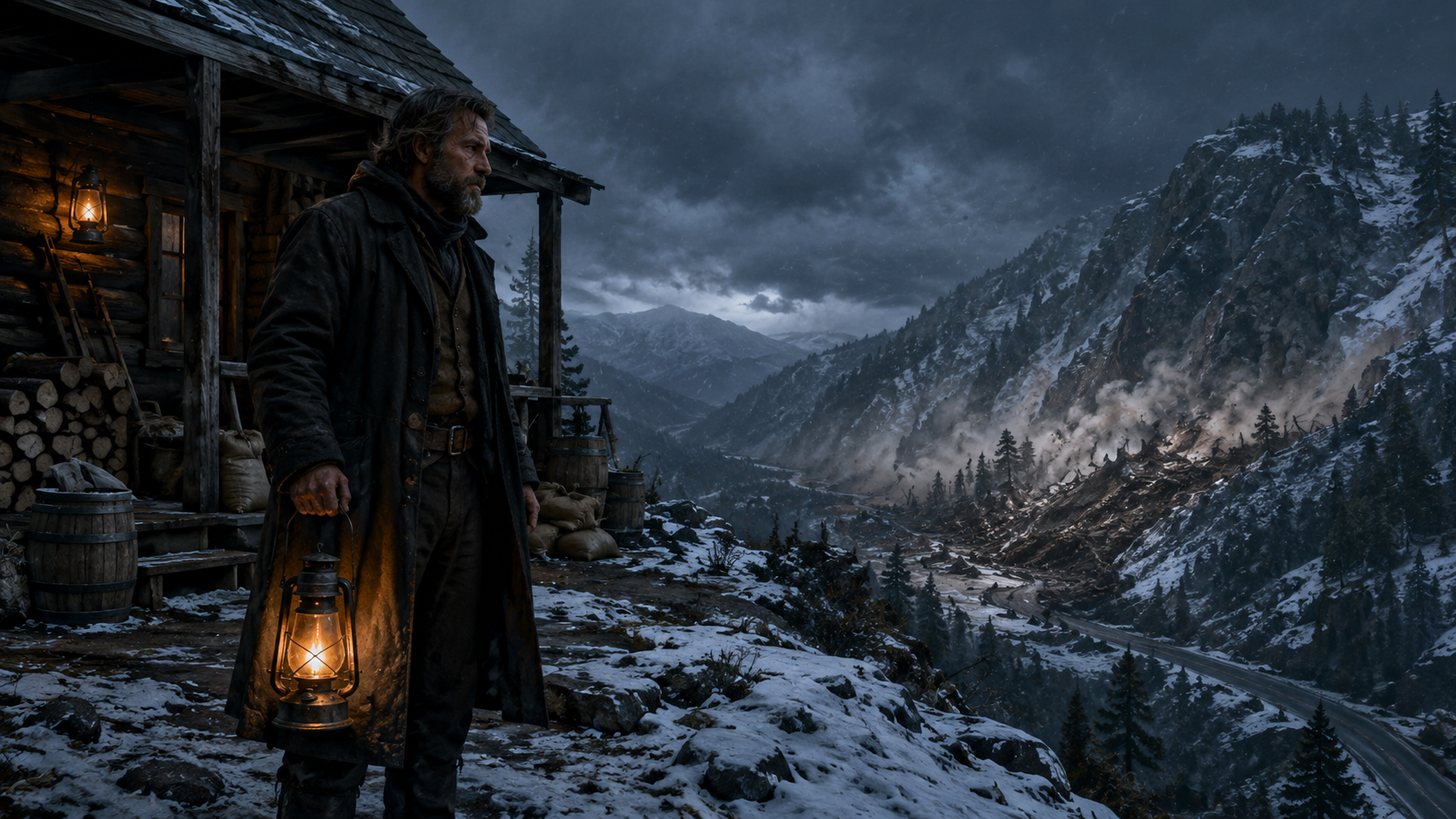
They buried Peter behind the cabin where the ground was so hard the men had to heat stones and lay them over the earth before digging. Amos Bell came up the ridge for the burial and wept like a man whose shame had finally found its own voice.
Nathaniel did not comfort him.
He had comforted the child.
That was all he had left to give that day.
At midnight, Juniper found him outside beside the small grave. Snow had gathered on his shoulders.
“Papa?”
He did not turn.
“I promised your mother I would keep you alive.”
“You did.”
“I promised myself no child would die under my roof.”
“He didn’t die because of you.”
“He died near me.”
“That is not the same.”
Nathaniel closed his eyes.
Juniper stepped beside him. She was thirteen, thin from rationing, brave because she had never been allowed the luxury of anything else.
“You opened the door,” she said. “That is why the rest are breathing.”
“One grave still weighs more than sixteen breaths.”
“No,” she whispered. “It only feels that way because graves don’t speak.”
In the morning, an old woman climbed the ridge.
Her name was Agnes Vale, though she had not used her son’s house or money in years. Mayor Elias Vane’s own mother lived in a two-room cabin behind the church, proud, nearly blind, and sharper than ice. People said the mayor sent her supplies. Agnes said lies were cheaper than flour.
Nathaniel let her in because she brought a sack of turnips and because she had never wasted words.
She sat by the stove, warming bent hands.
“Elias hired the Brant brothers,” she said.
Tommy looked up.
Nathaniel did not move.
Agnes continued, “I heard him through the wall behind the mayor’s office. He promised them your ridge claim if they scared you off or burned you out.”
Dr. Holt, who had come to check the baby, went pale. “Why would he do that?”
Agnes laughed once, bitterly.
“Because my son wants what he has always wanted. Whatever another man refuses to give him.”
Nathaniel knew the answer before Agnes said it.
“The spring,” he said.
“The spring,” she confirmed. “And the pass.”
Miriam frowned. “The pass?”
Agnes leaned forward. “He was blasting above the old mine cut in August. Looking for a silver vein. Secret crew. Paid off-book. I found the ledger after the slide. He weakened that slope and laughed when you warned him.”
The stove popped.
No one spoke.
The truth entered the room slowly, like cold through a crack.
Mayor Vane had helped bury the road. Whether through greed, arrogance, or both, he had trapped the town he claimed to protect. Then, when the one man prepared enough to keep children alive stood in his way, he had paid hungry men to remove him.
Tommy’s face twisted.
“We should go down there.”
“And do what?” Nathaniel asked.
“Make him confess.”
“He will lie.”
“Then make him bleed.”
Juniper flinched.
Nathaniel turned on the boy with such force that Tommy stepped back.
“Do not mistake rage for justice.”
“He killed Peter!”
“No. A gunman killed Peter. Vane may have paid him. We will prove it.”
“And if we can’t?”
“Then we keep the living alive until we can.”
Tommy’s eyes shone with fury. “That’s not enough.”
Nathaniel looked toward the room of sleeping children, then at the stove, then at the dwindling stack of wood near the door.
“It has to be,” he said. “Because enough is not what we want. Enough is what survival gives us.”
That day, the cabin changed.
Not outwardly. From the outside, it remained a crooked black cabin beneath snow-heavy pines.
Inside, Nathaniel moved half the visible supplies into the old mining chamber beneath the floor. He shifted shelves, sealed cracks, reinforced shutters, and strung bells low across the trees where no honest visitor would walk. He placed traps in the snow and marked them with pine cones arranged in patterns only Juniper and Tommy understood.
He trained the children without frightening them more than necessary.
“When I say cellar, you go down.”
“When I say floor, you lie flat.”
“When Birch growls but does not bark, you freeze.”
“When someone knocks, no one speaks until I do.”
Tommy learned to load a rifle. Not because Nathaniel wanted a boy armed, but because he had seen what happened when only bad men carried guns.
“I don’t want to shoot anyone,” Tommy said, hands shaking around the stock.
“Good,” Nathaniel replied. “A person eager to shoot is already half lost. But if the door breaks and children are behind you, your fear does not get to decide for you.”
Three nights later, the Brant brothers came.
Nathaniel smelled lamp oil first.
Then Birch rose beside the stove, hackles lifted, teeth showing.
Nathaniel opened his eyes in the dark.
“Cellar,” he said.
Juniper woke instantly.
She touched Tommy’s shoulder. Tommy touched Ruth. Ruth grabbed Lottie. The children moved like whispers.
A bottle smashed against the smokehouse.