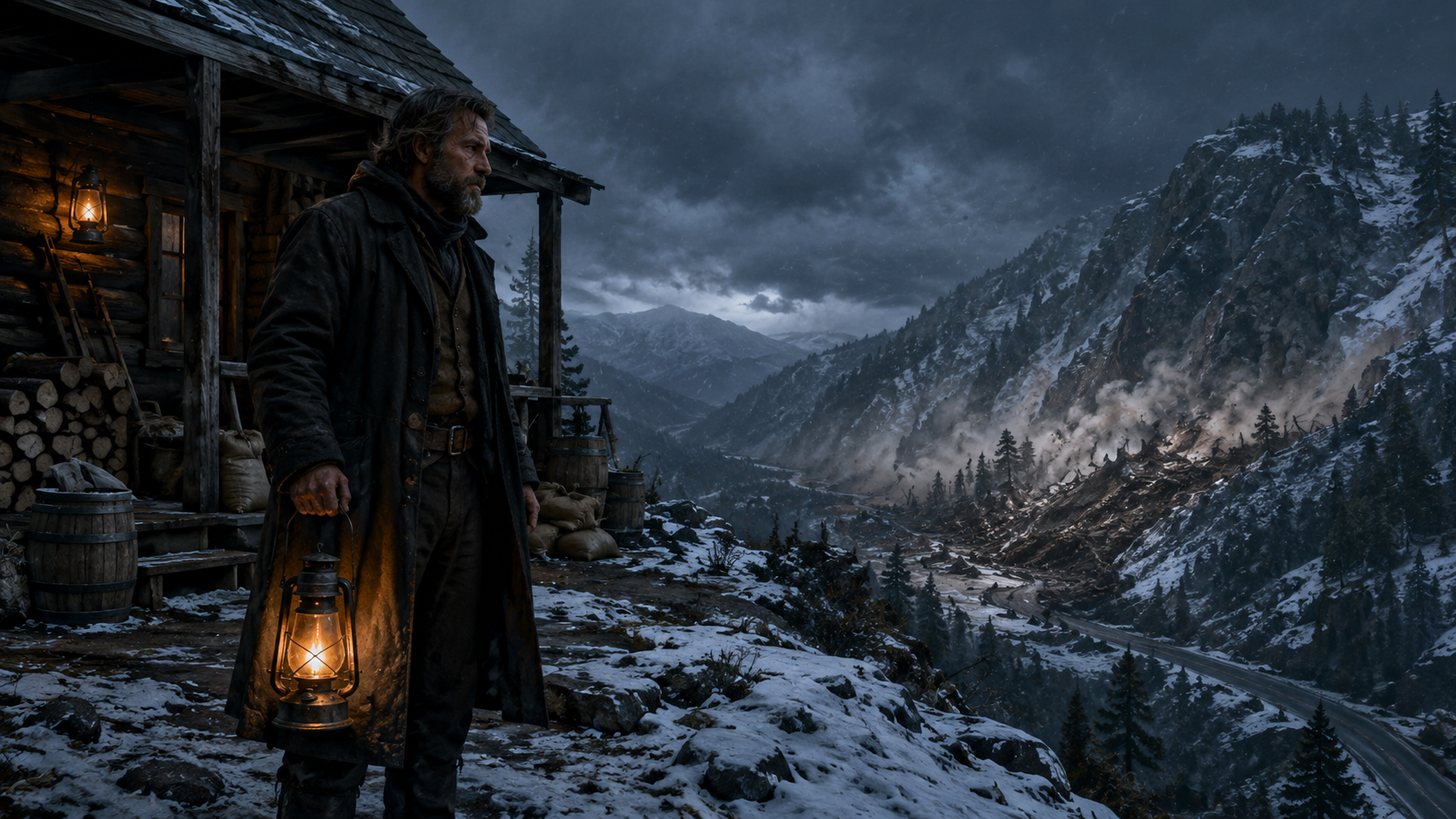
Juniper heated broth while Nathaniel stripped the frozen rags from Tommy’s feet. The boy woke long enough to see the shelves along the cabin wall: jars of beans, sacks of meal, dried fruit, smoked fish, bundles of herbs, stacked roots, sealed crocks, candles, salt, oil, blankets.
His eyes filled.
“I won’t steal,” Tommy whispered.
Nathaniel looked at him.
“No,” he said. “You won’t.”
“My sisters—”
“Where?”
Tommy told him.
Nathaniel wrapped his coat tight, took Birch, and went down the ridge before the broth finished warming.
By dawn, Tommy’s sisters slept near the stove.
One was eight. One was five. The youngest held a wooden spoon like a doll and would not let go.
Juniper knelt beside them.
“What are their names?”
“Ruth and Lottie,” Tommy said.
Nathaniel set three bowls on the table.
“You can stay,” he said, “but this is not charity.”
Tommy stiffened.
Nathaniel continued, “Charity with no plan freezes by morning. This house runs on work. You carry water when you can. You stack wood. You clean bowls. You learn. You do not waste a crumb. You do not lie about what we have. You do not invite adults here without my say. You protect the little ones before yourself.”
Tommy swallowed. “Yes, sir.”
“If you are too weak to work, you rest until you are not. A child does not earn the right to breathe.”
The boy stared at him like that sentence hurt worse than hunger.
Then he nodded.
After Tommy came the Pratt twins.
Then a girl whose father had gone to check traps and never returned.
Then three brothers from the south road.
Then a baby carried by Dr. Holt under her coat while the mother coughed blood into a handkerchief and begged only, “Please, just until spring.”
By Christmas Eve, seventeen children slept inside Nathaniel Crowe’s cabin.
They slept on quilts, under tables, beside the stove, in the loft, across benches, and in a row by the wall like bundles of laundry. Juniper moved among them with a steadiness no child should have needed. She tied scarves, washed bowls, told stories, taught letters, and sang when the wind clawed at the shutters.
Nathaniel made rules.
Children could come.
The badly sick could come.
Adults who wanted food had to bring something that helped children survive: firewood, medicine, labor, grain, candles, information.
Some called him cruel.
Dr. Holt did not.
She arrived one afternoon with frost in her lashes and a satchel empty of nearly everything useful.
“You’re making them pay,” she said.
“I’m making them participate.”
“There is a difference?”
“Payment ends with pride. Participation keeps the fire alive.”
She looked toward the children gathered by the stove. Tommy was showing little Lottie how to twist straw into kindling. Juniper was teaching Ruth to count dried beans without eating them.
Miriam’s face softened.
“You understand people better than they think.”
“No,” Nathaniel said. “I understand hunger. People are harder.”
The hardest came in January.
His name was Peter Bell, Amos Bell’s nephew. Nine years old. Small. Fast. Always trying to be useful. He followed Tommy everywhere and begged for work.
“Let me carry wood.”
“That log is bigger than you,” Tommy said.
“I can carry half.”
“Half a log is still a log.”
Peter wanted to prove he deserved his bowl. Nathaniel saw it and hated it.
One morning, he found the boy sweeping snow from the porch before sunrise, shivering in a coat too thin at the wrists.
“Inside,” Nathaniel said.
“I’m helping.”
“You’re freezing.”
“I don’t want folks saying I ate for nothing.”
Nathaniel knelt before him.
“Listen to me. Grown men may trade work for bread. Children do not trade worth for food. You are not alive because you are useful. You are useful because you are alive.”
Peter blinked hard.
“Did your papa tell you that?”
Nathaniel thought of his own father, who had died with a trapline map folded in his coat.
“No,” he said. “I learned it too late.”
Three days later, Peter went missing in a fog.
It happened during the morning water run. Tommy, Peter, and Juniper had taken two buckets to the lower spring. Birch went with them, nose low, uneasy.
The fog rolled in from the creek white and thick. It erased trees. It softened sound. It made distance lie.
Then a shot cracked.
Juniper screamed.
Birch snarled.
Tommy carried Peter back up the ridge with blood darkening the boy’s coat.
Nathaniel took him in the doorway.
One look told him what mercy could not change.
Peter’s eyes found his.
“I dropped the bucket,” the boy whispered.
“It does not matter.”
“I was supposed to carry it.”
“You carried enough.”
“I was helping.”
“You helped.”
Peter’s fingers clutched Nathaniel’s sleeve.
“Will my uncle be mad?”
Nathaniel bent close.
“No.”
The boy tried to breathe again.
Couldn’t.
The cabin went silent in a way no crowded room should ever be silent.