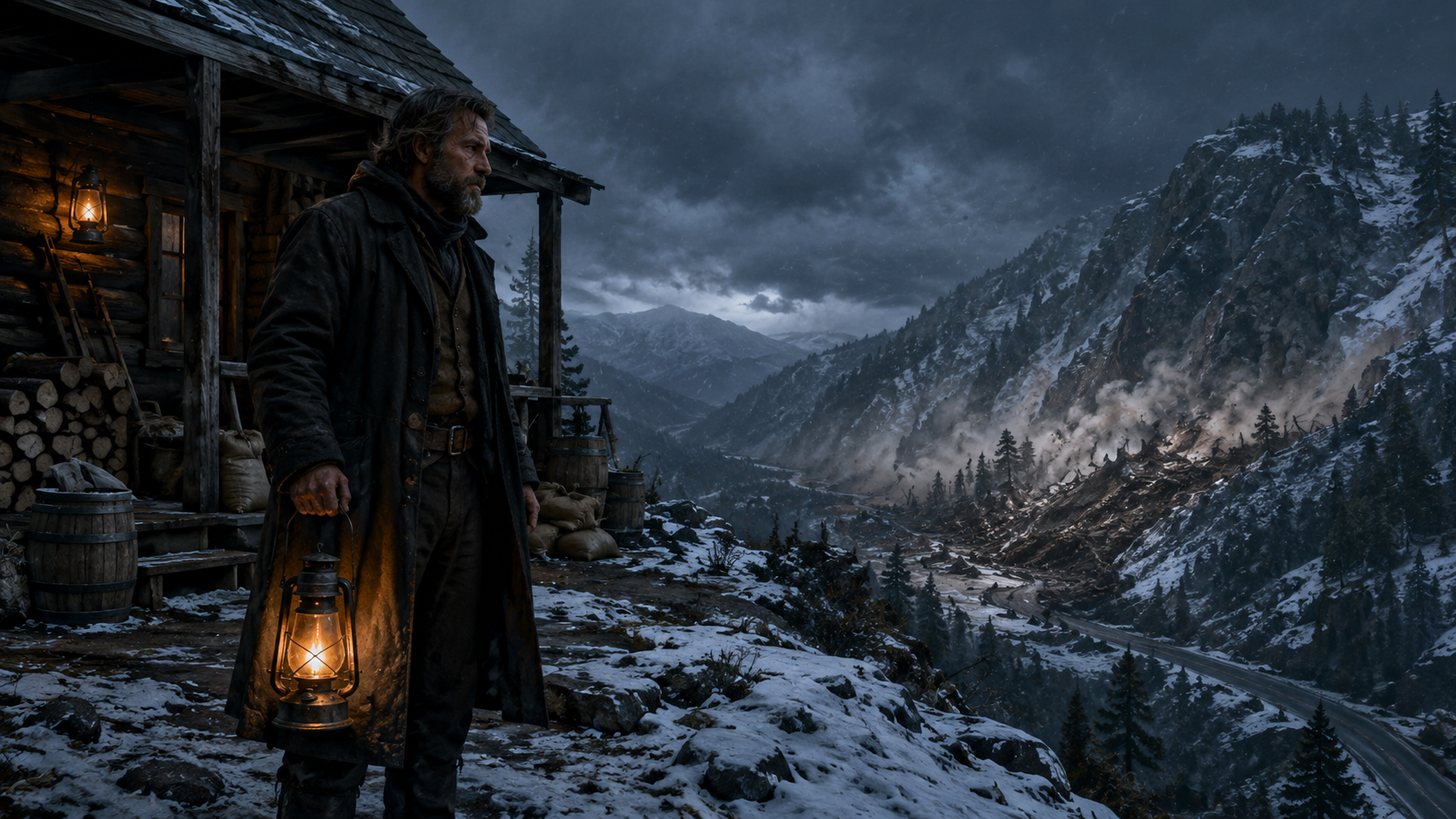
The first heavy rain began on September 6.
It fell straight down, thick and relentless, as if the sky had decided to empty itself over the valley. Gutters overflowed. Horses refused slopes. The creek behind the church turned brown and loud. Cellar floors sweated. The old pass road became a ribbon of mud.
On the third day, Nathaniel rode to the western overlook and saw the whole hillside breathing.
Not moving like an animal.
Moving like a wound.
He marked the broken ground, the leaning firs, the water spilling from old blast holes.
Then he rode down to Briar Hollow one last time.
The council was gathered inside the church because the mayor’s office roof had begun leaking. Men sat in pews, wet hats on their knees, arguing about bridge planks and hay prices.
Nathaniel walked in and rainwater ran from his coat onto the floor.
“Close the pass road,” he said.
Mayor Vane turned from the pulpit steps. “This again.”
“The slope is failing. Send no wagon through.”
“We have freight due from Mercy Crossing.”
“Then stop it before it reaches the cut.”
“And lose money because a grieving trapper smells doom in the rain?”
Nathaniel faced the room.
“You have children. Put flour away. Bring wood under cover. Fill water barrels. If you have medicine, protect it. If you have livestock, move them east. If you have pride, swallow it now because you can’t boil it for soup later.”
A few men shifted.
Amos Bell muttered, “There it is. Mad Crowe’s sermon.”
Nathaniel looked at him. “How much flour in your store?”
Amos flushed. “Enough.”
“How much?”
The storekeeper said nothing.
Dr. Holt stepped from the side aisle. “He is asking because it matters.”
Mayor Vane raised his hands. “Doctor, please. Fear spreads faster than fever when respectable people entertain it.”
“Respectability does not clear a landslide,” Miriam said.
The mayor smiled at the room. “Ladies and gentlemen, we will not govern this town by the nightmares of a man who has never recovered from his losses.”
Nathaniel nodded once.
Not in agreement.
In farewell.
He turned and left.
That night, just after two, the mountain fell.
Juniper woke before the roar. She woke because Birch was standing on her quilt, growling toward the west wall. Then the floor shivered beneath her.
“Papa?”
Nathaniel was already moving.
He flung the door open.
Lightning cracked the sky wide.
For one white second, the world became clear.
The western face of Wolfpine Ridge was sliding.
Trees pitched sideways and vanished. Rock folded over rock. Mud boiled down the ravine, carrying stumps, boulders, old mine timbers, and half the abandoned Silver Hook cut. The sound was larger than thunder. It was larger than fear. It was the kind of sound that made the body understand how small it had always been.
Juniper ran to Nathaniel’s side.
He pulled her against him.
The pass road disappeared beneath a moving wall of earth.
Then darkness swallowed the mountain again.
By morning, Briar Hollow was cut off.
No freight wagon could enter.
No messenger could leave.
No doctor could call for medicine.
No store could refill.
No family could escape.
At first, the town put on its bravest clothes.
Men gathered with shovels. They spoke loudly about teams of horses, ropes, blasting powder, and clearing the way in a week.
They came back after one afternoon.
Not loud anymore.
The pass was not blocked. It was gone. Trees lay under stone. Stone lay under clay. Clay slid underfoot and froze hard by dawn. Every shovel strike released more water. Every attempt to dig brought fresh rock sighing down from above.
A week passed.
Then two.
The rain stopped, but cold followed.
By October, frost silvered the windows.
By November, Bell’s Store had more empty shelves than full ones.
By December, nobody laughed at Nathaniel Crowe.
They whispered instead.
“How much does he have?”
“Enough for a year, I heard.”
“He must have known.”
“He warned us.”
“He could share.”
“He should share.”
“Why should children suffer because one man lost his mind in a useful direction?”
The first child came on a night with no moon.
He was fifteen, though hunger had stolen two years from his face. His name was Tommy Rusk. His father had spent most of his wages in the saloon before the saloon ran out of whiskey and warmth. His mother had died the year before. Tommy had two little sisters hidden in a shed behind their house with a blanket, a cracked jar of pickles, and nothing else.
He climbed Wolfpine Ridge in shoes wrapped with rags.
Birch barked once.
Nathaniel opened the door with a rifle in one hand and a lantern in the other.
Tommy tried to speak, but his lips had gone blue.
He fell forward into the snow.
Nathaniel brought him inside.