The Heiress They Declared Dead
Nobody bent to pick up the crayon.
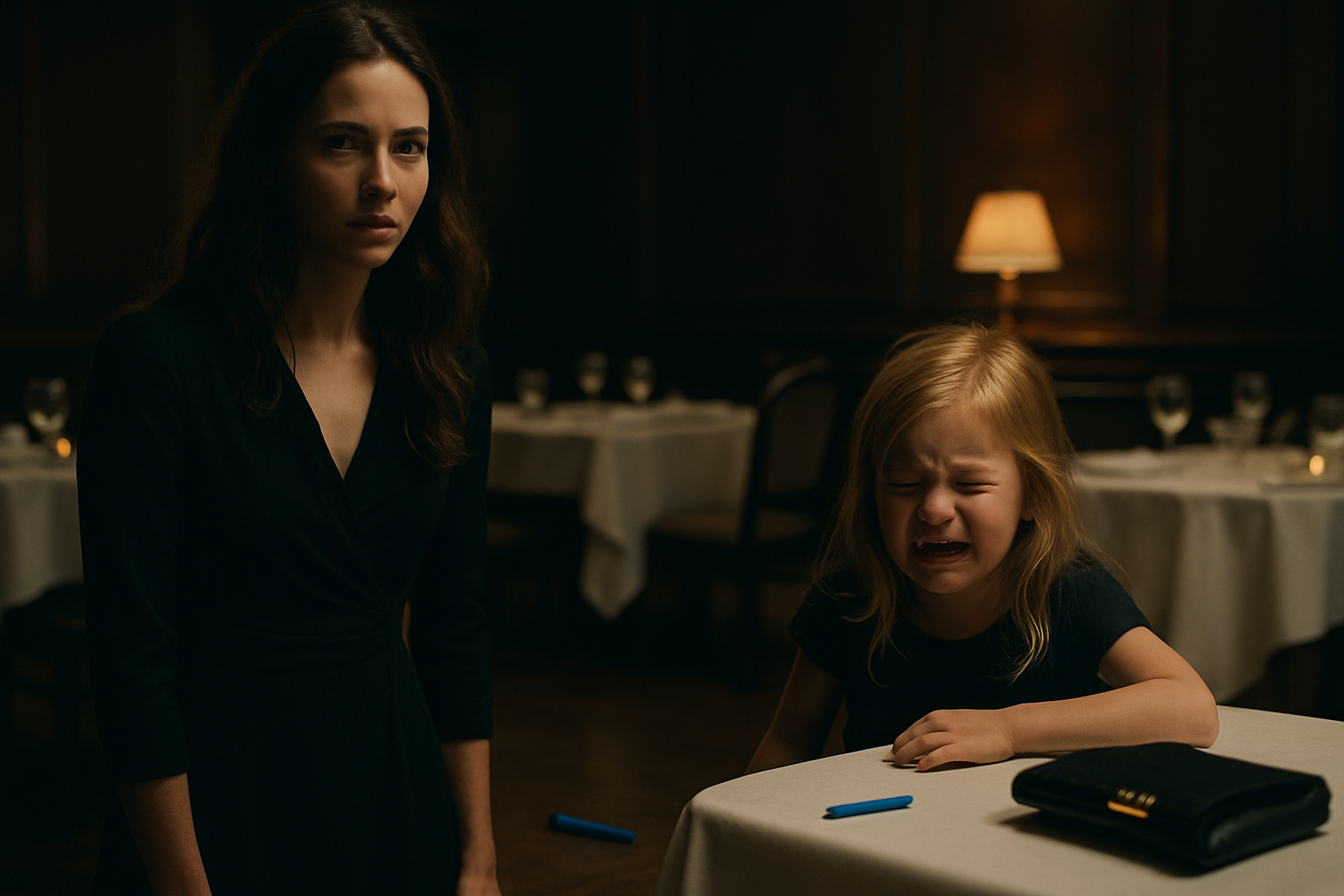
For three long seconds, the private dining room at The Gilded Stag seemed to exist outside of time, sealed inside a glittering bubble of shock. The only sounds were Mira’s small, broken sobs and the faint, velvety spill of jazz drifting from the hidden speakers above the paneled walls. The blue crayon had slipped from the child’s trembling fingers, rolled across the polished floor, tapped once against the leg of a white-draped table, and come to rest beside Governor Seraphina Calder’s black satin clutch.
Elara Voss stood near the center of the room with one cheek burning bright, her lower lip split, and the imprint of her mother’s fingers blooming scarlet around her upper arm.
At the head of the table, Cornelius Voss looked as if the marble floor had vanished beneath his imported shoes.
His sixtieth birthday dinner had not merely been planned. It had been engineered. Every detail had been arranged with the ruthless precision of a military campaign: the most exclusive steakhouse in Ashbourne, a private room with a minimum so obscene that ordinary families could have lived on it for years, orchids flown in from across the ocean, crystal stemware set at exact angles, a seven-tier bourbon chocolate cake crowned with gold leaf, and a guest list carefully selected to remind the city that the Voss family still belonged among the untouchable.
Judges. Lobbyists. Bankers. Old-money widows. New-money predators. Two cabinet hopefuls. One senator.
And now, in the middle of that perfect room, the governor of Bellwether herself stood between the tables, accusing Cornelius Voss’s wife of assault and praising the daughter the family had spent seven years pretending no longer existed.
Vivienne Voss found her voice first.
Of course she did.
Women like Vivienne did not believe silence was dignified. They believed it belonged to maids, servants, clerks, girls who cried in bathrooms, daughters who disappointed them.
“Governor Calder,” Vivienne said, forcing a laugh that scraped through the room like a knife across china, “I think there has been a terrible misunderstanding. Elara has always been… theatrical. She appears where she is not invited, she twists stories to suit herself, and frankly, she has had struggles you could not possibly understand.”
Elara reached for a linen napkin from the edge of the nearest table and pressed it carefully to her lip.
She did not argue.
Once, she would have. Once, she would have pleaded, explained, shaken with the desperate need to be believed. She would have dragged facts into a room that had already chosen a lie. She would have thought truth needed to raise its voice in order to survive.
She knew better now.
Governor Calder looked at Vivienne as if the woman were a wine stain spreading across expensive silk.
“I understand more than you imagine,” the governor said. Her voice was calm, but it carried to every corner of the room. “I understand that your daughter walked into my office two years ago with evidence of a bid-rigging scheme designed to steal hundreds of millions from Bellwether taxpayers. I understand that she risked her career, her safety, and the stability of her child’s life in order to expose it. And I understand that tonight, in front of witnesses, you raised your hand against the woman who helped save this state from one of the largest infrastructure fraud cases in its history.”
A sound passed through the room.
Not quite a gasp. Not quite a whisper.
It was the noise powerful people made when they suddenly realized the ground beneath their feet might not be as solid as they had assumed.
Men who had spent the first half hour of dinner discussing golf memberships, highway contracts, and quiet federal favors now stared at Elara as though she had become dangerous to stand near. Women who had smiled beside Vivienne at museum galas and hospital fundraisers began leaning subtly away from her, careful not to let their shoulders touch, careful not to be photographed too close.
Across the table, Celeste Voss’s red lips parted.
“That’s not possible.”
Elara finally turned toward her younger sister.
“Hello to you too, Celeste.”
Celeste’s eyes flashed, bright and cold beneath the chandelier light. “Don’t act like this is normal. You disappear for seven years, sweep in dressed like some grieving political widow, and suddenly the governor is making you sound like a hero?”
“She did not disappear,” Governor Calder said.
The room tightened around the words.
“Your family buried her.”
That sentence changed the temperature of the room.
Cornelius took one step forward. His face had gone pale beneath its careful tan. “Now wait just a minute.”
“No, Mr. Voss,” the governor said. “You have had seven years of minutes. Tonight, your daughter gets one.”
Elara lowered the napkin.
Blood still darkened the corner of her mouth, a small crimson mark against her composed face. Yet her expression remained almost serene. That calm frightened her family more than a scream ever could have.