They had expected the old Elara.
The girl who begged to be believed.
The young woman who cried outside locked doors while voices whispered on the other side.
The daughter who still believed someone at the Voss family table might love her enough to tell the truth.
But the old Elara had died long before her family paid to print the obituary.
Near the head of the table, Senator Gideon Thorne sat with one hand frozen around a glass of cabernet. He was an old Bellwether politician, silver-haired and smooth-faced, with the polished smile of a man who had survived three scandals by learning never to stand too close to the flames.
His son, Julian Thorne, looked worse than anyone else in the room.
“Elara,” Julian said again, as if her name were a key he could not make fit into the lock.
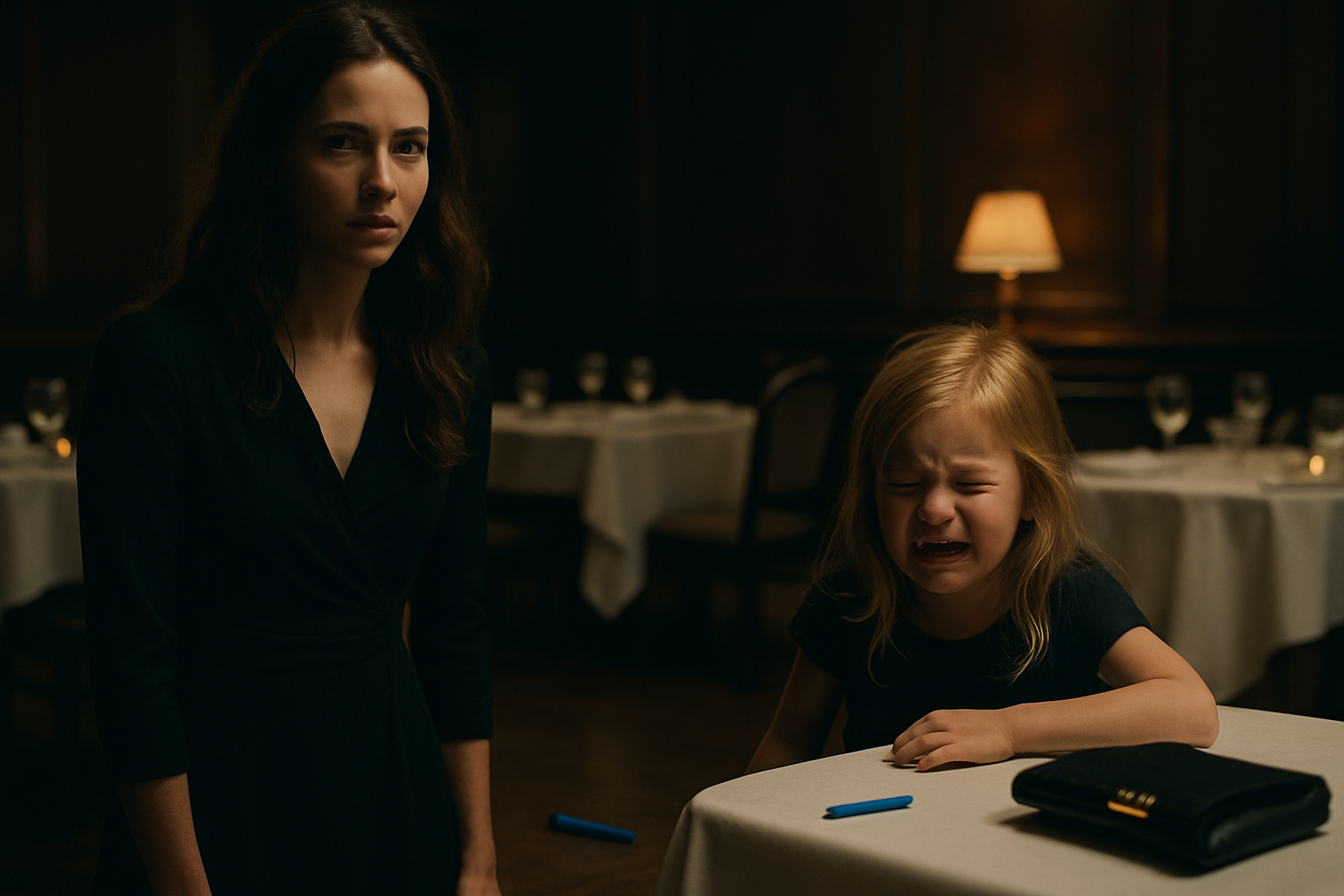
Mira turned her tear-streaked face toward her mother.
“Mommy,” she whispered, her little voice breaking, “why did Grandma hit you?”
The question landed harder than the slap.
Elara crossed the room before anyone could stop her. Governor Calder bent with quiet care, lifting Mira from her lap and placing the child safely into Elara’s arms. The little girl clung to her mother’s neck with both arms, burying her face in the dark satin of Elara’s gown.
“It’s okay, baby,” Elara whispered against her hair. “You are safe.”
Vivienne made the fatal mistake of speaking again.
“This child should not even be here.”
Elara lifted her head slowly.
For the first time that night, something sharp entered her eyes. Something bright. Something honed over years of humiliation, grief, hunger, fear, and survival.
“Say one more word about my daughter.”
The room stopped breathing.
Vivienne’s face tightened, her jaw working as though another insult were trapped behind her teeth. But even she heard the line beneath Elara’s voice. Even she understood it should not be crossed.
For years, Vivienne had mistaken her daughter’s kindness for weakness. She had mistaken Elara’s mercy for surrender. She had mistaken silence for defeat.
Now, in front of every person she had tried so desperately to impress, Vivienne realized too late that kindness had only ever been what Elara chose when she still believed mercy was deserved.
Governor Calder turned slightly toward the plainclothes officers stationed along the wall.
“Please make sure Mrs. Voss does not approach Ms. Voss or her child again tonight.”
One of the officers stepped closer to Vivienne.
Vivienne’s mouth opened in disbelief. “You cannot be serious.”
“I am very serious,” the governor said.
Cornelius wiped his forehead with a folded handkerchief, his practiced charm beginning to fracture beneath the pressure. “Governor, please. I am certain we can settle this quietly. This is my birthday dinner. My clients are here. Senator Thorne is here.”
“That is exactly why I came,” Elara said.
Every eye turned to her.
She shifted Mira higher on her hip and looked at her father.
For seven years, she had imagined this moment.
Sometimes, in the sleepless dark, she had imagined herself screaming until the chandeliers trembled. Sometimes she had pictured Cornelius falling to his knees, begging forgiveness before the same guests whose approval he valued more than blood. Sometimes she had imagined Celeste exposed, Vivienne humiliated, every lie dragged back to the mouth that created it.
But Elara had learned that revenge and justice were not the same creature.
Revenge wanted pain.
Justice wanted daylight.
“You told people I was dead,” Elara said.
A woman near the back table whispered, “Dead?”
Cornelius’s face drained of color.
“Elara.”
“No,” she said. “You don’t get to say my name like a warning. You signed the obituary.”
Julian Thorne turned sharply toward Cornelius. “What obituary?”
Elara reached into the small black clutch hanging from her wrist. With careful fingers, she withdrew a folded sheet of paper and placed it on the table beside the untouched birthday cake.
The paper was not new. Its edges had softened from years of handling, folding, unfolding, hiding, and bringing into the light again. The creases were deep. The ink had begun to fade. But the words remained clear enough to wound.
Governor Calder said nothing.
She already knew what it was.
Elara opened the page.
Despite themselves, several guests leaned forward.
At the top was the crest of the Ashbourne Chronicle.
ELARA MARIS VOSS, 29, PASSES AFTER LONG PRIVATE STRUGGLE.
Vivienne made a small choking sound.
Elara read only the first line aloud.
“The Voss family mourns the loss of their beloved daughter, Elara Maris Voss, who passed peacefully after years of battling personal hardship.”
Her voice did not shake.
That made it worse.
“I was twenty-nine,” Elara said. “I was living in Port Kellan. I was working as a forensic accountant for a federal subcontractor. I was pregnant with Mira. And I was very much alive.”
Senator Thorne slowly set down his wineglass.
Julian stared at the obituary as if the paper itself were burning.
“Celeste told me you had died,” he said.