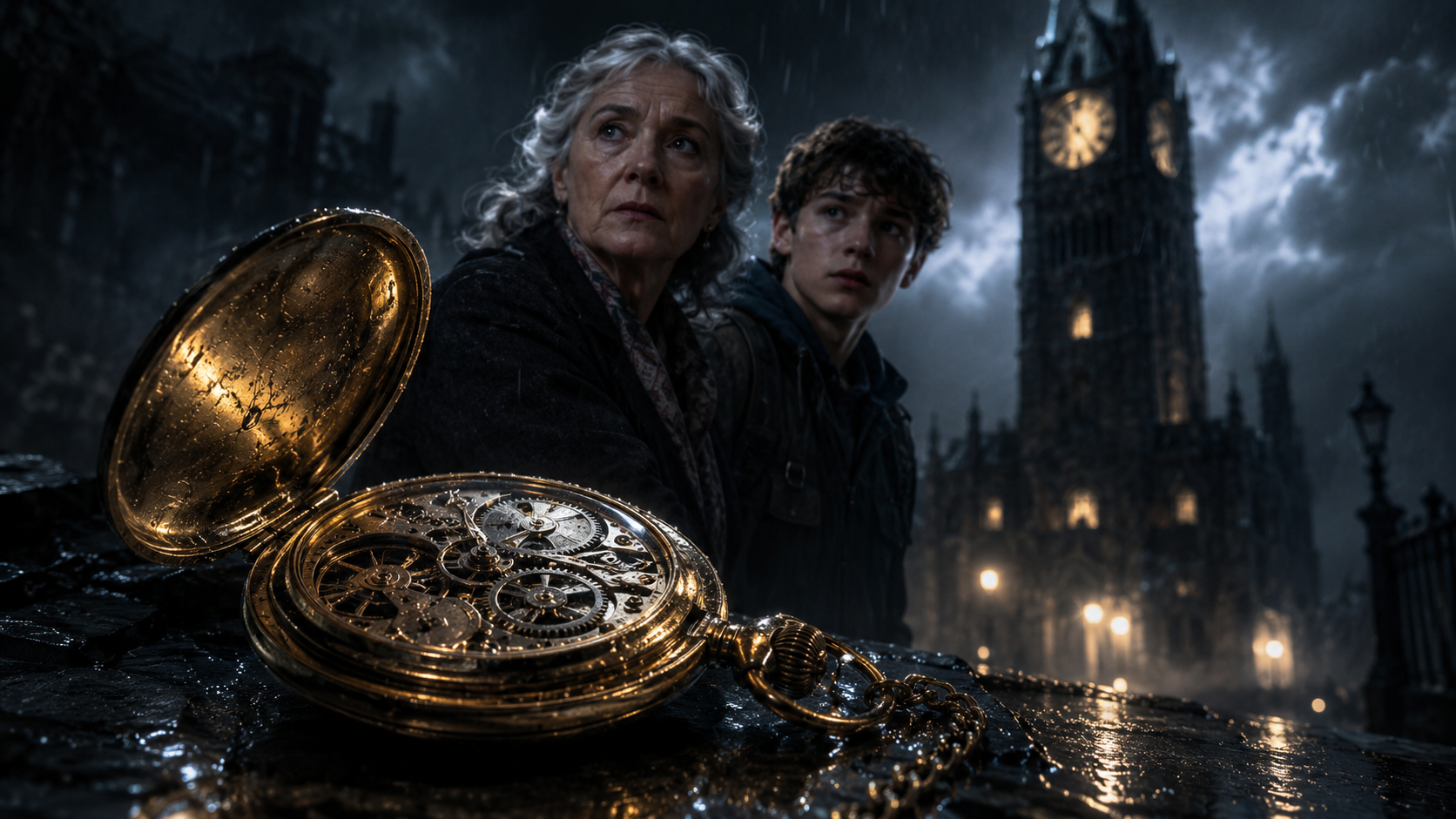
For a moment, she was no longer sixty-eight years old. She was twenty-six, standing beside a harbor while officials lowered an empty coffin into the ground.
She had hated Thomas for boarding that ferry after she begged him to stay.
Then she had hated herself for surviving him.
Leo touched the edge of the table.
“My mother never told me she knew your brother.”
“She may not have known him personally.”
“She did.”
Miriam looked up.
Leo took a photograph from his shoe. It was creased and damp, but the image remained visible.
Claire stood beside an elderly man in a wheelchair. He had a narrow face, white hair and one eyebrow raised higher than the other.
Thomas had always raised that eyebrow when he thought someone was lying.
The date printed on the photograph was six weeks old.
“My mother said he was being kept in a St. Orison nursing facility under another name,” Leo explained. “She helped him escape.”
“Where is he now?”
“I don’t know. They took both of them.”
A sound came from the corridor.
Not footsteps.
The gentle squeak of a rubber wheel moving across linoleum.
Miriam switched off the desk lamp.
A pale beam appeared beneath the door.
Someone was pushing a hospital trolley toward the laboratory.
Leo whispered, “They found us.”
The handle began to turn.
Miriam grabbed a bottle of preservative fluid from the shelf and moved beside the door.
It opened.
A security guard entered, pushing an empty metal trolley. A blue St. Orison emblem was stitched onto his jacket.
“Dr. Ashford,” he said. “Please step away from the boy.”
Miriam threw the preservative into his eyes.
He shouted and covered his face.
Leo rammed the trolley into his knees. The guard collapsed, knocking over a tray of instruments.
Miriam seized his access card.
“Run.”
They fled through the specimen corridor as an alarm began to ring behind them.
At the exit, Leo stopped.
The guard’s radio had fallen onto the floor.
A voice spoke through it.
“Kestrel to all teams. They know about the tower. Lock the lower mechanism and prepare the transfer room.”
Miriam picked up the radio.
“What transfer room?” she demanded.
There was a pause.
Then Kestrel answered.
“The room where your brother has been waiting for you.”
Chapter Three: The Meridian Clock Tower
The Meridian Clock Tower rose above the oldest district of the city like a black needle.
It had not displayed the correct time in more than a decade. The eastern face was frozen at 2:17. Ivy covered its lower walls, and iron barriers surrounded the entrance with signs warning that the structure was unsafe.
Miriam and Leo arrived shortly before dawn.
Rainwater ran through the empty streets.
“The public entrance will be watched,” Miriam said.
“My mother showed me another way.”
Leo led her into a narrow lane behind an abandoned theater. They climbed over a wall and descended into a courtyard filled with broken stone figures.
At the base of the tower stood a circular iron plate.
Leo inserted the railway locker key.
Nothing happened.
“Thomas said the entrance opens at 2:17,” Miriam remembered.
She removed the golden watch.
The hands still showed 11:04.
When she pressed the crown three times, the second hand began moving backward again. The hour hand crossed ten, nine, eight, spinning faster until both hands stopped at 2:17.
A mechanism moved beneath the courtyard.
The iron plate opened.
Cold air rose from the darkness.
They descended a spiral staircase into the foundations of the tower.
At the bottom, a corridor extended beneath the city. Copper pipes covered the ceiling, all connected to the clock mechanism above. Each movement of the tower’s gears produced a vibration through the walls, like the heartbeat of an enormous buried animal.
Hundreds of clocks hung along the passage.
Every clock showed a different time.
Small brass plaques had been fixed beneath them.
AMELIA PARK — 3:06
JONATHAN WELLS — 8:44
INFANT FEMALE 27 — 12:19
Leo touched one of the plaques.
“What are these?”
“Times of death,” Miriam said.
“Whose deaths?”
“People who may never have died.”
At the end of the corridor stood a steel door marked with the blue St. Orison emblem.
Miriam used the security card taken from the hospital guard.
The door opened.
Beyond it lay a vast circular archive.
Shelves rose from floor to ceiling, filled with files, medical photographs and sealed evidence boxes. A mechanical system connected the shelves to the tower’s clockwork. Each file had a time code instead of a normal reference number.
Leo found a cabinet marked 11:04.
Inside were records from the North Channel ferry.
Miriam opened the first file.
The official passenger manifest was on top. Beneath it lay another version containing names that had never been released to the public.
Twenty-six children.