Beside each name was a price, a new identity and the address of the family who had received them.
Miriam felt physically ill.
Leo pulled out another folder.
“Here’s my mother.”
The label read:
CLAIRE MERCER
ORIGINAL IDENTITY: UNKNOWN
TRANSFER AGE: THREE MONTHS
SOURCE: NORTH CHANNEL RECOVERY
Miriam stared at the page.
Claire had been one of the children removed from the ferry.
A handwritten note had been added years later.
Biological relationship confirmed: Thomas Ashford.
Leo read it twice.
“Thomas is my grandfather?”
Before Miriam could answer, the archive lights came on.
Adrian Kestrel stood on the upper gallery.
Six guards surrounded him.
“Your mother asked the same question,” he said.
Leo moved closer to Miriam.
Kestrel descended the stairs slowly.
“My father founded St. Orison after the war,” he continued. “He believed identity was merely a form of property. A name could be removed, transferred or improved. Children without protection became children with wealthy parents. Institutions received funding. Officials received generous donations.”
“You sold human beings,” Miriam said.
“We created futures.”
“You created graves.”
Kestrel smiled without warmth.
“The public accepts graves more easily than complicated truths.”
“Where are Thomas and Claire?”
“Alive, for the moment.”
He gestured toward the clocks.
“Your brother designed this archive. He believed recording every transaction would someday bring St. Orison down. My father discovered his plan and made him maintain the system instead.”
“For forty-two years?”
“Guilt is a remarkably durable chain.”
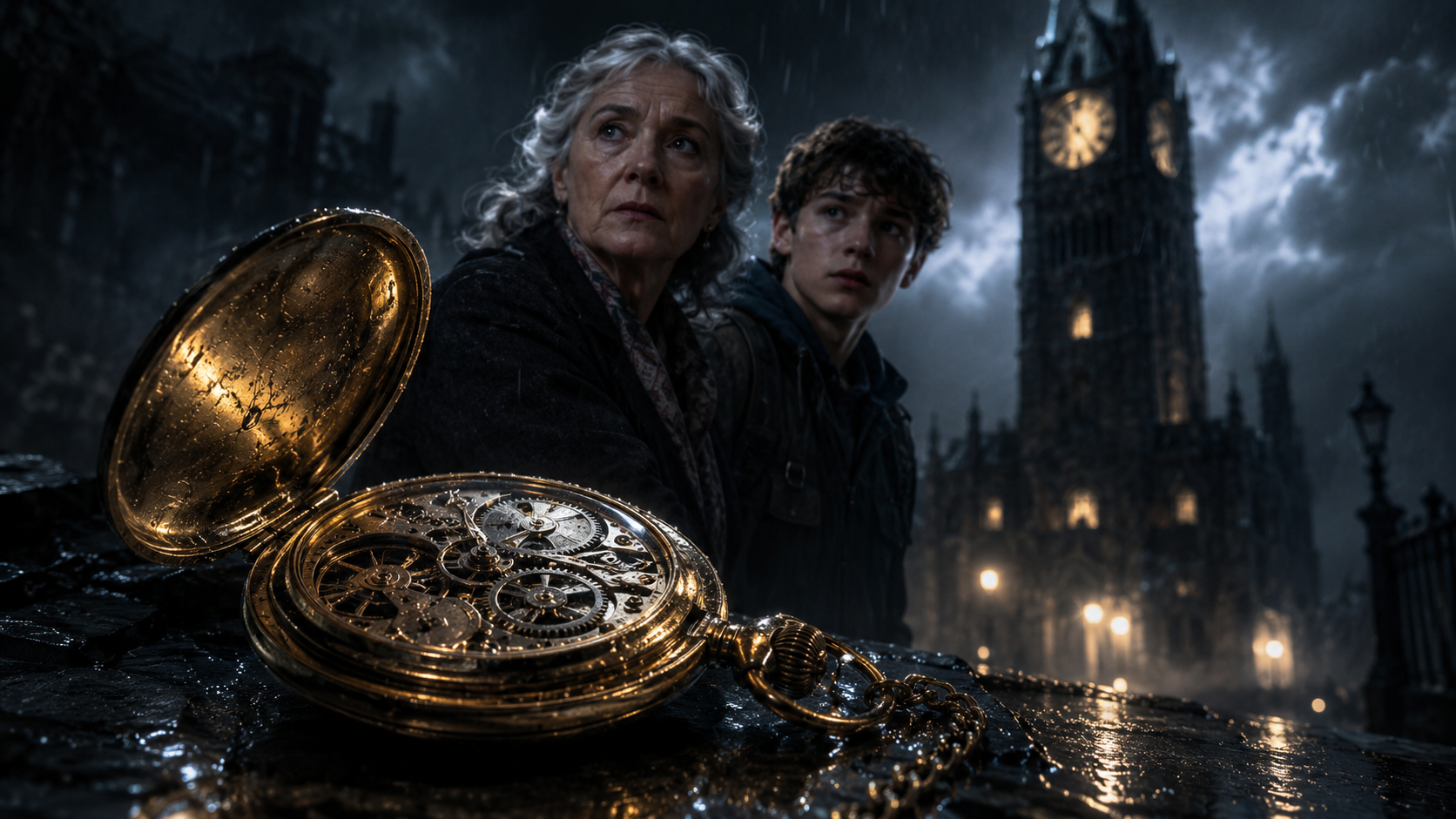
Miriam took out the watch.
Kestrel’s eyes fixed on it.
“That belongs in the central mechanism.”
“It belongs to my family.”
“The watch is the master index. Without it, the archive is useless. With it, every false identity, every payment and every participating official can be traced.”
A sound came from behind the shelves.
Three slow knocks.
Leo turned.
“Mom?”
A guard opened a side door.
Claire Mercer was pushed into the room. Her hands were tied, and dried blood marked one side of her face.
Behind her came an elderly man in a wheelchair.
Thomas Ashford looked older than the man in Leo’s photograph. His skin was gray, and an oxygen tube ran beneath his nose.
But when he saw Miriam, he raised one eyebrow.
“Still wearing those terrible glasses,” he said.
Miriam’s knees nearly failed her.
“You’re alive.”
“I was hoping to make a more dramatic entrance.”
She crossed the room before the guards could stop her and knelt beside him.
Thomas touched her cheek.
“I’m sorry, Mim.”
She covered his hand with hers.
“No. Not yet. You don’t get to apologize in one sentence.”
A faint smile appeared on his face.
“I knew you’d say that.”
Kestrel’s voice cut through the reunion.
“Place the watch in the mechanism.”
A guard pointed a pistol at Claire.
“Now.”
Miriam looked at the central column. A watch-shaped opening had been built into its brass surface.
She understood what Kestrel wanted.
Once the watch indexed the files, he could identify every piece of evidence and destroy it.
Miriam approached the mechanism.
Leo caught her sleeve.
“Don’t.”
She bent close to him.
“Your mother repairs recordings, doesn’t she?”
“Yes.”
“Then she taught you that information should always have a second copy.”
Leo’s eyes widened.
Miriam placed the golden watch into the opening.
The tower began to move.
Chapter Four: The Room Between Minutes
Every clock in the archive started at once.
The noise was overwhelming.
Hundreds of mechanisms clicked, rang and struck different hours. Shelves rotated along hidden rails. File drawers opened and closed. Brass cylinders turned inside the walls.
Kestrel raised his voice.
“Find the North Channel index!”
A guard approached the central column.
Leo dropped to the floor.
Before entering the tower, Miriam had given him the security guard’s radio. Now he connected its exposed wire to a small port beneath the mechanism.
Claire saw what he was doing.
She threw herself sideways into the guard holding her. The pistol fired into the ceiling.
Thomas struck another guard’s knee with the metal footrest of his wheelchair.
Miriam pulled the watch from the mechanism.
The second hand reversed.
The entire archive changed direction.
Drawers slammed open.
Paper flooded into the room.
Kestrel grabbed Miriam by the arm.
“What have you done?”
“Indexed every file.”
“That is not what I asked.”
“No. It is what Thomas designed.”
Thomas laughed weakly from his wheelchair.
“The master watch doesn’t destroy the archive, Adrian. It broadcasts it.”
Kestrel’s face lost its composure.
Above them, the Meridian Clock Tower began to ring.
The bells had been silent for twelve years.