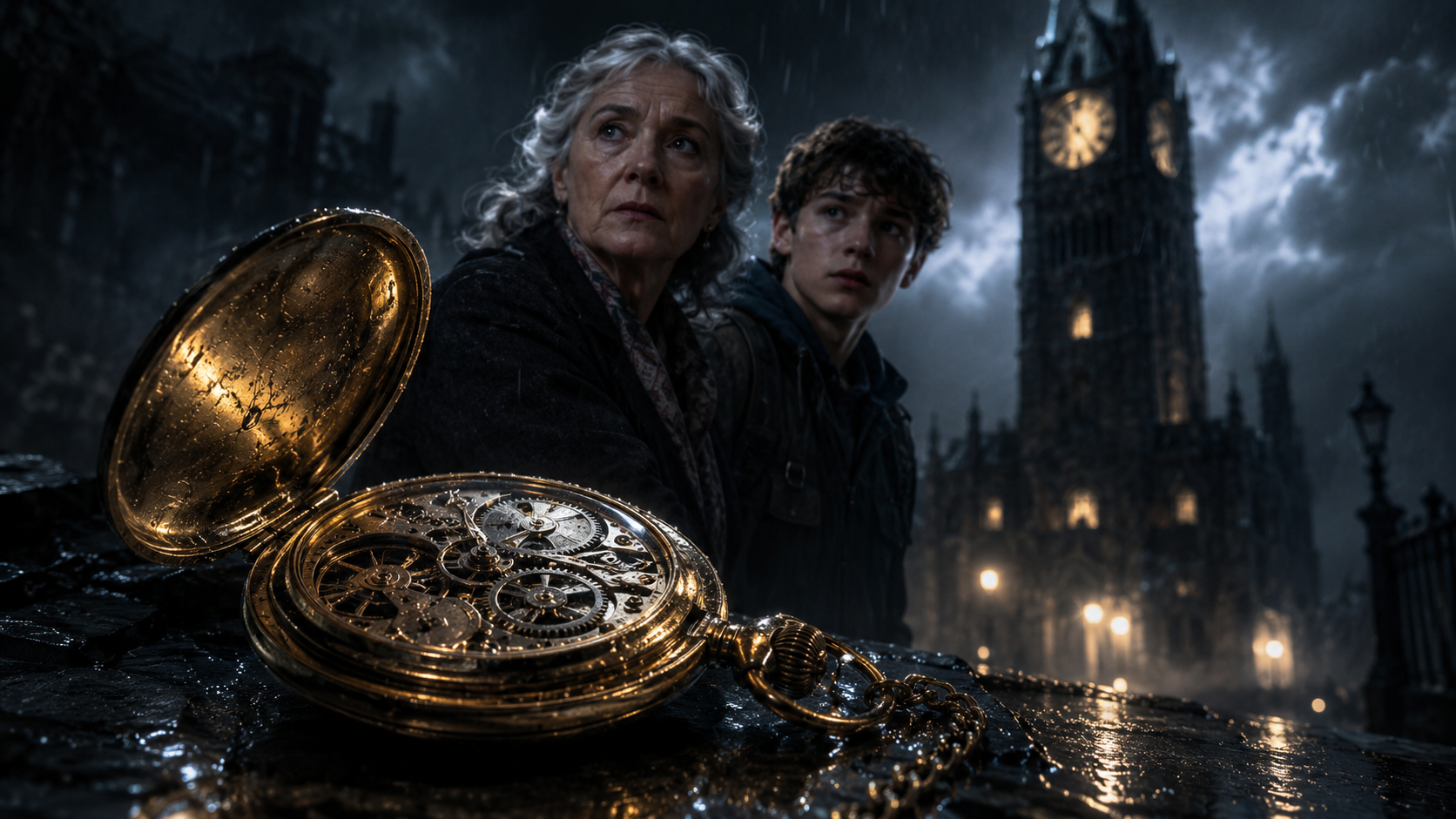
“The police will ask why a retired pathologist is hiding a runaway minor,” Kestrel continued. “They will also find evidence that the boy’s mother abandoned him after stealing confidential medical property.”
“He’s lying,” Leo whispered.
Miriam held the watch against her palm.
Its backward-moving mechanism grew faster.
Tick-tick-tick-tick.
Then it stopped.
The hands pointed to 11:04.
Miriam stared at them.
November fourth.
The date of the ferry fire.
She opened the inner cover again. Under the folded message, four words had been engraved into the gold.
THE DEAD HAVE RECORDS.
Outside, Adrian Kestrel knocked once.
“Last opportunity, Doctor.”
Miriam lowered her voice.
“Leo, does this building have a rear fire escape?”
The boy nodded.
“Then we are leaving.”
She placed the watch in her pocket and turned off every light in the apartment.
Chapter Two: The Voice Inside the Watch
They climbed down six stories through freezing rain.
Miriam’s hands ached by the time they reached the alley, but she refused to slow down. Leo followed without complaining, landing hard on the wet pavement beside her.
Above them, Miriam’s kitchen light came on.
Kestrel had entered the apartment.
“This way,” she said.
They crossed two streets, passed through a late-night market and took separate exits into an underground station. Miriam bought two tickets with cash and boarded the first departing train.
Only when the doors closed did she allow herself to look back.
No one followed them onto the platform.
Leo sat opposite her, dripping water onto the floor.
“Where are we going?”
“My former laboratory.”
“I thought you were retired.”
“I am. The building is not.”
Twenty minutes later, they entered the basement of the old municipal hospital through a service door whose lock Miriam had never trusted. Most of the pathology department had been moved to a modern complex outside the city. The old rooms now held obsolete microscopes, filing cabinets and equipment waiting to be auctioned.
Miriam switched on a desk lamp.
“Tell me everything your mother discovered.”
Leo rubbed his hands together for warmth.
“She repairs old recordings for museums. Last month, a railway company hired her to examine things found behind the wall of a closed station. There were suitcases, documents and a locker key.”
“The watch was in the locker?”
“Yes. Along with photographs of people from the ferry.”
“Survivors?”
“People listed as dead.”
Miriam looked at him sharply.
Leo continued.
“My mother found recent photographs of some of them. They had different names. Most had worked for St. Orison hospitals after the fire.”
“Did she contact the police?”
“She tried. The officer she met called Kestrel before she even left the station.”
Miriam placed the watch beneath a magnifying lens.
The silver disk covering its face was not decorative. It was a miniature spool, as thin as foil, fitted around the central mechanism.
“A recording,” she said.
Leo leaned closer.
“Can we play it?”
“Not with an ordinary machine.”
Miriam searched the storage cupboards until she found a microfilm reader, an old surgical camera and a magnetic playback head once used to examine damaged emergency recordings.
She worked for almost an hour.
The watch had been modified by someone with extraordinary skill. Its backward movement dragged the silver strip across a magnetic contact hidden beneath the face. The times at which the hands stopped were indexing points.
Miriam connected the watch to a speaker.
Static filled the room.
Then a man’s voice emerged.
Weak. Distorted. Older than she remembered.
But unmistakable.
“Miriam, if you are hearing this, I failed to reach you.”
She gripped the table.
Thomas.
Leo stared at her but remained silent.
“The North Channel fire was not an accident,” the recording continued. “The engine-room explosion was used to erase twelve passengers, three members of the crew and twenty-six children being transferred from St. Orison institutions.”
Miriam turned up the volume.
“No children were listed on the public manifest. Some had been taken from unmarried mothers. Others had survived accidents or disasters and no longer had anyone powerful enough to ask questions. St. Orison sold their identities to families willing to pay.”
The recording cracked.
“We discovered the transfers. They staged our deaths and offered us a choice: cooperate or disappear completely. I refused.”
A long stretch of static followed.
Then Thomas spoke again.
“The central register is hidden beneath the Meridian Clock Tower. The entrance opens at 2:17. Claire knows the route. Trust her. Do not trust anyone carrying the blue emblem.”
The message ended with a metallic scrape and a whisper.
“Tell my sister I counted every year.”
Miriam removed her glasses.