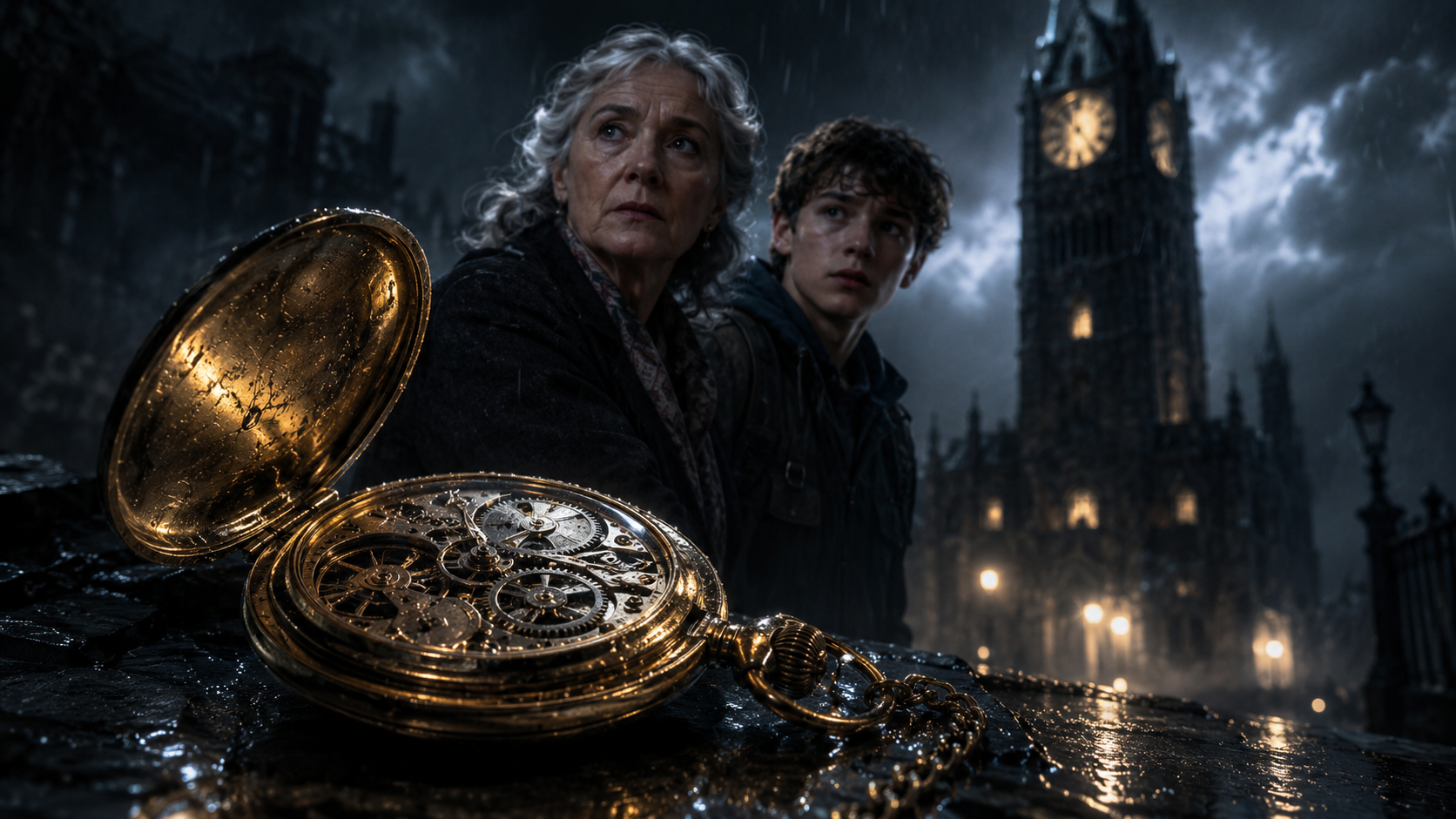
Chapter One: The Parcel at 2:17
At exactly seventeen minutes past two, the dead watch began to tick.
Dr. Miriam Ashford heard it from the other side of her apartment.
She was standing in the kitchen, pouring hot water over tea leaves, when the sound reached her through the rain tapping against the windows.
Tick.
A pause.
Tick.
It was too slow to be the clock above the stove and too heavy to come from the cheap alarm clock in her bedroom. Miriam set down the kettle and followed the sound into the hallway.
A small parcel rested on the floor beneath the mail slot.
She had not heard anyone approach the door.
The package was wrapped in brown paper darkened by rain. There was no stamp, no return address and no name written on it. A black thread had been tied around it three times.
Miriam carried it to the dining table.
For thirty-two years, she had worked as a forensic pathologist. She had opened suitcases pulled from rivers, boxes abandoned in train stations and envelopes containing things no person should ever send through the mail. Retirement had not cured her caution.
She put on a pair of thin gloves before cutting the thread.
Inside the paper lay a golden pocket watch.
The metal was scratched almost white around the edges. A deep dent crossed the back of the case, as though someone had struck it with a hammer. Despite its age, the watch was running.
Tick.
Tick.
Tick.
Miriam stopped breathing.
She knew that dent.
Her brother Thomas had made it when he was nineteen. He had dropped the watch while climbing the iron fence behind their childhood home. Their father had shouted for an hour. Thomas had laughed through the entire lecture.
The watch had disappeared with him during the North Channel ferry fire in November 1984.
There had been no body.
Only a passenger list, a burned jacket and an official declaration of death.
Miriam pressed the release and opened the watch.
The hands pointed to 2:17, but the second hand was moving backward.
Beneath the glass, someone had replaced the ordinary face with a thin silver disk marked by dozens of tiny numbers.
A folded piece of paper was hidden inside the cover.
Miriam opened it.
The message contained only one sentence.
Your brother did not die on the ferry.
A knock struck the apartment door.
Miriam closed the watch.
“Who is it?”
No answer.
The second knock was weaker.
She moved quietly into the hall and looked through the peephole.
A teenage boy stood outside. His wet hair clung to his forehead, and a bruise spread across one cheek. He wore no coat, though the November rain was cold enough to turn his lips blue.
Miriam opened the door but kept the security chain fastened.
“Are you Dr. Ashford?” he asked.
“Who wants to know?”
“My name is Leo Mercer. My mother sent me.”
Miriam studied him. He looked about fourteen, perhaps younger beneath the exhaustion.
“Did you leave the parcel?”
Leo nodded.
“Where did you get the watch?”
“My mother found it in an old railway locker. Three nights later, she disappeared.”
Miriam’s grip tightened on the door.
“What is your mother’s name?”
“Claire Mercer.”
The name meant nothing to her.
“Why would she send you to me?”
Leo glanced over his shoulder toward the empty stairwell.
“Because she said you were the only person who would recognize the watch.”
A floorboard creaked somewhere below.
The boy’s face changed.
“He followed me.”
“Who?”
“A man from the St. Orison Foundation.”
Miriam had heard the name. St. Orison operated private hospitals, children’s charities and rehabilitation centers across the country. Its smiling blue emblem appeared at charity dinners and on the sides of expensive ambulances.
“Why would a medical foundation be chasing a schoolboy?”
Leo looked directly at her.
“Because my mother discovered what happened to the people who were supposed to die with your brother.”
The elevator bell rang.
Miriam removed the chain and pulled Leo inside.
A man stepped out of the elevator as she locked the door.
He was tall, silver-haired and dressed in a charcoal overcoat. He did not knock.
Instead, he stood in the hallway and spoke in a calm, pleasant voice.
“Dr. Ashford, my name is Adrian Kestrel. I believe the boy has brought you something that belongs to my organization.”
Miriam looked at Leo.
The boy was trembling.
Kestrel tried the handle.
“Open the door,” he said. “There is no reason for this situation to become unpleasant.”
Miriam picked up her telephone.
“I’m calling the police.”
“You may certainly do that.”
His confidence made her pause.