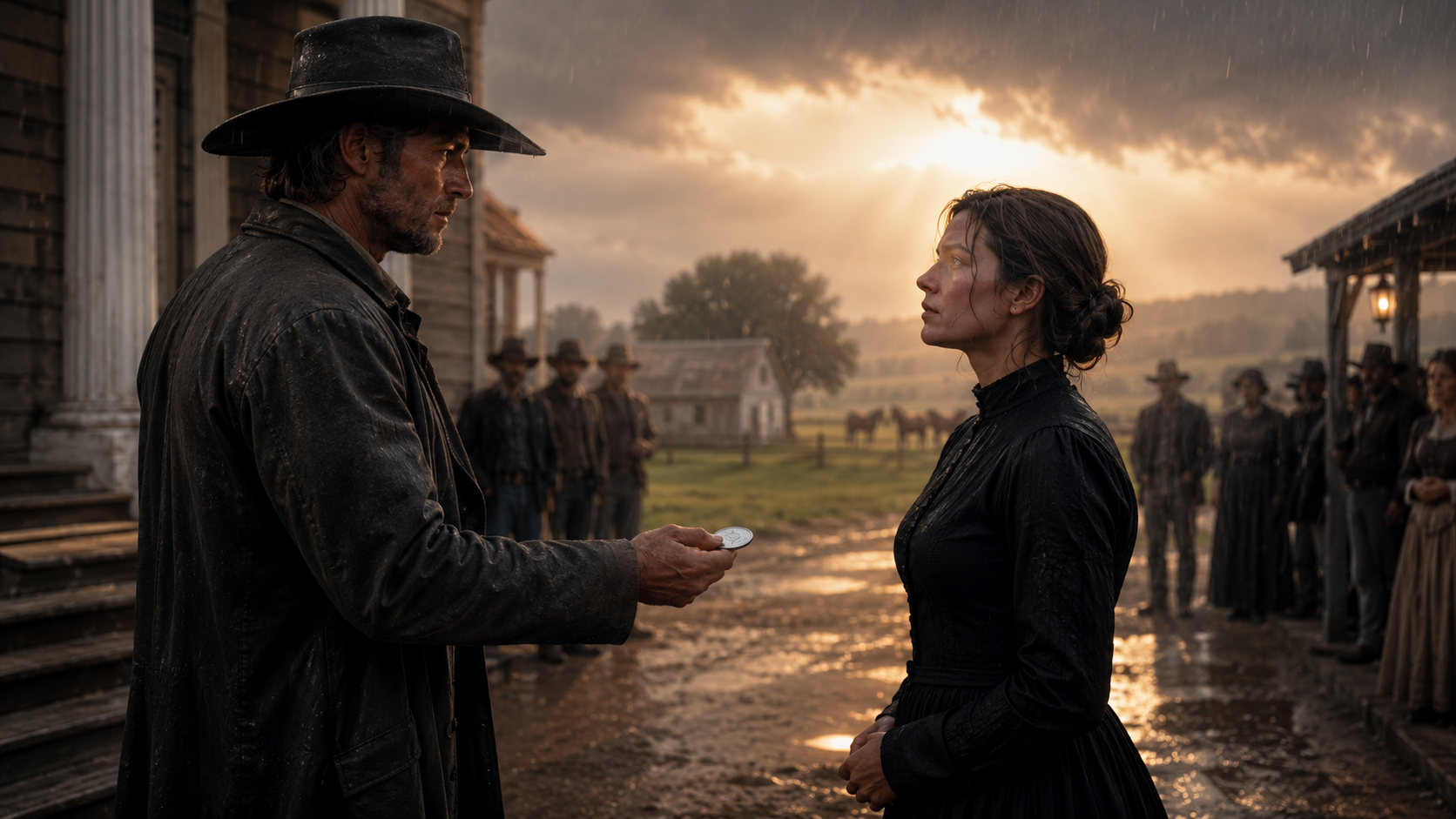
The room went quiet.
Mara turned to the sheriff. “The mares were purchased with income from land deeded to me. Their records are signed by me. Their breeding contracts are signed by me. Mr. Vane has not stolen from my husband. He has stolen from me.”
The case went to court.
By then Mara was pregnant again.
She stood before twelve male jurors with her belly round beneath a dark blue dress while Roland’s attorney tried to turn theft into comedy.
“Gentlemen,” he said, pacing dramatically, “we are asked to believe that a woman, one acquired through a courthouse bargain, understands bloodlines, contracts, and branding marks better than an established rancher.”
Silas sat behind Mara, silent and furious enough to frighten the lamps.
Mara did not look back.
When she took the stand, the attorney asked, “Mrs. Crowe, are you truly asking this jury to believe you know more about horseflesh than Mr. Vane?”
“No,” Mara said. “I am asking them to read.”
A ripple moved through the courtroom.
She opened her ledger.
“These are the purchase records. These are the breeding notes. These are the veterinary descriptions of each mare, including old scars Mr. Vane’s men failed to cover with fresh brands. This is the bank document from which my husband’s signature was copied. You can see the same hesitation in the lower loop, because the forger copied not only the shape but the flaw.”
The attorney reddened. “You expect simple men to follow all that?”
“I expect honest men not to pretend confusion because the explanation comes from a woman.”
The jury found for Mara in less than an hour.
Roland Vane was fined, disgraced, and later charged after one of his own men confessed.
Outside the courthouse, in front of half the town, Silas took Mara’s hand.
“You saved us again,” he said.
“No,” she answered. “I saved what was mine.”
His smile was slow, proud, and bright enough to shame every whisper that had ever followed her.
Two months later, Mara delivered twin girls: Rose and Clara.
Six children filled the once-silent house.
Elias was serious and protective. Bennett was loud enough for three boys. Amos watched everything before speaking. Willa climbed fences faster than ranch hands could build them. Rose and Clara screamed if anyone dared separate them for longer than a minute.
Silas loved them with an intensity that bewildered those who had feared him. He still looked like a man who could bend iron, but Willa tied ribbons in his beard, the twins slept on his chest while he read cattle reports, and Elias once convinced him to attend a tea party with a wooden rifle as his guest.
Mara would pause in doorways and watch the giant cowboy softened by small hands.
Sometimes love arrived like lightning.
Sometimes it grew like grass after rain, quietly covering every scar in the ground.
The seventh child nearly cost them everything.
Mara was thirty-five when she realized she was carrying again. Eight years had passed since the courthouse. She had six healthy children, a thriving ranch, land in her own name, and a marriage that had become the spine of her life.
This time, when she told Silas, he did not smile.
He sat down heavily.
“Mara.”
“I know.”
“Dr. Harlow warned after the twins.”
“I know.”
“You nearly bled to death.”
“I know that too.”
His face looked older than it had that morning. “I cannot lose you.”
She crossed the room and took his face in her hands.
“You do not get to decide the future by fear.”
“No,” he said. “But I get to be afraid.”
“Yes.” She kissed his forehead. “You do.”
The pregnancy was hard from the start.
Mara tired easily. Her back ached. Dr. Harlow visited every two weeks and wore a cheerful expression that fooled no one. Silas reduced her work without asking. Mara fought him until she found Elias standing outside her office with tears in his eyes.
“Pa says you need rest,” he said. “But you won’t rest because you think resting means losing.”
Mara lowered the ledger she had been pretending to read.
“Did your father say that?”
“No,” Elias said. “I thought it myself.”
Behind him, Willa hugged a rag doll and nodded gravely. “If you die, Mama, I’ll be very angry.”
Mara laughed and cried at once.
After that, she rested.
The baby came during the first snow of November, eight years almost to the day after Elias’s birth. Labor began before dawn. By noon it had worsened. By evening Mara was feverish, exhausted, and losing strength.
Dr. Harlow tried to send Silas out.
“No,” Mara gasped. “He stays.”
So he stayed.
He held her hand while she cursed him, prayed with her when she trembled, and pressed his forehead to hers when she whispered, “I can’t.”
“You can,” he said, his voice breaking. “Not because I need another child. Not because of my name. Because you are Mara Crowe, and pain has never been the strongest thing in any room where you stood.”
The final push tore a scream from her.