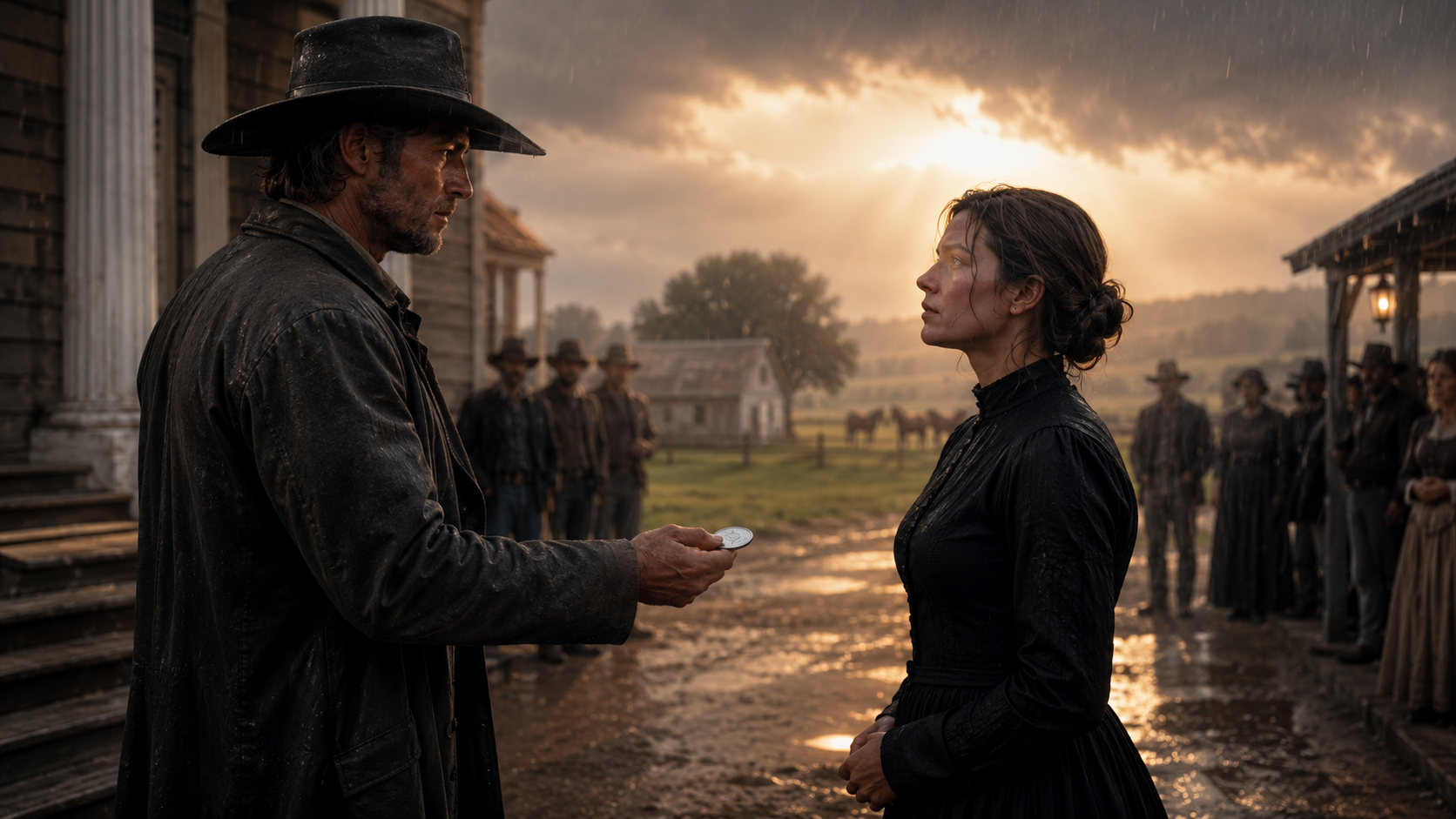
Then a baby cried.
A girl.
Small, furious, alive.
Dr. Harlow moved quickly. Too quickly. Mrs. Ortega went pale. Silas saw blood on the sheets and fear in the doctor’s eyes.
Mara saw it too.
“Name her,” she whispered.
Silas shook his head. “You will name her when you are stronger.”
“Name her.”
He bent over her, terror stripping him bare.
“Mercy,” he said. “Her name is Mercy.”
Mara’s eyes filled.
“Good.”
Then she fainted.
For two days, Black Lark held its breath.
The children were kept quiet. Ranch hands removed their hats when passing the bedroom door. Mrs. Ortega prayed in Spanish and scolded God in English. Silas did not sleep. He sat beside Mara’s bed holding her hand, bargaining with heaven like a man trying to buy back the sun.
On the third morning, Mara opened her eyes.
“You look awful,” she whispered.
Silas made a sound that was half laugh, half sob.
“You scared ten years off my life.”
“Then we are closer in age now.”
He kissed her hand, her wrist, her forehead.
“No more children,” he said. “Seven is more than any man deserves. More than I deserve. I once thought legacy meant blood carrying my name. I was a fool.”
Mara watched him through tired eyes.
“What does it mean now?”
Silas looked toward the hallway, where six children were failing to whisper while waiting for news of the seventh.
“It means what we teach them. How we treat people. What we build that outlives our pride.”
Mara smiled faintly. “You have become wise, Mr. Crowe.”
“No,” he said. “I married well.”
Mercy lived.
Mara lived.
And the story of the barren widow who gave the giant cowboy seven children traveled faster than any horse Black Lark ever bred.
People told it badly, of course.
They said Silas bought Mara for one dollar and she repaid him with sons and daughters. They said motherhood proved she had value after all. They said the giant cowboy had known what he was doing when he chose her.
Mara hated that version.
So when a newspaper reporter came from Cheyenne in 1902 to write about the famous Crowe family, she told the truth.
“I was never worthless,” Mara said, sitting in her parlor while the young reporter tried to keep his pencil steady. “Not before children. Not before marriage. Not when men laughed at me in the courthouse. My value did not begin when my body became useful to someone else.”
The reporter blinked and wrote quickly.
“Then what did the dollar buy?” he asked.
Mara looked out the window.
Elias was helping Silas repair a gate. Bennett and Amos were arguing over a rope. Willa was riding too fast while Rose and Clara shouted encouragement from the fence. Mrs. Ortega rocked baby Mercy on the porch and threatened all of them with soup if they tracked mud into her kitchen.
“The dollar bought a pause,” Mara said. “That is all. A pause in cruelty. A chance to stand somewhere safe. Silas gave me that chance. I gave him one too. Everything after that, we had to build.”
“And the seven children?”
Mara smiled.
“They are not proof that I was valuable. They are proof that life can be generous when two people stop treating each other like bargains and start treating each other like souls.”
The reporter printed almost all of it.
By then, Silas had placed half the horse program in Mara’s name. Worker housing had expanded. A school fund had been created for the children of ranch hands. Mara taught bookkeeping, livestock records, and contract reading to women every other Saturday. Some came secretly at first, claiming they wanted Mrs. Ortega’s recipes. Within a year, their husbands stopped objecting because the women who attended stopped being easy to cheat.
Black Lark became more than a ranch.
It became a place where competence mattered more than birth, where girls learned numbers beside boys, where hired men were paid on time, where widows found work, where no one used the word barren as an insult twice.
Years later, when Silas’s beard had gone silver and Mara’s hair had softened white at the temples, they stood together on the hill above Cotton Hollow and watched their children scatter into lives neither could have imagined.
Elias took over cattle operations with calm authority. Bennett became a horse trader with too much charm and just enough honesty. Amos studied law after watching his mother face Roland Vane in court. Willa ran the horse program better than either parent had dared hope. Rose became a teacher. Clara trained as a nurse. Mercy, the child born from fear and named in desperation, became a writer who told the family story without polishing away its pain.
On Silas and Mara’s thirtieth anniversary, the children held a celebration at Black Lark. Lanterns hung from the cottonwoods. Music drifted across the yard. Grandchildren ran between boots and skirts. Mrs. Ortega declared the cake inferior to hers and then ate two pieces.
Elias stood to give a toast.