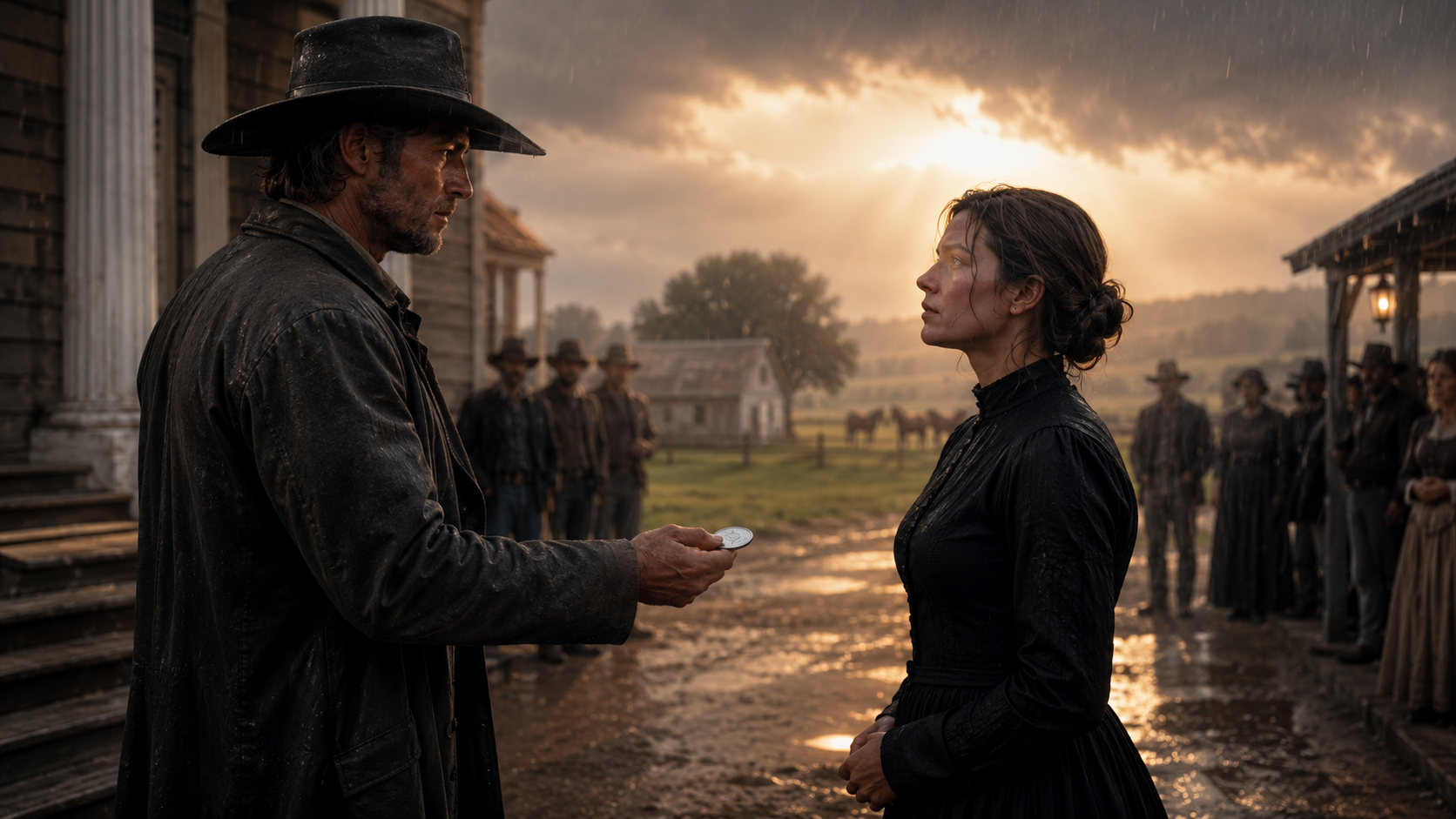
“And I heard fear pretending to be judgment.”
His eyes flashed. “This ranch was standing before you came here.”
“It may not stand long after if you confuse pride with strategy.”
He slammed one hand on the desk hard enough to jump the ink bottle. “You think I don’t know cattle?”
“I think you know cattle so well you cannot bear to admit the land is telling you no.”
That struck.
Silas looked away.
Mara softened her voice. “Sell the weakest third before every desperate rancher tries to do the same. Keep the best breeding stock. Use the money for hay before the price doubles. The men will complain. Let them. Better a smaller herd alive in March than a grand herd dead in January.”
He resisted for four days.
Then he did exactly as she said.
That winter ruined three neighboring ranches.
Black Lark survived.
In April, Silas placed a folded deed beside Mara’s breakfast plate.
She opened it and stared.
“What is this?”
“Three hundred acres along Cotton Hollow.”
“In whose name?”
“Yours.”
Her fork slipped from her hand.
“Silas.”
“You saved this place. You manage the house. You read numbers clearer than any man I’ve hired. You advised the herd sale that kept us alive. Yet the law says everything here is mine because I am the husband. I can’t fix the law. I can fix that deed.”
Mara touched the paper with shaking fingers.
“People will say I bewitched you.”
“People say I killed two wives, you tricked me with a child, Elias was born too soon, and Mrs. Ortega uses too much cinnamon. People are unreliable.”
“You don’t understand what this means.”
“Yes, I do.”
“No,” she whispered. “You don’t. I have belonged to a father, then a husband, then creditors, then public opinion. I have never had land belong to me.”
Silas came around the table and knelt beside her chair, huge and humble.
“Then start with Cotton Hollow.”
Their second pregnancy came that summer.
Then came the surprise.
Twins.
Bennett and Amos were born during a thunderstorm. Bennett came into the world howling. Amos arrived silent until Dr. Harlow gave him one sharp tap, at which point he objected to existence with admirable fury. Mara laughed and cried at the same time. Silas walked into the hall afterward looking so pale Mrs. Ortega shoved him into a chair and ordered him to put his head between his knees.
“Three sons,” Dr. Harlow said. “That ought to satisfy any rancher alive.”
Silas, holding both twins badly while little Elias tried to climb his boot, looked at Mara.
“Only if it satisfies their mother.”
Mara thought three children would be the shape of their family.
Life had other arithmetic.
Two years later came Willa, with Mara’s gray eyes and Silas’s solemn stare. The town women brought pink quilts and foolish advice. Silas ignored most of it and carried his daughter around the ranch as though she were a visiting queen.
“Girls don’t need to inspect cattle,” an old hand joked.
Silas looked down at Willa asleep against his chest.
“Then cattle should behave without supervision.”
By their sixth anniversary, Black Lark was no longer spoken of merely as Silas Crowe’s ranch. People had begun saying “the Crowe place,” then “Mara Crowe’s office,” and finally, among merchants who had learned caution, “Do not cheat that woman unless you enjoy losing money in public.”
Mara turned Cotton Hollow into a horse program. Silas understood strength. Mara understood temperament. Together they bred horses that could work long days, carry nervous riders, learn fast, and keep their heads in storms. Buyers came from three territories. Men who had once laughed at the dollar widow now stood in her yard asking her price.
Mara gave it without apology.
Trouble came wearing a polished smile and a white hat.
His name was Roland Vane, owner of a rival spread east of Mercy Creek. He wanted Silas’s water rights. Silas refused to sell. Roland tried charm on Mara.
“You understand business,” he told her at the county fair. “A woman with influence over her husband could make him see reason.”
Mara looked at him over a glass of lemonade.
“Men who praise a woman’s influence usually hope she is vain enough to be useful.”
Roland’s smile cooled.
A month later, three of Mara’s best mares vanished.
Silas was away buying bulls in Kansas. The sheriff shrugged and said horses wandered. Mara knew better. She followed the tracks herself with Silas’s foreman, Abel Knox, and found the mares hidden in a canyon on Roland’s land, their brands altered so badly the wounds still bled.
Roland produced a bill of sale bearing Silas’s signature.
The signature was good.
Too good.
Mara studied it in the sheriff’s office and felt cold certainty settle inside her.
“This was copied from our bank papers,” she said.
Roland smiled. “Careful, Mrs. Crowe. Accusing a man of forgery is serious.”
“So is stealing from me.”
“From your husband,” Roland corrected.