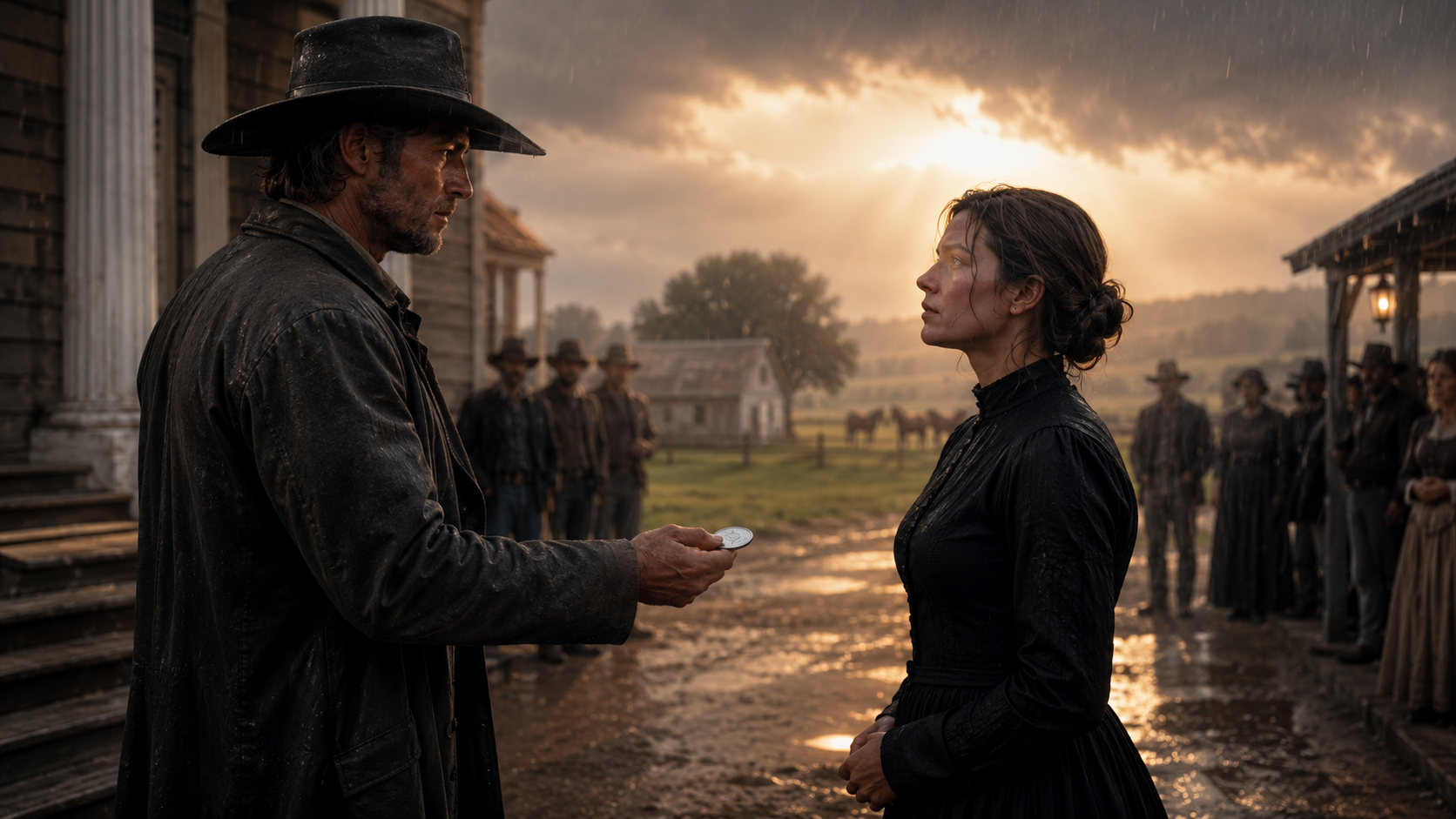
Silas’s voice roughened. “Then why?”
“Because I am tired of being a grave for other people’s lies.”
The mare blew softly between them.
Silas stepped back, giving her room though she had moved toward him.
“If you ever come to me,” he said, “and change your mind afterward, you walk away. No apology. No explanation.”
Mara looked at the scar across his face, the careful distance in his body, the big hands that had gentled a frightened horse at midnight.
“If I come to you,” she said, “I will already know my mind.”
She came to him three nights later.
Their first tenderness was not like the songs. It had pauses in it. Questions. Awkward laughter. Silas asked before every touch, and Mara answered honestly. They were not suddenly healed. People did not become whole because a door opened between two bedrooms.
But something began.
A marriage, perhaps.
Not the paper kind.
The living kind.
In spring, Mara missed her courses.
For three weeks, she told no one. Hope was a dangerous animal. If fed too early, it could turn and bite.
But the signs gathered. Morning sickness. Heavy sleep. The strange bright ache beneath her ribs. Finally she sat across from Silas at the kitchen table while Mrs. Ortega kneaded bread nearby.
“I believe I am carrying a child,” Mara said.
Silas froze.
Mrs. Ortega’s hands stopped in the dough.
Mara tried to smile. “This is the part where a husband usually says something.”
Silas stood so fast the chair scraped backward.
“I’ll get Dr. Harlow.”
“Silas, he is thirty miles away.”
“I have fast horses.”
“It is early.”
“Elise died of fever.”
“I am not Elise.”
The words were firm but not cruel.
Silas stopped. His face had gone pale beneath the tan.
Mara reached across the table. “I need you happy, not haunted.”
He looked at her hand. Slowly, he covered it with his own.
“I am happy,” he said. “So happy I don’t know where to put it.”
Their first son, Elias, was born in November during a windstorm that rattled every window in Black Lark. Labor lasted eighteen hours. Silas, who could face a charging bull without flinching, spent half the night on his knees outside the bedroom door until Mara demanded he be brought in because his praying was louder than her groaning.
When the baby finally cried, Dr. Harlow laughed.
“A boy,” he said. “Strong as a church bell.”
Mara, exhausted and damp with sweat, looked at Silas. “There is your heir, Mr. Crowe.”
Silas came to the bedside.
But he did not look first at the child.
He looked at her.
“There is my wife,” he said. “Alive. That is the miracle.”
Mara wept then, not because she had given him a son, but because for the first time in her life a man valued her more than what her body could prove.
Mercy Creek did not allow happiness to pass untaxed.
The whispers began before Mara could comfortably walk to the porch.
“Too soon.”
“She must have been carrying before the auction.”
“Barren women do not bloom that fast unless they lied first.”
Silas wanted to settle the matter with his fists.
Mara forbade it.
“You cannot beat gossip dead,” she told him.
“I can make it limp.”
“You can make it louder.”
So Mara did something harder.
She went into town.
She carried Elias to church. She attended sewing circles. She brought broth to sick neighbors. She corrected the church accounts so politely that the treasurer thanked her before realizing she had uncovered two years of missing coins. She did not beg for kindness. She simply became too useful to dismiss.
Some women softened. Some did not.
The worst was Lavinia Pike, daughter of a railroad investor and once hopeful that Silas might marry her for her father’s money. At a spring picnic, Lavinia approached Mara while half the town listened.
“I admire your courage,” Lavinia said sweetly. “Most women bought at auction would hide themselves.”
Mara shifted Elias higher on her hip.
“I admire your confidence,” she replied. “Most women with manners that poor would try to speak less in public.”
The silence afterward was a thing of beauty.
Then Mrs. Ortega laughed so loudly she spilled lemonade on the mayor’s shoes.
By supper, half the town had repeated Mara’s answer.
That evening Silas looked at her across the porch and said, “You are a dangerous woman.”
“No,” Mara said. “Only properly rested.”
The second time Silas called her dangerous came two years later, when she saved Black Lark Ranch.
A dry summer burned the grass down to yellow wire. Cattle prices fell. A sickness moved through the southern herd and took forty-seven head in nine days. Silas worked from before dawn until after midnight, trying to hold disaster back with muscle and stubbornness.
Mara watched him become hollow-eyed.
One night she brought ledgers into his office and laid them open.
“You must sell part of the herd now.”
“No.”
“You will lose more if you wait.”
“I said no.”