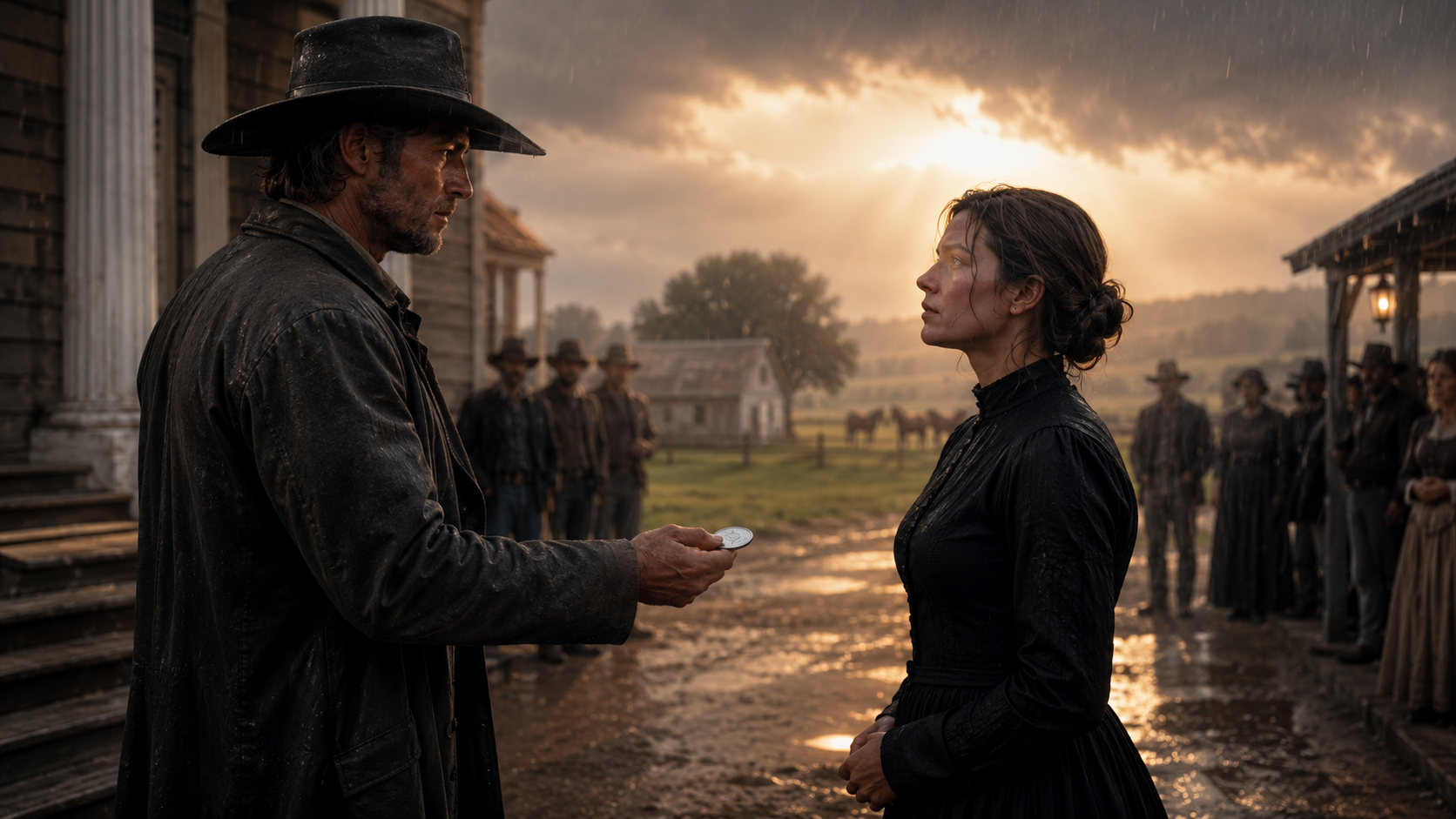
A sound came out of him then. Rough. Surprised. Rusty from disuse.
A laugh.
Mara looked away before he could see how much it startled her.
Silas read every page.
When he finished, he said, “The house is yours.”
“No.”
His brow lifted.
“The work is mine if I choose it. The responsibility may become mine. But do not hand me a house as if it is a basket of mending. Ownership is a different word.”
Silas studied her for a long moment.
“You care about words.”
“I care about what men hide inside them.”
After that, he stopped calling household matters “inside work.” He called them operations. When ranch hands smirked, he stared until they remembered something urgent elsewhere.
By Christmas, Black Lark no longer felt like a house holding its breath.
Curtains were washed. Floors shone. The pantry ran like a small army. Meals improved enough that men began finding reasons to linger near the kitchen door. Mrs. Ortega hummed when she baked. The hired girls laughed again. Even Silas changed in small ways. He wiped his boots before crossing Mara’s clean floors. He sent receipts to her desk without being asked. He stopped drinking coffee as though suffering were proof of manhood after Mara taught Mrs. Ortega to make a second pot that did not taste like boiled horseshoes.
Yet they slept in separate rooms.
The question of children remained between them like a locked gate.
One January night, snow came hard against the windows. Mara woke to the sound of movement in the yard and found Silas in the barn, brushing a restless mare by lantern light.
The horse trembled at every gust.
Silas murmured to her in a voice so low Mara could not hear the words, only the gentleness.
“You avoid the house after supper,” Mara said.
The brush paused.
Silas did not turn. “Do I?”
“Yes.”
“Maybe I prefer horses.”
“Horses do not ask why a man who needs an heir refuses to touch his wife.”
The mare shifted nervously. Silas laid one big hand along her neck until she quieted.
“I told you I would not force anything.”
“I believed you. That is not what I asked.”
His shoulders rose and fell once.
“Edwin told the town I was barren,” Mara said. “You told me a husband’s word is not a doctor’s verdict. Why?”
Silas finally looked at her.
Because I knew Edwin Bellamy.”
Mara went still.
Silas’s jaw hardened. “He came to Black Lark once, years ago, drunk enough to mistake boasting for conversation. He said a wife who could not give him sons was useful for blame. Then he laughed and said the doctor had told him after a fever in his youth that he would likely never father a child. He made me promise nothing. I promised nothing. But I remembered.”
The barn seemed to tilt around her.
Mara gripped the edge of a stall door. “You knew?”
“I knew there was a chance the shame was never yours.”
“And you said nothing?”
“It was not mine to throw into the street.”
“Not yours?” Her voice shook now. “My life was buried under that lie.”
“I know.”
“You know?” She stepped closer, anger hot enough to keep out the cold. “The town spat that word at me. Barren. Empty. Useless. Edwin let them. His creditors used it to price me. And you knew?”
Silas took the blow of her words without defense.
“Yes.”
“Why bid, then? Pity?”
“No.”
“Then why?”
His eyes were dark in the lantern light.
“Because when the auctioneer dropped the price to five dollars, every man in that room looked at you as if the world had permission to finish breaking you. I had spent years letting people believe lies about me because those lies kept greedy fathers from sending daughters to my door. I knew what it meant to stand inside a story you did not choose.”
Mara swallowed.
He continued quietly. “I paid one dollar because twenty sounded like purchase. One sounded like interruption.”
She wanted to stay angry. Some part of her did remain angry, and would for a long time. But beneath it something else moved.
Pain recognizing pain.
“People say you buried two wives,” she said.
Silas looked toward the storm-dark doors.
“Elise died of fever before our first anniversary. She was eighteen and frightened of everything, including me. I was too young and too clumsy to know how to comfort her. Marianne married me for land and hated every acre of it. She left with a cardsharp from Denver after seven months. Folks prefer saying I buried two wives. It makes me sound more interesting.”
“So only one died.”
“Only one.”
“And you let people call you a monster.”
“It kept certain people away.”
Mara studied him.
The giant of Black Lark. The cursed widower. The man who had carried a lie because correcting it would invite another kind of trouble.
“You are foolish,” she said.
A faint smile touched his mouth. “Mrs. Crowe, I have been called worse.”
“I have not decided to be Mrs. Crowe.”
“No.”
“But if I do decide…” She took a breath. “It will not be because you need an heir.”