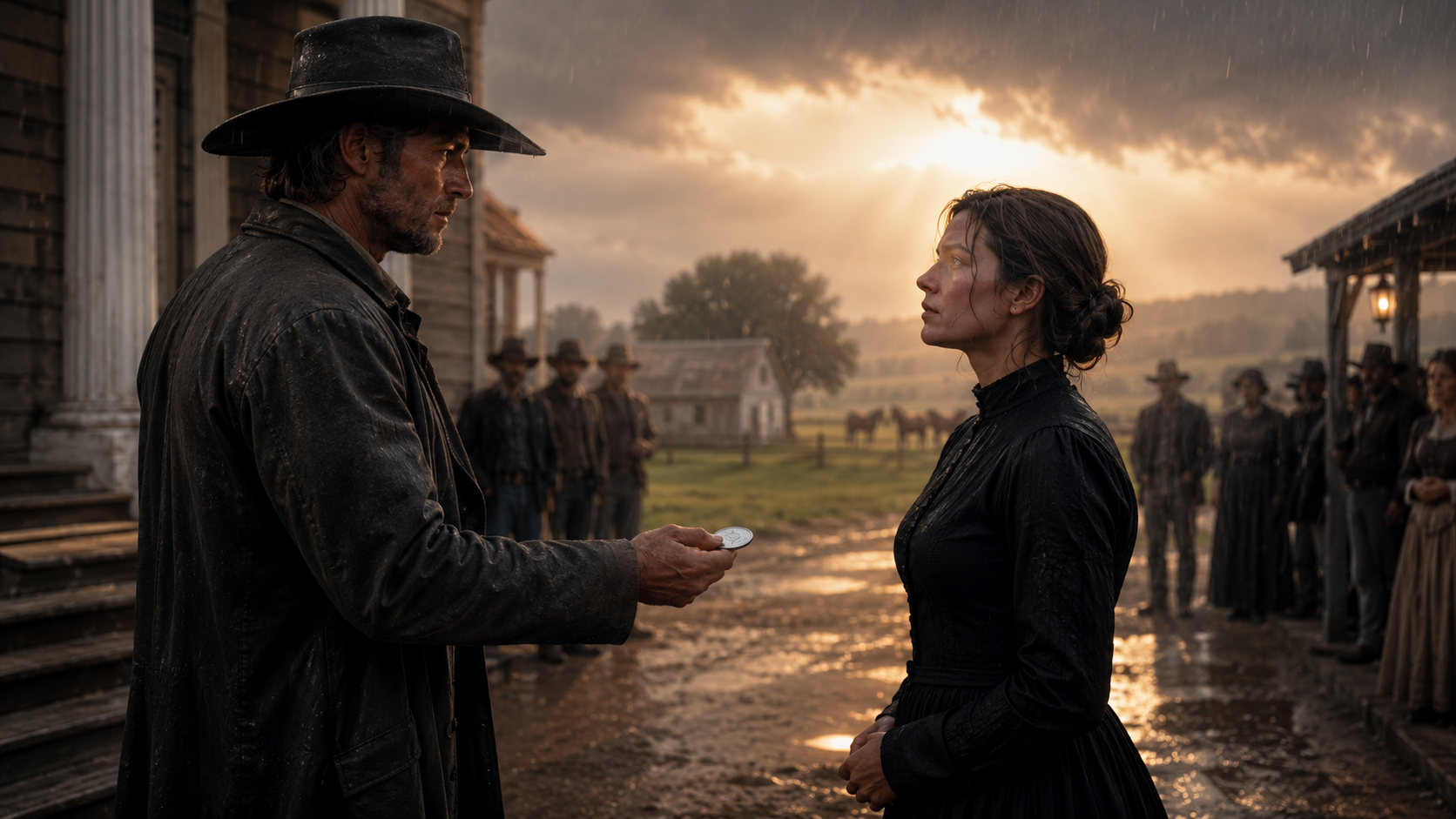
Black Lark Ranch lay twelve miles west of Mercy Creek, where the land opened into long grass, red stone, and sky so wide it made a person feel exposed. The ranch house stood on a rise above Cotton Hollow, built from dark timber and pale limestone, broad-porched and severe. It looked less like a home than a decision no storm had ever managed to change.
Silas stopped the wagon before the porch.
“You’ll have your own room,” he said.
Mara turned toward him. “And your expectations?”
“My expectation is that you eat supper and sleep behind a locked door if that makes you feel safer.”
She studied him carefully. “Men rarely purchase women in public and then ask what makes them feel safe.”
“I told you. I purchased paper.”
“And if the paper says I am your wife?”
His mouth tightened. “Then the paper is wrong until you say otherwise.”
That answer unsettled her more than cruelty would have.
A plump woman with silver threads in her black hair came out onto the porch, wiping her hands on an apron. She had sharp eyes, kind cheeks, and the posture of someone who had survived enough to be impressed by very little.
“This is Mrs. Ortega,” Silas said. “She manages the kitchen and most of us when we’re foolish.”
Mrs. Ortega looked Mara over once, then smiled. “You must be frozen through. Come inside before the rain turns you into soup.”
Mara almost smiled back. Almost.
Inside, the house smelled of coffee, woodsmoke, leather, and loneliness. The rooms were clean but bare. Chairs lined walls as if waiting for guests who never came. The dining table could seat fourteen, but only one place was set.
Mara noticed everything.
Silas noticed that she noticed.
At supper, he sat across from her, not at the head of the table. Mrs. Ortega served beef stew, bread, and coffee so strong it seemed to have a temper.
Mara took one sip and coughed.
Mrs. Ortega’s mouth twitched.
Silas looked concerned. “Is it spoiled?”
“No,” Mara said, setting the cup down. “It is simply trying to kill me.”
For one second, silence held.
Then Mrs. Ortega laughed into her apron.
Silas stared at Mara as though she had performed a magic trick. The corner of his mouth moved, not quite a smile, but close enough to change his whole face.
After supper, he walked her to a room at the end of the hall. It held a bed, a washstand, a trunk, a small stove, and a window facing the cottonwoods.
“There’s a key on the inside,” he said.
Mara stepped in and turned back. “Why did you bid?”
Silas’s gaze dropped briefly to the floorboards.
“I needed a wife.”
“For an heir?”
“Yes.”
The honest answer struck harder than any polite lie.
Mara lifted her chin. “Then you chose poorly.”
“I know what people say.”
“People say it because it is true. Three years married. No child. Edwin made certain everyone knew whose fault it was.”
Silas’s eyes narrowed slightly. “Did a doctor tell you that?”
“My husband told me.”
“That is not the same thing.”
She had no answer to that.
Silas stepped back. “Sleep, Mrs. Bellamy.”
“Crowe, I suppose.”
“Only if you want the name.”
He left her standing in the doorway with a key in her hand and a silver dollar hidden in her fist.
The first weeks at Black Lark were not tender. They were stranger than that.
They were useful.
Mara rose before dawn because habit did not know she was supposed to be ruined. She found the pantry in confusion, the household accounts neglected, the linen supplies overcounted, the lamp oil overpriced, and three barrels of flour stored too close to damp stone. She discovered that a merchant in Mercy Creek had been charging Silas nearly double for coffee because Silas paid bills without reading them if the total looked plausible. She found two hired girls doing the work of five, not because Silas was cruel, but because no one had ever explained to him that fair wages did not matter if the work itself was unfairly divided.
On the sixth morning, she entered his office without knocking.
He looked up from a cattle ledger. “That room is private.”
“So is bankruptcy,” she said. “But if you keep managing household expenses like this, you will meet it publicly.”
He leaned back.
Most men would have shouted. Silas did not. He looked at the papers in her hand and then at her face.
“Come in.”
Mara laid her notes on his desk.
“You are being cheated by the coffee merchant, the lamp oil supplier, and possibly the man who sells you nails. The pantry roof leaks. The smokehouse door does not seal. Your cook is excellent, but she has been stretching poor supplies to hide waste. The laundry girls need a schedule. The north chimney needs cleaning before it burns your roof. Also, one of your ranch hands is stealing sugar.”
Silas picked up the first page. His eyebrows drew together.
“You found this in six days?”
“I was angry.”
He looked up.
“That helps me concentrate,” she added.