The auctioneer would not look Mara Bellamy in the eyes.
That was the first thing she remembered afterward. Not the smell of wet wool in the courthouse hall, not the muddy boots scraping the floorboards, not the dozen men pretending they had only come to watch. She remembered the auctioneer’s eyes sliding past her as though shame were contagious.
“Lot number seven,” he called, his voice cracking only once. “Widow Mara Bellamy. Age twenty-seven. No living kin in the county. Household skills, sewing, accounts, basic reading. Widow of the late Edwin Bellamy.”
Someone near the back snorted. “And barren as a salted field.”
A few men laughed.
Mara kept her chin level.
Her black dress had been brushed until the seams shone. The hem was still damp from the walk through the rain. She had no gloves because Edwin’s creditors had taken the trunk where she kept them. They had taken the stove, the mule, the bedstead, the butter churn, and the little walnut desk that had belonged to her mother. Then they had found the old county marriage debt contract Edwin had signed years before, a cruel bit of legal rot that allowed a widow without property to be placed under “protective purchase” if a creditor pressed hard enough.
Protective.
That word had nearly made her laugh.
The men in Mercy Creek had spent three years calling her useless because she had never carried a child. Now they stood in a courthouse waiting to see if any of them could buy that uselessness cheaply enough to amuse themselves.
The auctioneer cleared his throat.
“Opening bid, twenty dollars.”
Silence.
Rain tapped the windows.
Mara could hear the clock above the judge’s empty chair. Tick. Tick. Tick. Every second seemed to peel another strip of skin from her pride.
“Ten dollars,” the auctioneer tried.
No one spoke.
“Five.”
A man coughed into his fist. Someone whispered, “Wouldn’t pay five for another man’s failure.”
Mara stared at the back wall until the courthouse blurred.
Then the doors opened.
Cold air rolled in first. After it came Silas Crowe.
Every man in the room seemed to shrink without moving.
Silas was not merely tall. He was built like the mountains had decided to walk on two legs. His shoulders filled the doorway. Rain darkened the brim of his hat and ran down the sides of his weathered coat. A scar cut from the corner of his left eyebrow to the cheekbone, pale against sun-browned skin. His beard was trimmed, but it did nothing to soften him. His hands were the hands of a man who could break a rail, mend a harness, or lift a calf out of a flood without needing help.
People called him the Giant of Black Lark Ranch.
They also called him cursed.
He had buried one wife, they said. Driven another mad, they said. Some even claimed women disappeared into his ranch house and came out as ghosts. The fact that no one could name those ghosts never troubled the town much. Mercy Creek preferred a good fear to an honest fact.
Silas removed his hat.
The auctioneer swallowed. “Mr. Crowe.”
Silas looked at Mara.
Not at her body. Not at the paper tied to her wrist. Not at the crowd waiting to see whether she would cry.
At her face.
“One dollar,” he said.
The room broke into noise.
The auctioneer blinked. “Sir?”
“One dollar,” Silas repeated. “For the contract. Not for the woman.”
A few men laughed louder now, delighted by the insult.
Mara’s cheeks burned. One dollar. She had expected humiliation, but not that precise a measurement.
The auctioneer looked around for another bid, almost pleading.
None came.
“Sold,” he said at last, and struck the table with his little wooden hammer. “To Silas Crowe of Black Lark Ranch.”
Mara stepped down from the platform without assistance. Her knees wanted to tremble, so she refused them permission. Silas approached, and close up he seemed even larger, even quieter.
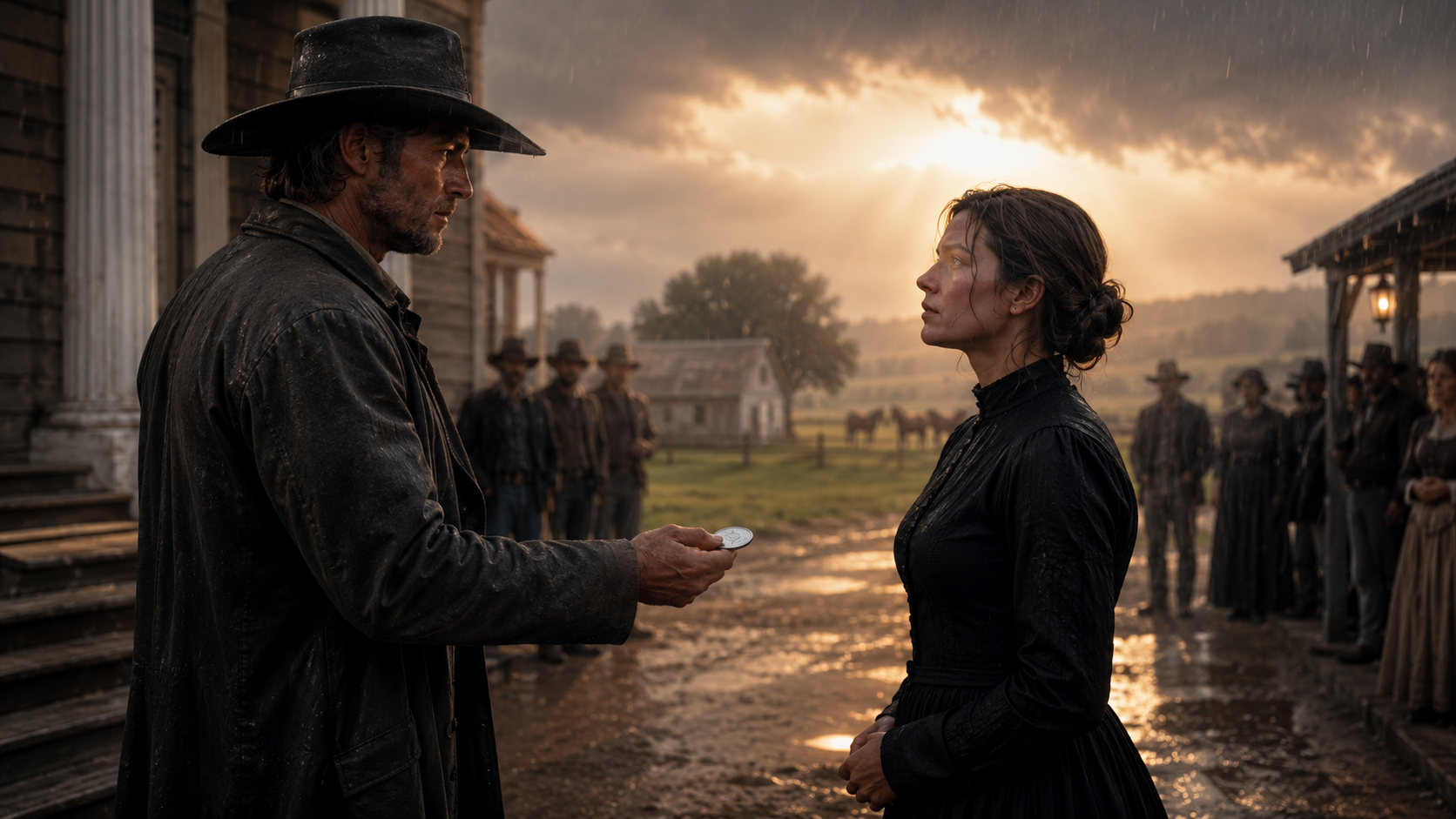
He held out his hand.
In his palm lay a single silver dollar.
“This belongs to you,” he said.
Mara looked from the coin to his face. “You paid it to the court.”
“I paid the court to end the bidding. I did not buy you.”
“That may be a distinction only you can afford.”
His expression did not change, but something in his eyes moved. Not pity. She could not have borne pity.
Respect, perhaps.
“Then keep the dollar,” he said. “You may need proof someday that the bargain was never you.”
She took the coin because refusing it would have looked like weakness.
Outside, rain fell in silver ropes. Silas brought a wagon around himself. No driver. No servant. Just the giant cowboy, holding the reins while the town watched from under awnings and courthouse eaves.
He helped her climb in without touching more than her sleeve.
As they rolled away, Mara heard a woman say, “Poor thing. Bought by a monster.”
Mara looked straight ahead.
Silas heard it too.
He said nothing.