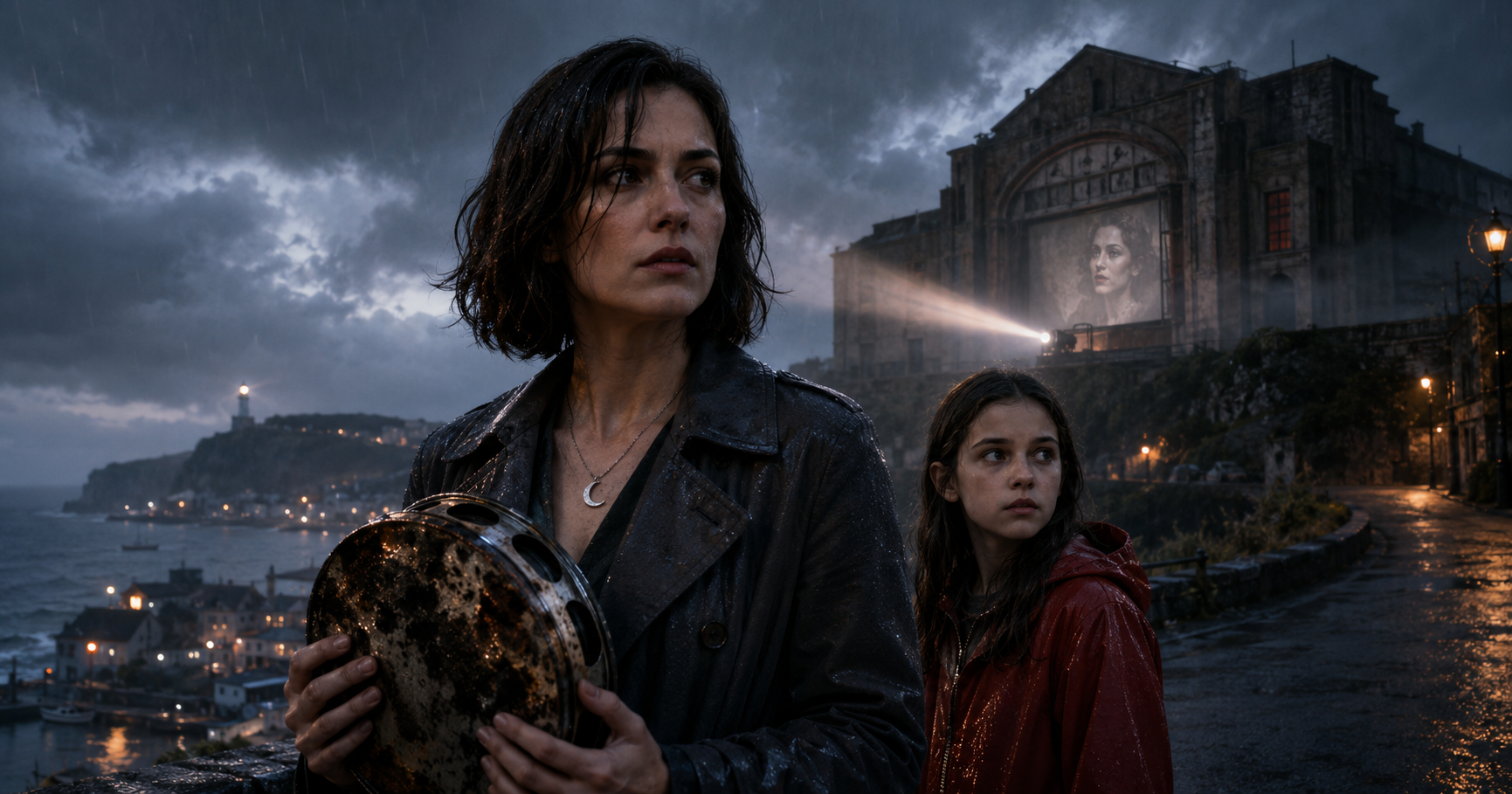
Mara looked at Saffy.
“Where did you get this?”
“My grandfather gave it to me yesterday morning.”
“That is impossible.”
“He said if anything happened to him, I had to find you before the cinema came down.”
Mara took the canister. It was colder than the rain.
“My mother died eighteen years ago.”
Saffy looked at the handwriting on the lid.
“My grandfather said that was the first lie.”
A black car turned into the taxi lane.
Saffy’s face drained of color.
“We have to go.”
The car stopped beside the curb.
Gideon Voss emerged from the rear door.
He was fifty-eight, tall and straight-backed, with iron-gray hair and the calm expression that had reassured investors, judges and newspaper editors for three decades. He wore a dark wool coat and carried no umbrella.
He looked first at Mara.
Then at the film can in her hands.
For less than a second, his composure vanished.
Saffy saw it too.
“That’s the man who came to our house,” she whispered.
Gideon approached.
“Mara, step away from the girl.”
Mara did not move.
“You know her?”
“I know that her grandfather has spent years inventing stories about our family.”
“His name is Elias Reed.”
Gideon’s jaw tightened.
“Mr. Reed worked as a projectionist. He was dismissed for theft.”
“You told me the cinema staff left after my mother died.”
“Most of them did.”
“Was Elias there the night she drowned?”
Gideon’s gaze dropped to the canister.
“Give that to me.”
Mara held it closer.
“What is on it?”
“Nothing that belongs to you.”
“My name is written on the lid.”
“That film was stolen from a private family archive.”
Saffy stepped forward.
“You searched my grandfather’s house.”
Gideon ignored her.
Mara studied his face. He still appeared calm, but his right hand had curled into a fist. A pale burn scar ran from his wrist to the base of his thumb.
She remembered seeing that scar throughout her childhood.
She remembered asking how he had received it.
A kitchen accident, he had always said.
“Mara,” he continued, “you are tired and grieving. Hand me the reel. We will discuss it privately.”
“I stopped grieving years ago.”
“No, you became good at hiding it.”
“That is not the same thing.”
His voice softened.
“Your mother was not well in the months before her death. You were too young to understand.”
“I was sixteen.”
“Then you were old enough to remember how unpredictable she had become.”
Mara remembered arguments behind closed doors.
She remembered her mother checking the locks twice each night.
She remembered Celeste waking her before dawn and asking whether Mara would be brave enough to leave Blackwater Bay forever.
She also remembered Gideon explaining afterward that grief and exhaustion had confused her.
“What happened to Elias?” Mara asked.
Gideon’s expression remained still.
“I have no idea.”
“He disappeared after giving his granddaughter this reel.”
“Perhaps he ran away from the consequences of his actions.”
Saffy lunged forward.
“My grandfather would never leave me!”
Mara caught the girl by the shoulders before she reached him.
Gideon looked toward the cinema tower.
“We have an appointment,” he said. “The solicitor is waiting.”
Mara opened her document case and removed the demolition agreement.
For eighteen years, she had allowed Gideon to manage everything connected to her mother. The memorial service. The empty coffin. The cinema accounts. The explanation that no body had been recovered because the current had carried Celeste beyond the bay.
Mara had been grateful for his certainty.
Certainty was useful when grief made every room tilt.
Now she looked at the scorched film canister and tore the demolition agreement in half.
The sound was surprisingly quiet.
Gideon’s eyes hardened.
“What are you doing?”
“Postponing our appointment.”
“The council will not grant another delay.”
“Then I should find a projector quickly.”
Mara grabbed Saffy’s hand.
They ran.
Behind them, Gideon shouted her name.
Neither looked back.
The Voss Picture House had once been the grandest building on the coast.
Now its copper roof had turned green. Salt had eaten into the stone angels above the entrance. Plywood covered the lower windows, and demolition notices fluttered across the doors.
Mara and Saffy entered through an opening in the scaffolding.
A chain secured the main entrance.
Saffy led her around the building to an alley where a drainpipe had pulled away from the wall. Behind it was a narrow wooden door almost invisible beneath layers of black paint.
“My grandfather showed me,” Saffy said.
She removed a key from her boot.
The door opened into darkness.
The smell struck Mara first: dust, wet plaster and something sweeter beneath it.
Old velvet.
The scent of the cinema seats.
Saffy switched on a small flashlight.