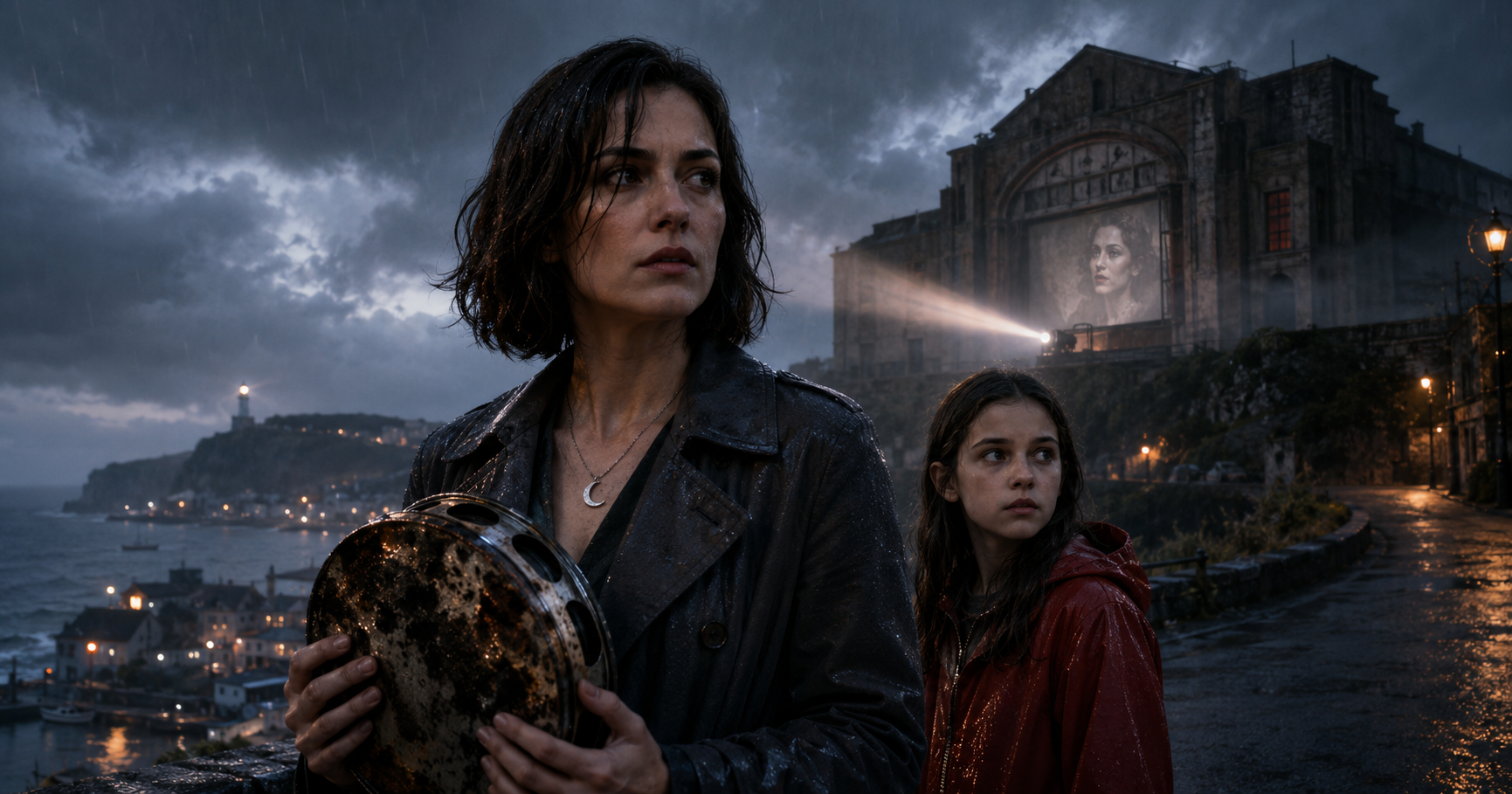
They passed through a storage room filled with broken frames and curled posters. Water dripped from the ceiling into rusted buckets. Their footsteps stirred pale clouds from the floor.
Mara had not entered the building since her mother’s memorial.
The memories did not arrive gently.
She saw herself at seven, asleep beneath the ticket counter while Celeste counted coins.
At ten, standing in the aisle and pretending the empty seats were an audience.
At fourteen, watching her mother dance alone in the projector beam after the final screening.
At sixteen, waiting all night for Celeste to return from the harbor.
“Where is the projector?” Saffy asked.
“Upstairs.”
They entered the auditorium.
Rows of red seats descended toward a torn screen. Part of the ceiling had collapsed. Rain fell through the opening and glittered in the flashlight beam.
Saffy looked around in wonder.
“My grandfather said this place was beautiful.”
“It was.”
“Why did your family close it?”
“They said nobody wanted old cinemas anymore.”
“What did your mother say?”
Mara looked toward the projection booth.
“She said people would always need a dark room where they could believe in impossible things.”
They climbed the narrow staircase.
The booth door was locked.
Mara tried Saffy’s key, but it would not turn.
“Move back.”
She struck the door with her shoulder.
Pain shot down her arm. The door held.
She tried again.
On the third impact, the rotten frame split and the door swung inward.
The projector stood beneath a gray cloth.
Unlike everything else in the cinema, it appeared untouched by decay.
Saffy pulled away the covering.
The machine had been cleaned and oiled recently.
“My grandfather was here,” she said.
Mara opened the film canister.
Inside lay a reel of sixteen-millimeter film wrapped in black paper. A small brass key rested in the center.
There was also a note.
The words had been written by Elias Reed.
The truth was never in the sea. It was in the walls.
Mara turned the note over.
Nothing.
Saffy examined the brass key.
“It’s too small for a door.”
“Maybe it opens a cabinet.”
They searched the booth.
Most of the drawers were empty. The key fit none of them.
Saffy knelt beside the projector.
“There’s a moon here.”
A crescent had been scratched into the wooden base.
Mara crouched beside her.
When the bells ring, look up.
She aimed the flashlight at the ceiling.
A brass keyhole was hidden inside an old ventilation plate.
Mara climbed onto a chair and inserted the key.
Something clicked behind the wall.
A section of wooden paneling shifted open.
Inside was a second projector.
Smaller.
Newer.
Connected to a battery and a digital conversion unit.
A green light blinked on the side.
Saffy smiled for the first time.
“My grandfather built this.”
Mara found an empty spindle and began threading the film. Her hands remembered the process even after eighteen years: feed reel, guide rollers, sound head, gate, take-up reel.
Celeste had taught her.
Never pull the film, her mother used to say. Guide it. Stories resist force.
Mara closed the gate.
The projector came to life.
Light struck the damaged screen below.
For several seconds, only dust and scratches appeared.
Then a woman stepped into the frame.
Mara forgot to breathe.
Celeste Voss sat in an unfamiliar room before a plain blue curtain.
Her hair was shorter. Silver touched her temples. A faint scar crossed her chin.
She was older than she had been on the night of her supposed death.
Much older.
A handwritten date appeared briefly on a board beside her.
The recording had been made nine years after the drowning.
Celeste looked directly into the camera.
“If you are watching this, Mara, Elias kept his promise.”
Her voice filled the empty auditorium.
Mara gripped the projector table.
Saffy reached for her hand.
Celeste continued.
“I need you to understand one thing before you hear anything else. I did not abandon you.”
Mara’s knees weakened.
“I wanted to take you with me. I had a bag packed. I had two train tickets and enough money to keep us safe for perhaps a month. Gideon discovered the tickets before I could reach you.”
The picture jumped.
A burn scar flashed across the film.
“He told me that if I spoke publicly, you would be charged as my accomplice. You were sixteen. I believed him because he had already forged documents in my name. Medical evaluations. Bank transfers. Letters that made me appear unstable.”
Mara remembered Gideon’s words at the terminal.
Your mother was not well.
Celeste lowered her eyes.
“Our family fortune was built on the redevelopment of the northern harbor. The official records say the residents sold their homes willingly. They did not. Fires were set in six buildings. Insurance companies paid. The land was cleared. Gideon arranged the contracts, but he was not acting alone.”