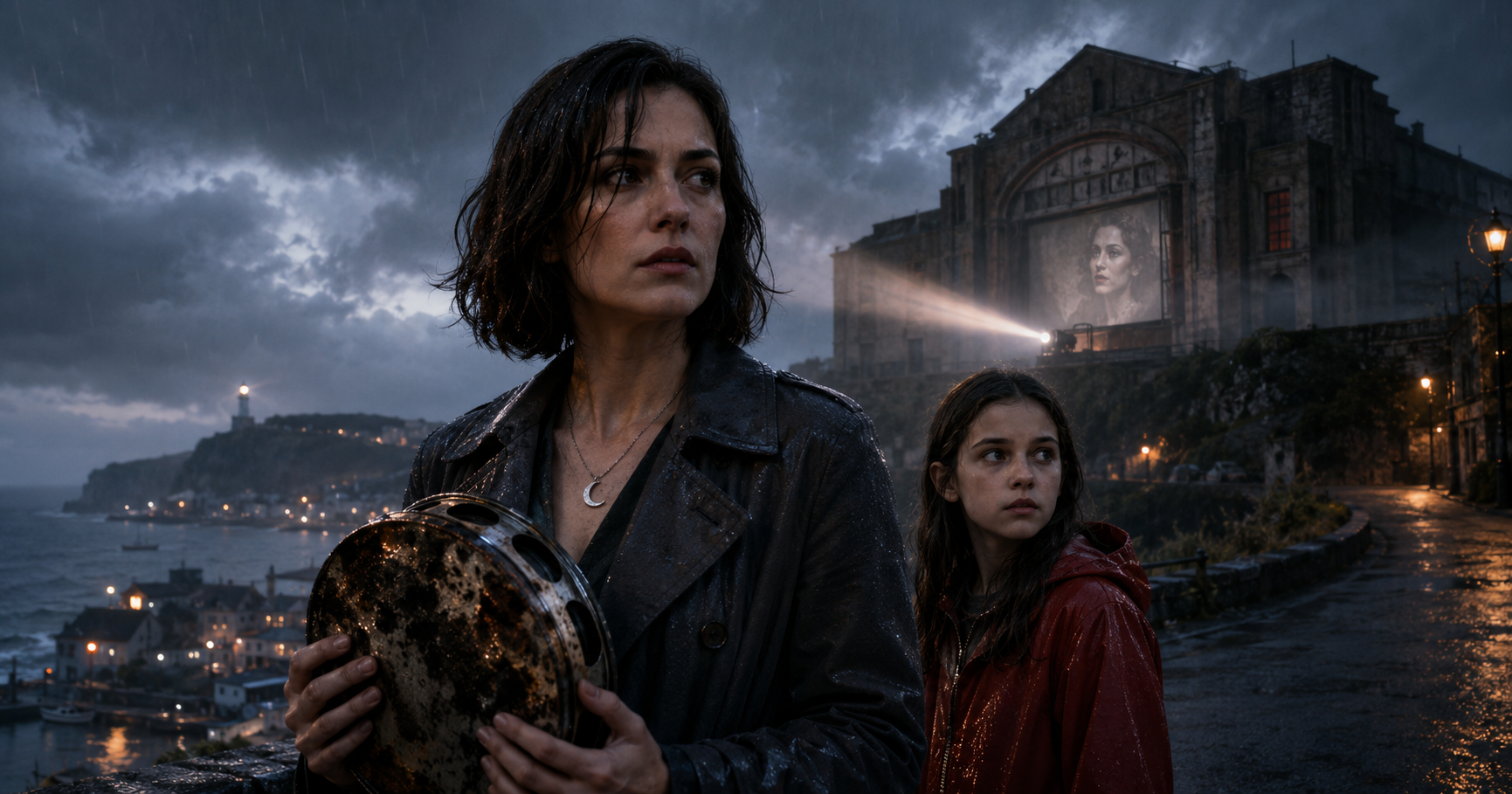
Mara Voss returned to Blackwater Bay on the evening the town decided to erase her childhood.
Rain floated above the harbor in silver sheets, soft enough to look harmless and persistent enough to soak through wool. Fishing boats rocked behind the seawall. The old ferry terminal groaned whenever the wind pressed against its windows. Beyond the wet roofs, on the highest street in town, the Voss Picture House stood beneath a web of scaffolding.
By midnight, the demolition order would become permanent.
By sunrise, the first machines would arrive.
Mara had come to sign the papers.
She crossed the terminal with a leather document case beneath one arm and her phone pressed to her ear.
“I am walking there now,” she said.
Her uncle’s voice answered sharply.
“You should have been at the solicitor’s office twenty minutes ago.”
“My train was delayed.”
“The train was twelve minutes late. You are considerably later than that.”
Mara stopped beside the exit doors.
“Good evening to you too, Gideon.”
“This is not an evening for jokes.”
“No. It is an evening for tearing down a building that has been empty for eighteen years.”
“It is an unsafe building.”
“It was my mother’s cinema.”
A pause followed.
Gideon Voss had mastered the art of silence long before Mara had learned to recognize it as a weapon.
At last he said, “Your mother has been gone for eighteen years.”
Mara looked through the rain toward the hill.
The cinema’s tower was barely visible through the mist. Once, a blue light had revolved at its peak, sweeping across Blackwater Bay like the beam of a lighthouse. Her mother used to tell her that every person caught in the light was being invited into a story.
The light had been dark since the night Celeste Voss drowned.
“I know how long she has been gone,” Mara said.
“Then come and sign.”
The call ended.
Mara lowered the phone and touched the small silver crescent hanging at her throat. It had belonged to her mother. On the back, nearly worn smooth, were five engraved words:
When the bells ring, look up.
Mara had never understood them.
She stepped outside.
The rain struck harder immediately. People moved along the pavement with umbrellas lowered against the wind. A bus hissed at the curb. Somewhere near the harbor, a bell rang once.
Mara had taken only three steps when someone crashed into her.
A red sleeve flashed across her vision.
Her document case vanished from beneath her arm.
“Hey!”
A child ran through the crowd carrying it.
Mara reacted without thinking. She pushed past two passengers, nearly slipped on the pavement and followed the red coat toward the taxi lane.
The thief was small and fast.
“Stop!”
The child looked back.
It was a girl, perhaps eleven or twelve, with dark curls plastered against her cheeks. Fear widened her eyes, but she kept running.
She darted between two taxis.
Mara followed, anger driving away the cold.
The girl reached the far end of the terminal, where an iron fence separated the road from the harbor. Finding no exit, she turned. The document case was clutched against her chest.
Mara stopped several feet away.
“Put it down.”
The girl shook her head.
“That case contains legal documents.”
“I know.”
“You know?”
“I needed to make sure you would follow me.”
Mara stared at her.
The girl’s boots were split along the sides. Rainwater streamed from the hem of her coat. She did not look like a practiced thief. She looked terrified.
“Who are you?”
“My name is Saffy Reed.”
“Give me the case, Saffy.”
“Not until you promise you won’t sign the demolition papers.”
The anger returned.
“This is none of your business.”
“It became my business when my grandfather disappeared.”
Mara took a careful step forward.
“I don’t know your grandfather.”
“He knew your mother.”
The sounds of the terminal seemed to recede.
Mara’s hand rose unconsciously to the crescent at her throat.
Saffy noticed.
Her expression changed.
“That’s the necklace,” she whispered.
Mara stopped.
“What did you say?”
“The silver moon. He told me you would be wearing it.”
“Who told you?”
“My grandfather.”
“Where is he?”
“I don’t know.”
Saffy slowly set the document case on the wet ground. Then she reached beneath her coat and removed a round metal canister, no wider than her hand.
It was an old film can.
The metal was scratched and blackened around one edge, as though it had once been pulled from a fire.
A strip of faded tape crossed the lid.
Mara could just make out the handwriting.
For Mara, after the final bell.
She knew the shape of those letters.
The long downward stroke of the M.
The narrow loop in the r.
The way the final word tilted upward.
Her mother had written birthday cards in that hand. Shopping lists. Notes tucked beneath Mara’s pillow whenever she returned late from the cinema.
Mara looked at Saffy.
“Where did you get this?”
“My grandfather gave it to me yesterday morning.”
“That is impossible.”
“He said if anything happened to him, I had to find you before the cinema came down.”
Mara took the canister. It was colder than the rain.
“My mother died eighteen years ago.”
Saffy looked at the handwriting on the lid.
“My grandfather said that was the first lie.”
A black car turned into the taxi lane.
Saffy’s face drained of color.
“We have to go.”
The car stopped beside the curb.
Gideon Voss emerged from the rear door.
He was fifty-eight, tall and straight-backed, with iron-gray hair and the calm expression that had reassured investors, judges and newspaper editors for three decades. He wore a dark wool coat and carried no umbrella.
He looked first at Mara.
Then at the film can in her hands.
For less than a second, his composure vanished.
Saffy saw it too.
“That’s the man who came to our house,” she whispered.
Gideon approached.
“Mara, step away from the girl.”
Mara did not move.
“You know her?”
“I know that her grandfather has spent years inventing stories about our family.”
“His name is Elias Reed.”
Gideon’s jaw tightened.
“Mr. Reed worked as a projectionist. He was dismissed for theft.”
“You told me the cinema staff left after my mother died.”
“Most of them did.”
“Was Elias there the night she drowned?”
Gideon’s gaze dropped to the canister.
“Give that to me.”
Mara held it closer.
“What is on it?”
“Nothing that belongs to you.”
“My name is written on the lid.”
“That film was stolen from a private family archive.”
Saffy stepped forward.
“You searched my grandfather’s house.”
Gideon ignored her.
Mara studied his face. He still appeared calm, but his right hand had curled into a fist. A pale burn scar ran from his wrist to the base of his thumb.
She remembered seeing that scar throughout her childhood.
She remembered asking how he had received it.
A kitchen accident, he had always said.
“Mara,” he continued, “you are tired and grieving. Hand me the reel. We will discuss it privately.”
“I stopped grieving years ago.”
“No, you became good at hiding it.”
“That is not the same thing.”
His voice softened.
“Your mother was not well in the months before her death. You were too young to understand.”
“I was sixteen.”
“Then you were old enough to remember how unpredictable she had become.”
Mara remembered arguments behind closed doors.
She remembered her mother checking the locks twice each night.
She remembered Celeste waking her before dawn and asking whether Mara would be brave enough to leave Blackwater Bay forever.
She also remembered Gideon explaining afterward that grief and exhaustion had confused her.
“What happened to Elias?” Mara asked.
Gideon’s expression remained still.
“I have no idea.”
“He disappeared after giving his granddaughter this reel.”
“Perhaps he ran away from the consequences of his actions.”
Saffy lunged forward.
“My grandfather would never leave me!”
Mara caught the girl by the shoulders before she reached him.
Gideon looked toward the cinema tower.
“We have an appointment,” he said. “The solicitor is waiting.”
Mara opened her document case and removed the demolition agreement.
For eighteen years, she had allowed Gideon to manage everything connected to her mother. The memorial service. The empty coffin. The cinema accounts. The explanation that no body had been recovered because the current had carried Celeste beyond the bay.
Mara had been grateful for his certainty.
Certainty was useful when grief made every room tilt.
Now she looked at the scorched film canister and tore the demolition agreement in half.
The sound was surprisingly quiet.
Gideon’s eyes hardened.
“What are you doing?”
“Postponing our appointment.”
“The council will not grant another delay.”
“Then I should find a projector quickly.”
Mara grabbed Saffy’s hand.
They ran.
Behind them, Gideon shouted her name.
Neither looked back.
The Voss Picture House had once been the grandest building on the coast.
Now its copper roof had turned green. Salt had eaten into the stone angels above the entrance. Plywood covered the lower windows, and demolition notices fluttered across the doors.
Mara and Saffy entered through an opening in the scaffolding.
A chain secured the main entrance.
Saffy led her around the building to an alley where a drainpipe had pulled away from the wall. Behind it was a narrow wooden door almost invisible beneath layers of black paint.
“My grandfather showed me,” Saffy said.
She removed a key from her boot.
The door opened into darkness.
The smell struck Mara first: dust, wet plaster and something sweeter beneath it.
Old velvet.
The scent of the cinema seats.
Saffy switched on a small flashlight.
They passed through a storage room filled with broken frames and curled posters. Water dripped from the ceiling into rusted buckets. Their footsteps stirred pale clouds from the floor.
Mara had not entered the building since her mother’s memorial.
The memories did not arrive gently.
She saw herself at seven, asleep beneath the ticket counter while Celeste counted coins.
At ten, standing in the aisle and pretending the empty seats were an audience.
At fourteen, watching her mother dance alone in the projector beam after the final screening.
At sixteen, waiting all night for Celeste to return from the harbor.
“Where is the projector?” Saffy asked.
“Upstairs.”
They entered the auditorium.
Rows of red seats descended toward a torn screen. Part of the ceiling had collapsed. Rain fell through the opening and glittered in the flashlight beam.
Saffy looked around in wonder.
“My grandfather said this place was beautiful.”
“It was.”
“Why did your family close it?”
“They said nobody wanted old cinemas anymore.”
“What did your mother say?”
Mara looked toward the projection booth.
“She said people would always need a dark room where they could believe in impossible things.”
They climbed the narrow staircase.
The booth door was locked.
Mara tried Saffy’s key, but it would not turn.
“Move back.”
She struck the door with her shoulder.
Pain shot down her arm. The door held.
She tried again.
On the third impact, the rotten frame split and the door swung inward.
The projector stood beneath a gray cloth.
Unlike everything else in the cinema, it appeared untouched by decay.
Saffy pulled away the covering.
The machine had been cleaned and oiled recently.
“My grandfather was here,” she said.
Mara opened the film canister.
Inside lay a reel of sixteen-millimeter film wrapped in black paper. A small brass key rested in the center.
There was also a note.
The words had been written by Elias Reed.
The truth was never in the sea. It was in the walls.
Mara turned the note over.
Nothing.
Saffy examined the brass key.
“It’s too small for a door.”
“Maybe it opens a cabinet.”
They searched the booth.
Most of the drawers were empty. The key fit none of them.
Saffy knelt beside the projector.
“There’s a moon here.”
A crescent had been scratched into the wooden base.
Mara crouched beside her.
When the bells ring, look up.
She aimed the flashlight at the ceiling.
A brass keyhole was hidden inside an old ventilation plate.
Mara climbed onto a chair and inserted the key.
Something clicked behind the wall.
A section of wooden paneling shifted open.
Inside was a second projector.
Smaller.
Newer.
Connected to a battery and a digital conversion unit.
A green light blinked on the side.
Saffy smiled for the first time.
“My grandfather built this.”
Mara found an empty spindle and began threading the film. Her hands remembered the process even after eighteen years: feed reel, guide rollers, sound head, gate, take-up reel.
Celeste had taught her.
Never pull the film, her mother used to say. Guide it. Stories resist force.
Mara closed the gate.
The projector came to life.
Light struck the damaged screen below.
For several seconds, only dust and scratches appeared.
Then a woman stepped into the frame.
Mara forgot to breathe.
Celeste Voss sat in an unfamiliar room before a plain blue curtain.
Her hair was shorter. Silver touched her temples. A faint scar crossed her chin.
She was older than she had been on the night of her supposed death.
Much older.
A handwritten date appeared briefly on a board beside her.
The recording had been made nine years after the drowning.
Celeste looked directly into the camera.
“If you are watching this, Mara, Elias kept his promise.”
Her voice filled the empty auditorium.
Mara gripped the projector table.
Saffy reached for her hand.
Celeste continued.
“I need you to understand one thing before you hear anything else. I did not abandon you.”
Mara’s knees weakened.
“I wanted to take you with me. I had a bag packed. I had two train tickets and enough money to keep us safe for perhaps a month. Gideon discovered the tickets before I could reach you.”
The picture jumped.
A burn scar flashed across the film.
“He told me that if I spoke publicly, you would be charged as my accomplice. You were sixteen. I believed him because he had already forged documents in my name. Medical evaluations. Bank transfers. Letters that made me appear unstable.”
Mara remembered Gideon’s words at the terminal.
Your mother was not well.
Celeste lowered her eyes.
“Our family fortune was built on the redevelopment of the northern harbor. The official records say the residents sold their homes willingly. They did not. Fires were set in six buildings. Insurance companies paid. The land was cleared. Gideon arranged the contracts, but he was not acting alone.”
The projector clicked steadily.
“I found the original ledgers in the cinema office. Names, dates, payments and photographs. I planned to take everything to a journalist in the capital.”
Celeste paused.
“Someone warned Gideon.”
Saffy whispered, “Who?”
On the screen, Celeste seemed almost to hear her.
“The night I was supposed to leave, Gideon brought me to the harbor. He forced me onto a boat. He said I would sign a statement admitting fraud and disappear quietly. We struggled. A fuel lamp fell. The cabin caught fire.”
Mara looked at Gideon’s scar in her memory.
The kitchen accident.
“Elias pulled me from the water,” Celeste said. “The newspapers were already reporting my death by morning. Gideon had prepared the story before the boat ever left the harbor.”
The film trembled in the gate.
“I wanted to come home. Elias begged me to wait. He believed Gideon would hurt you if I returned without proof. We hid the ledgers inside the cinema walls and arranged to expose everything.”
Celeste’s voice broke.
“But Gideon found us again.”
The picture disappeared.
White light filled the screen.
“No,” Mara whispered.
The reel continued spinning, but the remaining film had been cut away.
Saffy inspected the loose end.
“Someone removed the rest.”
A sound came from below.
The auditorium doors opened.
Footsteps entered the darkness.
Mara switched off the projector.
A man’s voice echoed through the cinema.
“You have something that belongs to me.”
Gideon.
Saffy tightened her grip on Mara’s hand.
Another set of footsteps followed him.
Then another.
He had brought security men.
“You know the building better than they do,” Mara whispered. “Is there another way out?”
“My grandfather showed me a tunnel under the stage.”
“Go.”
“I’m not leaving you.”
“You are finding Elias.”
Saffy’s eyes shone with anger and fear.
“How?”
“The note said the truth was in the walls. Your grandfather left clues for us. The rest of that film is somewhere inside this building.”
A flashlight beam swept across the projection booth window.
Gideon called again.
“Mara, this has gone far enough.”
She opened the booth door and stepped onto the narrow balcony.
Gideon stood in the center aisle beneath the broken ceiling. Two men waited behind him.
“You knew she survived,” Mara said.
His face was half-hidden in darkness.
“I knew she escaped the boat.”
“You declared her dead.”
“She chose not to return.”
“You threatened me.”
“I protected you.”
“From what?”
“From becoming like her.”
Mara descended the stairs one step at a time.
“Like my mother?”
“Obsessed. Reckless. Unable to understand that families such as ours survive only because unpleasant decisions are made quietly.”
“You burned people from their homes.”
“I was twenty-nine years old and following instructions.”
“Whose instructions?”
Gideon looked toward Saffy.
“Take the girl outside.”
One of the security men moved forward.
Saffy ran.
She slipped through a side curtain and disappeared behind the screen.
The man followed.
Mara stepped into Gideon’s path.
He caught her wrist.
“Listen to me,” he said. “Your mother destroyed herself chasing a truth that changed nothing. Do not repeat her mistake.”
“Where is she?”
Gideon’s grip tightened.
“Gone.”
“That is not an answer.”
“It is the only answer you need.”
Behind the screen, something heavy crashed.
Gideon glanced toward the sound.
Mara twisted free and ran down the aisle.
The second security man caught the back of her coat. She tore one arm from the sleeve and kept moving.
Saffy appeared beside the stage.
“This way!”
They climbed through a gap in the screen.
The space behind it was filled with ropes, ladders and fragments of painted scenery. Saffy pulled open a trapdoor.
They dropped into a narrow passage beneath the stage.
A wooden beam blocked the door behind them.
“Will that hold?” Mara asked.
“No.”
They hurried through darkness.
At the end of the passage stood an iron cabinet.
A crescent had been painted above the lock.
Mara tried the brass key.
It opened.
Inside were dozens of film canisters.
Photographs.
Ledgers wrapped in waxed cloth.
And a small portable recorder with a red light blinking.
Mara pressed the playback button.
Elias Reed’s voice emerged through static.
“Saffy, I am sorry.”
The girl covered her mouth.
“If you are hearing this, Gideon found me before I could finish transferring Celeste’s final testimony. Do not come to the house. Do not go to the police station. The deputy chief has been receiving Voss money for years.”
Saffy began to cry silently.
“I moved the last reel to the safest place I could think of. Celeste always said a secret shown to one person can be buried again. A secret shown to an entire town becomes history.”
Mara looked at the projector cables running through the cabinet wall.
“The bell tower,” she said.
Saffy stared at her.
“What?”
“The cinema light used to project across the town square. During festivals, they showed films on the outside wall.”
A distant bell rang.
Eight o’clock.
Across the street, the annual Founders’ Dinner would be beginning inside the town hall. Business owners, council members, journalists and nearly every influential family in Blackwater Bay would be gathered there.
Elias had not hidden the last film.
He had prepared a premiere.
They carried the reels up a service staircase toward the tower.
Heavy footsteps followed below.
The final door opened onto the cinema roof.
Wind struck them with enough force to make Saffy stumble. Mara caught her.
At the center of the roof stood the old projection lantern, repaired and connected to a modern battery. Its lens faced the white stone wall of the town hall.
A reel was already loaded.
Saffy found a control box beneath a waterproof cover.
There was only one switch.
Mara looked at the clock tower above the harbor.
The minute hand moved toward twelve.
Nine o’clock.
The first bell rang.
Gideon burst through the roof door.
“Do not touch that switch.”
The second bell rang.
Saffy placed her hand over it.
Gideon stepped forward.
“You have no idea what is on that film.”
The third bell.
Mara moved between him and Saffy.
“I know my mother made it.”
“She was angry.”
“She had every right to be.”
“She was prepared to destroy this family.”
“She was trying to expose it.”
The fourth bell.
Gideon’s face twisted.
“You think the town will thank you? Hundreds of people depend on Voss companies. Shops, boats, construction crews, the hospital foundation. Truth does not feed families.”
The fifth bell.
“Neither do lies,” Mara said. “They only decide which families are allowed to matter.”
The sixth bell.
Gideon reached inside his coat.
Mara tensed.
He removed a silver lighter.
The seventh bell.
“You always wondered how I burned my hand,” he said.
He flicked the lighter open.
The flame bent in the wind.
The eighth bell.
Saffy pulled the switch.
The projector roared to life.
Gideon lunged toward the reel.
Mara struck his arm. The lighter flew across the roof and vanished over the edge.
A beam of white light cut through the rain.
On the wall of the town hall, forty feet high, Celeste Voss appeared.
Guests began pouring out of the building.
Voices rose from the square.
Gideon stared at the enormous image of his sister.
Celeste spoke.
“My name is Celeste Voss. If this recording is being shown publicly, then my brother has failed to erase me.”
Gideon went still.
The film showed photographs of burned apartment buildings. Ledgers. Payments. Signed orders.
Faces in the square turned toward Gideon on the cinema roof.
Celeste continued.
“Gideon carried out the crimes, but our father designed them. Nathaniel Voss believed fear was simply another form of property. He taught his son to enforce it and his daughter to remain silent.”
Mara felt tears mixing with the rain.
“I refused,” Celeste said. “For that refusal, I lost my name, my home and my child.”
Gideon grabbed Mara by the shoulders.
“You have to stop this.”
She looked into his face.
For the first time, he did not resemble the powerful man who had controlled every difficult moment of her life.
He looked frightened.
“You spent eighteen years turning her into a ghost,” Mara said. “Tonight she gets a voice.”
Below them, someone shouted that the police were coming.
Gideon laughed bitterly.
“The local police belong to us.”
“Not all of those people are local.”
He looked toward the square.
Several national news crews had attended the Founders’ Dinner. Cameras were now aimed at the cinema and at Celeste’s projected testimony.
The film reached its final minutes.
Celeste leaned closer to the camera.
“Mara, there is something I could not trust to paper.”
Mara forgot Gideon.
She looked up.
“I am alive.”
The square became silent.
“I have lived under another name because Gideon promised that returning would place you in danger. For years, I believed distance was the only protection I could give you. I know now that silence protected only him.”
Celeste held up a railway timetable.
“If you choose to find me, listen for the station where the sea cannot be heard, but the bells still follow the tide. Elias knows the rest.”
The picture faded.
The projector beam remained.
Gideon released Mara.
Behind them, Saffy gasped.
A figure stood in the roof doorway.
Elias Reed leaned against the frame. Blood darkened one side of his shirt, and a rope still hung from one wrist.
“Grandpa!”
Saffy ran to him.
He collapsed to his knees as she embraced him.
“I told you not to come looking for me,” he said weakly.
“You also told me never to trust instructions given by frightened adults.”
Despite everything, he laughed.
Mara hurried to them.
“Where is my mother?”
Elias looked at the projection on the town hall wall.
“Safe, the last time I heard from her.”
“That could have been years ago.”
“Six weeks.”
Mara’s heart struck painfully against her ribs.
“You spoke to her six weeks ago?”
“She was waiting to see whether you would sign the demolition order.”
“Why?”
“Because if you signed, she would know Gideon still controlled the story.”
Mara looked at the torn papers scattered somewhere near the ferry terminal.
“And because I refused?”
Elias nodded.
“She asked me to give you a choice.”
Sirens approached from several directions.
This time Gideon looked genuinely confused.
Elias smiled.
“I did not call the local police.”
Federal investigators entered the roof with members of the harbor authority behind them.
Gideon did not resist when they took him.
He only looked at Mara and said, “You have destroyed everything.”
Mara watched Celeste’s face disappear as the reel ended.
“No,” she replied. “I stopped helping you preserve it.”
Near dawn, Mara sat inside the projection booth with a blanket around her shoulders.
Elias had been taken to the hospital. His injuries were serious but not life-threatening. Saffy had refused to leave him and was now asleep in a chair beside his bed.
The cinema remained standing.
The demolition order had been suspended. Investigators filled the hidden archive room, photographing ledgers and sealing film cans inside evidence boxes.
Mara sat alone before the projector.
Her phone rested on the table.
Elias had given her the name of a railway station in the mountains, hundreds of miles from Blackwater Bay. Celeste had collected mail from a box there six weeks earlier.
It was not an address.
It was only a beginning.
Mara touched the silver crescent at her throat.
Her phone rang.
The number was hidden.
For several seconds she could not move.
Then she answered.
“Hello?”
Static whispered across the connection.
A woman breathed on the other end.
Her voice, when it came, was older than the one Mara remembered and softer than the voice on the film.
But Mara knew it.
“Did the bells ring?” the woman asked.
Mara closed her eyes.
Outside, the first gray light of morning entered through the broken roof.
“Yes,” she whispered.
“Did you look up?”
“I did.”
A quiet sob crossed the distance between them.
Mara gripped the phone with both hands.
“Mom?”
“I’m here.”
Mara had imagined this moment in a thousand different ways during the years after the drowning.
She had imagined accusations.
Questions.
Anger sharp enough to cut through bone.
Instead, only one sentence found its way out.
“I thought you chose to leave me.”
Celeste was silent for a moment.
“I chose whatever kept you alive. I was not always right about what that meant.”
“Where are you?”
“I can tell you now.”
Mara looked through the booth window at the empty auditorium.
Rainwater shone on the red seats. Dust moved through the first beam of sunlight. The old screen hung torn and colorless, waiting for another story.
“No,” Mara said.
Her mother’s breathing stopped.
Mara smiled through her tears.
“Don’t tell me over the phone. Stay where you are.”
“Mara—”
“I’m coming to you.”
“You don’t know what you’ll find.”
“I’ve spent eighteen years living with what I couldn’t find.”
She stood and placed her hand on the projector.
“I’m done being afraid of the truth.”
Beyond the cinema walls, Blackwater Bay was waking.
Shop doors opened.
Boats left the harbor.
People gathered in the square beneath the blank wall where Celeste’s face had appeared.
The town had not collapsed beneath the weight of the truth.
It had simply become a different town.
“Mara,” Celeste whispered.
“Yes?”
“I watched every film you made.”
Mara bowed her head.
“You saw them?”
“Every one.”
“Why didn’t you contact me?”
“Because Gideon watched you too.”
Mara thought of the career opportunities her uncle had arranged, the contracts he had reviewed and the cities he had encouraged her to visit. What she had mistaken for support had also been surveillance.
“He can’t watch me anymore,” she said.
“I know.”
“How?”
“I saw the projection.”
Mara turned toward the window.
From the cinema roof, the entire harbor was visible.
So were the hills beyond it.
“Are you in Blackwater Bay?”
“No.”
“But you saw it?”
“Elias arranged a live camera in the square. He said if the truth finally appeared on that wall, I deserved to witness it.”
Mara laughed and cried at the same time.
“That sounds like him.”
“He was always too dramatic.”
“He worked in a cinema.”
“So did I.”
The old familiarity in her mother’s reply shattered the final distance between past and present.
For the first time, Mara understood that reunion would not repair eighteen missing years in a single moment. There would be explanations that hurt, memories that contradicted each other and questions with no satisfying answers.
But there would also be tomorrow.
Tomorrow had once seemed impossible.
Now it was waiting.
“I’ll take the morning train,” Mara said.
“I’ll be at the station.”
“How will I recognize you?”
Celeste laughed softly.
“You will.”
The call ended.
Mara remained beside the projector until sunlight filled the auditorium.
Then she descended the stairs, crossed the ruined lobby and opened the cinema’s front doors.
A crowd waited outside.
Reporters raised microphones. Neighbors called her name. Investigators carried boxes through the scaffolding. Across the street, someone had placed flowers beneath the wall where Celeste’s testimony had been shown.
Mara stepped into the morning.
Above her, the cinema tower was still dark.
She looked at the rusted mechanism that had once turned the blue lamp.
It would need new wiring.
New glass.
Perhaps an entirely new motor.
But it could be repaired.
Some things could not be restored to what they had been.
That did not mean they had to remain broken.
Mara turned toward the railway station.
Behind her, high above Blackwater Bay, the final bell began to ring.

