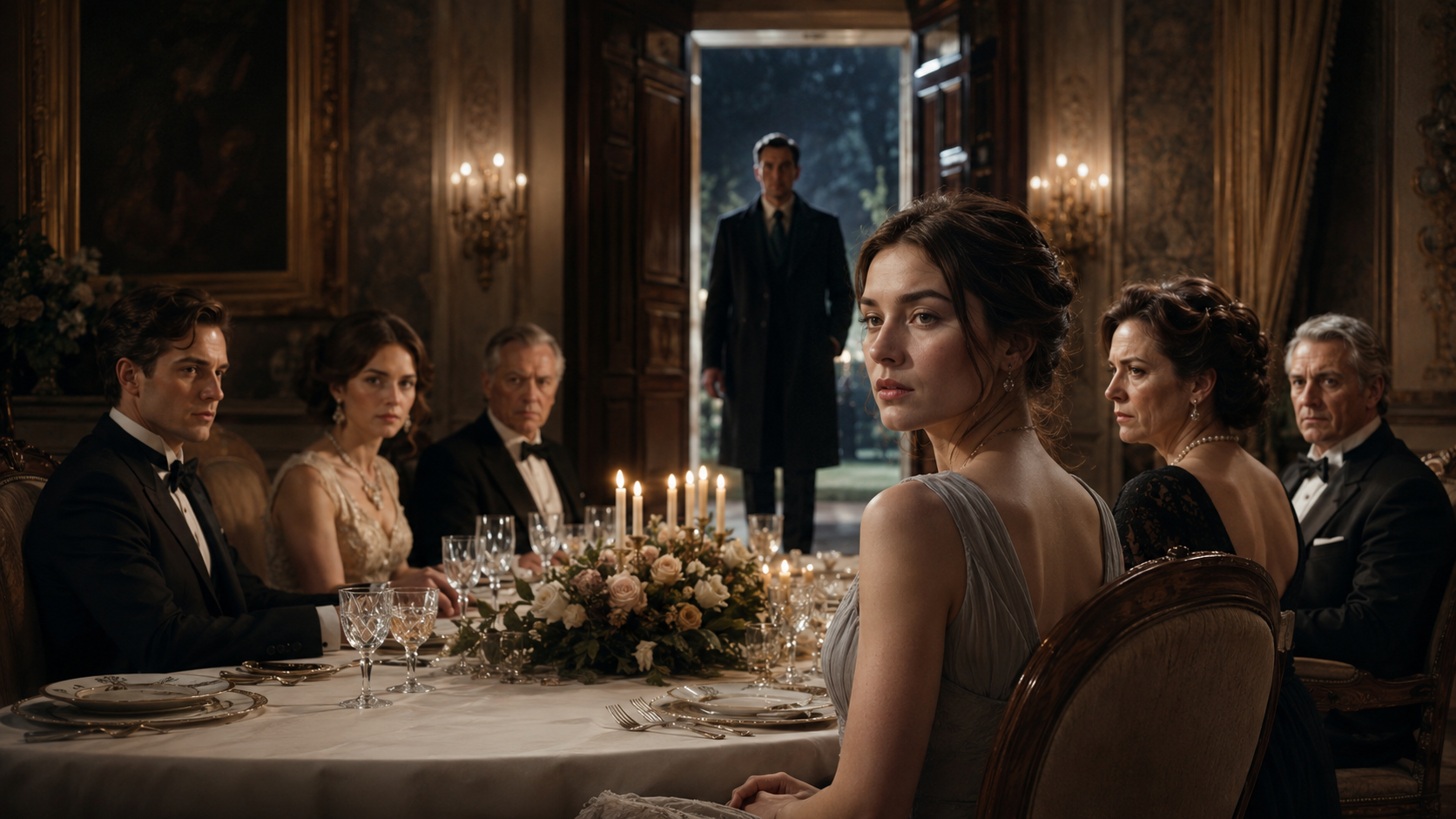
Elias did not look at him.
His eyes were fixed on Nora’s bleeding mouth.
The room seemed to grow colder.
“Clearly,” Elias said, “I arrived just in time.”
Vivienne recovered first. “This is a private family dinner.”
Elias walked closer.
“No,” he said. “This is a crime scene with candles.”
A guest gasped.
Adrian pushed his chair back. “Watch how you speak in this house.”
One of Elias’s men looked at Adrian.
Adrian sat down again.
Elias stopped beside Nora.
For the first time that night, someone looked at her as if she were not furniture, not an inconvenience, not a stain on the family portrait.
He removed a white handkerchief from his pocket and held it out.
Nora did not take it at first.
She knew better than to accept gifts from dangerous men.
Elias seemed to understand.
He placed it gently beside her plate instead.
Then he turned toward the table.
“I came for the watch.”
Celeste’s fingers tightened around the velvet box.
Marcus frowned. “The watch?”
Elias held out his hand.
No one moved.
His voice dropped. “Now.”
Marcus slowly lifted the box and placed it in Elias’s palm.
Elias opened it, studied the watch, then pressed the latch. The tiny bird rose, delicate and shining.
For a moment, something almost sorrowful crossed his face.
“Exquisite,” he said.
Celeste swallowed. “I restored it.”
Elias looked at her.
“No.”
The single word silenced everything.
Celeste’s lips parted.
Elias turned the watch over, opened the back plate with a small tool one of his men handed him, and angled the inner hinge toward the chandelier.
“There,” he said.
Marcus stood slowly.
He saw the mark.
N.C.
Nora closed her eyes.
Not because she was relieved.
Because being believed so late felt less like justice than another wound.
Vivienne’s mouth hardened. “Anyone could have marked it.”
Elias smiled without warmth. “You are right. That is why I brought more than a mark.”
He snapped his fingers.
One of his men placed a leather folder on the table.
Elias opened it and removed photographs.
Nora’s studio. The watch in pieces. Nora’s hands holding the mechanism. Notes written in her precise script. Dates. Receipts. Sketches.
Then another photograph.
Celeste entering Nora’s studio at 2:13 in the morning.
Another.
Celeste leaving with the velvet box.
Marcus turned toward Celeste. “Tell me that isn’t true.”
Celeste’s tears returned. “I only borrowed it. I wanted tonight to be perfect.”
Nora laughed once.
The sound was small and broken.
Vivienne pointed at her. “Do not mock your sister.”
Elias’s hand came down on the table.
Not loudly.
But every glass trembled.
“You still don’t understand,” he said. “The watch is only the thread. I followed it here because it was attached to a much older lie.”
Roland’s face drained of color.
Vivienne took one step back.
Elias noticed.
“So you do remember.”
Nora looked between them.
“Remember what?”
No one answered.
Elias removed another document from the folder.
It was a yellowed police report.
Nora saw the date and felt the room tilt.
Fourteen years ago.
The fire.
Her lungs seemed to close.
She was eleven again, barefoot on winter marble, smoke pouring beneath a nursery door, Celeste screaming in the hallway, Adrian coughing, her mother shouting, and Roland nowhere to be found.
For years the story had been told one way.
Celeste had saved a child from the fire in the east wing.
Nora had frozen.
Nora had panicked.
Nora had been useless.
After that night, Celeste became the family miracle.
Nora became the family disappointment.
Elias placed the report on the table.
“The official statement says Celeste Carrow rescued my nephew from the east wing nursery.”
Vivienne whispered, “This is unnecessary.”
Elias’s eyes cut to her. “You sold me a lie about the night my sister died. I decide what is necessary.”
The guests began to murmur.
Nora’s pulse roared in her ears.
Elias continued. “My sister, Mara Voss, was employed here under a false name. She was protecting my nephew from men who wanted to use him against me. The fire was not an accident. It was set by someone looking for documents hidden in the nursery wall.”
Roland gripped the back of his chair.
Elias glanced at him. “Yes, Roland. We found the payments.”
Roland’s knees nearly buckled.
Vivienne turned on him. “You said that was buried.”
The words left her mouth before she could stop them.
The room went dead silent.
Elias smiled.
“There it is.”
Nora stared at her parents.
“What did you do?”
Vivienne looked at Nora then, and for the first time in Nora’s life, there was no performance left in her mother’s face.
Only panic.
Elias opened another envelope.
Inside was a photograph, smoke-stained and creased.