Her friends stopped calling.
Gala committees replaced her.
That wounded her more than any legal notice.
People like Marjorie can survive guilt.
They cannot survive becoming irrelevant.
Nearly two years after the airport, Marjorie asked to meet Lila.
Gideon refused at first.
Lila surprised him.
“I’ll hear her.”
“You owe her nothing.”
“I know,” Lila said. “That is why it will be my choice.”
They met in a quiet café in Albany.
Gideon sat nearby, close enough to intervene, far enough away to let Lila own the moment.
Marjorie looked older. Not ruined. Not poor. But stripped of the stage lighting she had always carried with her. Her pearls were smaller. Her posture remained perfect. Her eyes were tired.
For a long time, she said nothing.
Then she whispered, “I was cruel to you.”
Lila waited.
“I told myself I was defending Rowan’s legacy. The truth is, I resented you because he loved you without asking us for permission.”
Lila’s fingers tightened around her cup.
“He loved all of you too.”
“I know,” Marjorie said. “But with us, he was always negotiating. With you, he was free.”
That hurt because Lila knew it was true.
Marjorie’s eyes filled.
“I wanted to punish you for having the part of him I could not control.”
Lila looked out the window. Snow drifted over the sidewalk.
“You punished my son.”
Marjorie flinched.
“Yes.”
“That is the part I cannot make gentler for you.”
“I know.”
“Do you?”
Marjorie nodded, crying now.
“I see him sometimes in photographs. At foundation events. He looks so much like Rowan. And I remember his face that day when the guards carried your suitcases down the stairs. He asked if he could bring his dinosaur.”
Lila closed her eyes.
Marjorie covered her mouth.
“I told him no.”
That detail was new.
Lila’s face tightened.
Marjorie whispered, “I am sorry.”
Lila drew a slow breath.
“I believe you are sorry now. But my forgiveness is not a doorway back into his life.”
Marjorie nodded.
“You may write him a letter. I will keep it. When he is older, if he chooses to read it, he can. Until then, you do not get access to him simply because guilt finally found you.”
Marjorie cried harder.
Lila stood.
“Goodbye, Marjorie.”
When Lila walked back to Gideon, he rose.
“Are you all right?”
She nodded.
Then she said, “I am not the woman she put on that plane anymore.”
Gideon looked at her with pride so deep it nearly hurt.
“No,” he said. “You are not.”
Years passed.
Finn grew tall, curious, and stubborn like his father. He loved airplanes, dinosaurs, and asking impossible questions at impossible times.
He carried the Vale name, but Lila never let him believe it made him better than anyone.
That was her rule.
A name was not a crown.
It was a responsibility.
On the fifth anniversary of Rowan’s death, the foundation held a memorial event at an Air Force museum in Dayton. Families of fallen service members filled the hall. Children ran between display aircraft. Widows held one another without needing to explain a thing.
Lila stood at the podium with Finn beside her.
Gideon sat in the front row.
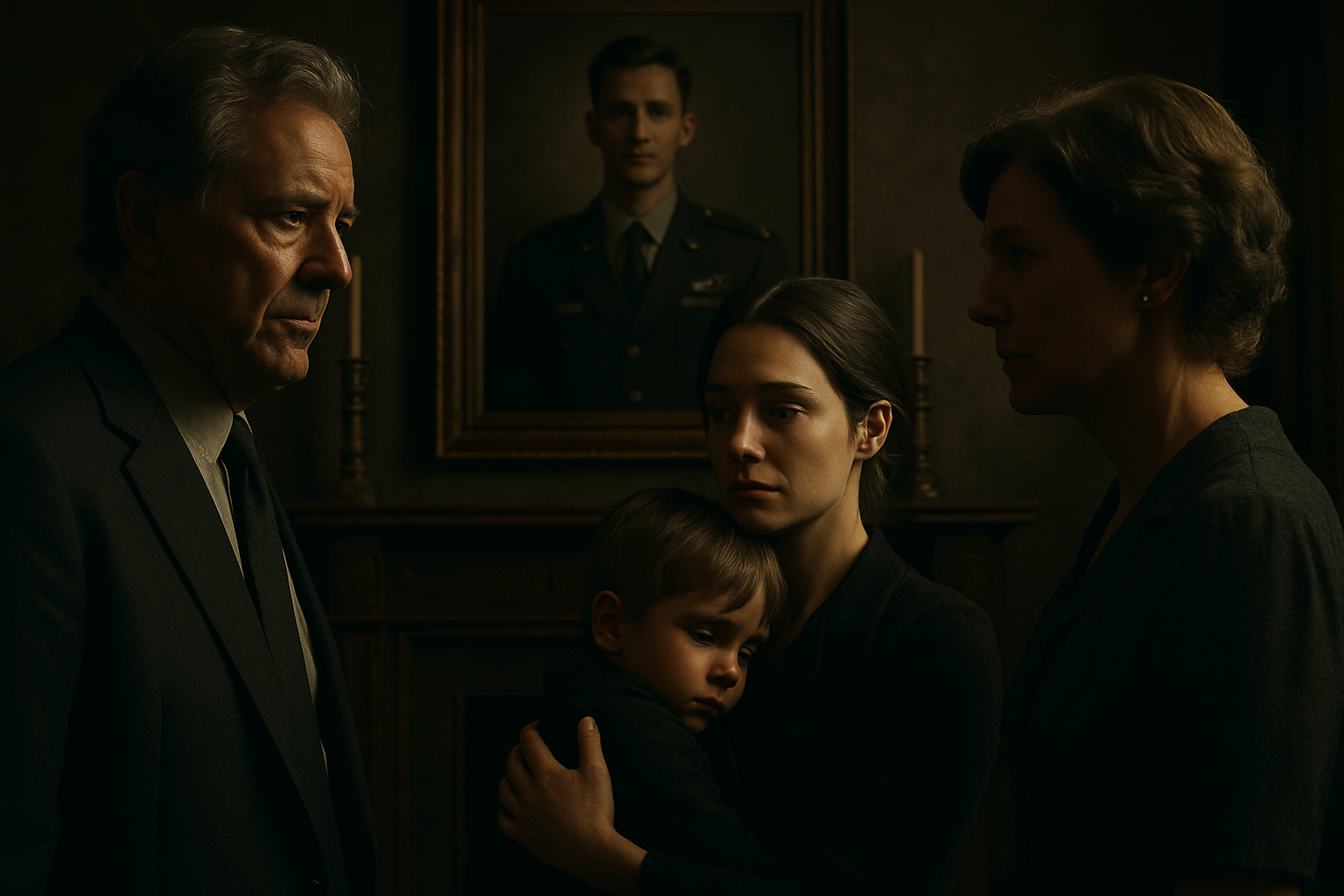
Behind them was a large photograph of Rowan in uniform.
Lila looked out over the room.
“After my husband died,” she said, “someone told me my son and I no longer belonged to his family. For a little while, I believed her. Grief can make you believe terrible things about your own worth.”
The hall went quiet.
“But one person found us at an airport and reminded me that family is not decided by the cruelest voice in the room. Family is proven by who comes for you when you have nowhere else to go.”
Gideon looked down, his eyes wet.
Lila rested her hand on Finn’s shoulder.
“This program exists so no surviving spouse, no child, no parent, no family left behind after service ever has to beg for belonging. If someone served, if someone loved them, if someone was left carrying the grief, then they matter.”
Applause rose slowly, then filled the room.
Finn leaned toward the microphone.
“My dad flew planes,” he said.
The crowd softened.
“And my mom says he made sure we always had a home.”
Lila covered her mouth.
Gideon stood with everyone else, clapping through tears.
That night, after the event, Gideon and Lila walked outside while Finn slept in the back seat of the car, holding the same green dinosaur he had kept since the airport.
The air was cold and clear.
Gideon looked at Lila.
“I never thanked you.”
“For what?”
“For staying.”
Lila seemed surprised.
“You gave us a home.”
“No,” Gideon said. “Rowan did that. I only enforced what he left behind. You stayed when this family gave you every reason to disappear.”
She looked through the car window at her sleeping son.
“I stayed because Finn deserved to know where his father came from.”
Gideon nodded.
“And because you belonged.”
Lila smiled softly.
“I know that now.”
A year later, Marjorie died quietly after a brief illness.
She had spent her final years far from society rooms, volunteering at a veterans’ hospice under her middle name, where almost no one knew who she had once been.