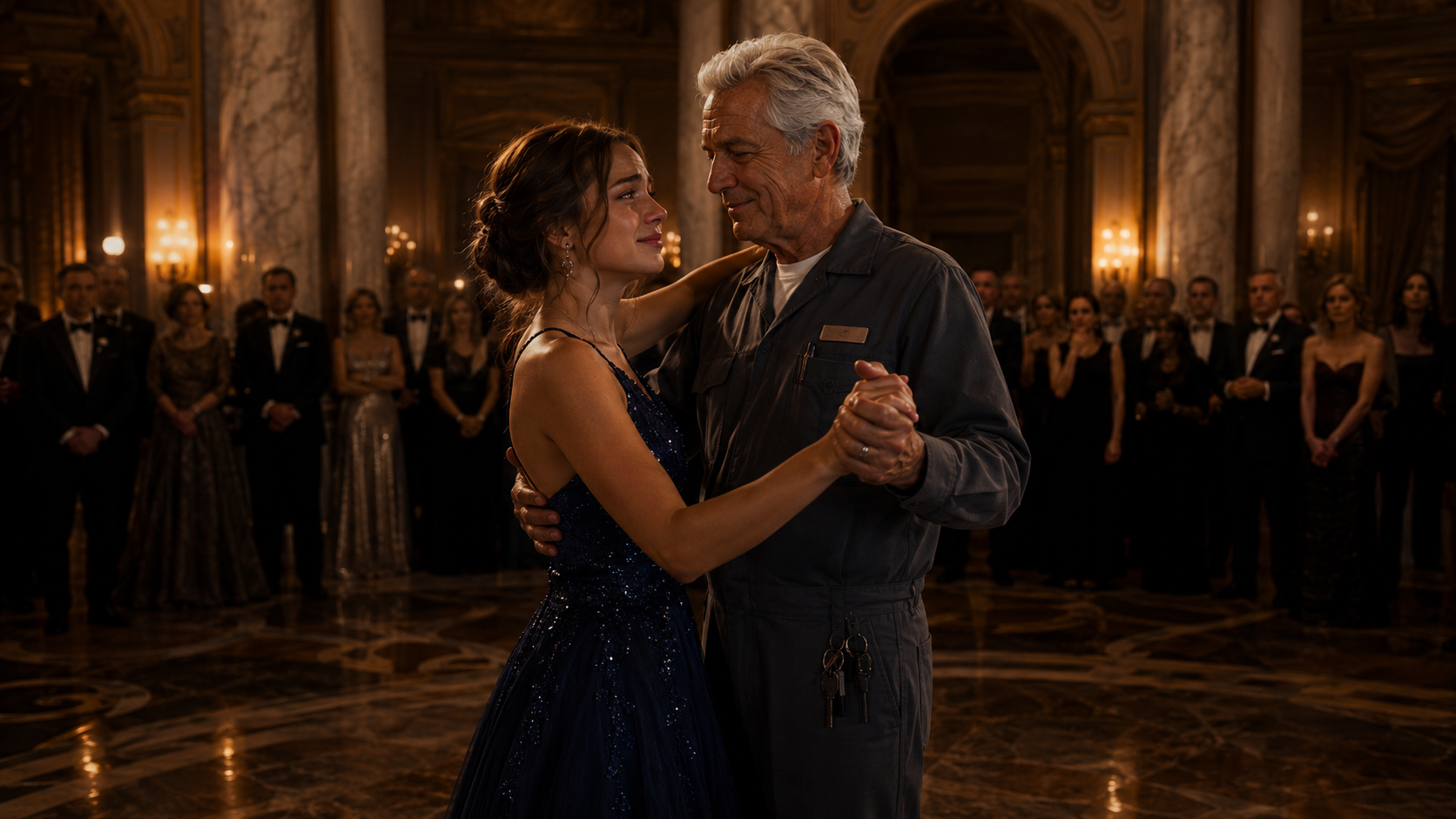
The Dance That Silenced the Ballroom

The Grand Aurelia Hotel had hosted royal receptions, political victories, and weddings expensive enough to become newspaper stories. Its central ballroom was famous for its crystal ceiling, marble columns, and chandeliers that scattered warm golden light across the polished floor.

On the final Saturday of November, the hotel welcomed nearly four hundred guests for the Winter Hearts Gala, an annual charity event attended by business leaders, celebrities, and old families whose names appeared on buildings throughout the city.

Everything had been designed to impress.

A string orchestra performed beneath an arch of white roses. Waiters moved between the tables carrying silver trays. Cameras flashed near the entrance as elegantly dressed couples paused beside the marble staircase.

At the center of it all stood twenty-eight-year-old Celeste Armand.

She wore a midnight-blue gown with a narrow silver ribbon around her waist. Her dark hair was pinned above her shoulders, and a small diamond pendant rested against her throat. To anyone watching, she appeared calm and completely in control.

Only her younger brother, Noah, noticed how tightly she held the event program.

“You’re going to tear it,” he whispered.

Celeste looked down and realized that the paper had folded beneath her fingers.

“I’m fine.”

“You’ve said that six times tonight.”

“Then perhaps you should start believing me.”

Noah smiled, but Celeste did not.

Across the ballroom, her fiancé, Marcus Vale, was speaking with his father and several members of the gala committee. Marcus was tall, confident, and perfectly suited to the expensive black tuxedo he wore. He moved through rooms as though every door had been built specifically for him.

Their wedding was only three weeks away.

The city’s social pages had already described it as the union of two respected families. Marcus came from wealth, while Celeste had built her reputation through work. She was the youngest director in the history of the Aurelia Foundation and the person responsible for transforming the Winter Hearts Gala from a formal dinner into the city’s most successful charity event.

Few people in the ballroom knew that Celeste had grown up in a small apartment above a repair shop.

Even fewer knew that her father was working in the building that night.

His name was Daniel Armand.

He was sixty-one years old, with silver at his temples and deep lines around his eyes. He wore the gray uniform of the hotel’s maintenance department and carried a ring of keys at his belt.

Daniel had spent most of the afternoon repairing a faulty lighting panel behind the ballroom. He had been asked to remain nearby in case the chandeliers failed during the event.

Celeste had known he would be there.

She had not told Marcus.

Daniel stood behind a service door and watched his daughter through its narrow glass window. He saw her greeting donors, directing staff members, and smiling for photographs. Pride filled his face, but he did not enter the ballroom.

He understood that Celeste belonged to a different world now.

Years earlier, she had asked him not to visit her office wearing his work clothes. She had apologized afterward, but the memory had remained between them like a locked door.

Daniel had never blamed her.

He knew how hard she had fought to escape the assumptions people made about children from their neighborhood. He knew that she had learned to hide every sign of uncertainty because the people around her treated weakness as permission to dismiss her.

Still, he missed the daughter who had once danced with him in their kitchen.

When Celeste was a child, Daniel would push the table against the wall and turn on an old radio. They had no proper dance floor, but he taught her how to follow the music.

“Don’t count every step,” he used to tell her. “Listen first. Your feet will understand.”

Celeste’s mother, Isabelle, would stand near the stove and laugh as they moved between the chairs.

Those evenings ended after Isabelle became ill.

She died when Celeste was sixteen.

After the funeral, the radio remained silent for years.

A sudden burst of applause pulled Daniel back to the present. Marcus had stepped onto the ballroom stage.

He adjusted the microphone and smiled at the audience.

“Ladies and gentlemen, thank you for joining us tonight. Because of your generosity, the Winter Hearts Foundation will be able to support more families than ever before.”

More applause followed.

Marcus spoke with polished ease, thanking sponsors and introducing important guests. Then he looked toward Celeste.

“And none of this would have been possible without the extraordinary woman who organized tonight’s event.”

The spotlight found her.

Celeste smiled as the guests applauded again.

“My future wife, Celeste Armand.”

Marcus extended his hand, and she joined him on the stage.

He kissed her cheek.

“You look nervous,” he murmured without moving his smile.

“I’m not.”

“Good. My father invited several journalists. Tonight matters.”

“I know that.”

Marcus turned back to the audience.

“Celeste has spent her entire life proving that our beginnings do not have to define our future.”

The sentence sounded complimentary, but something in his tone made Celeste uncomfortable.

Marcus continued.

“She came from circumstances very different from those many of us have known. Yet through ambition, discipline, and good judgment, she has earned her place among us.”

A few guests nodded approvingly.

Celeste’s smile remained in place, but her eyes changed.

Among us.

The phrase lingered in the ballroom.

Behind the service door, Daniel lowered his gaze.

Marcus had never met him properly. Their only encounter had happened months earlier, when Daniel arrived at Celeste’s apartment carrying a wooden music box that had belonged to Isabelle.

Marcus had mistaken him for a deliveryman.

Celeste had corrected him, but the embarrassment on her face had hurt Daniel more than the mistake itself.

After the speeches, the orchestra began a slow waltz. Couples entered the center of the ballroom.

Marcus led Celeste onto the floor.

“You could have chosen your words more carefully,” she said quietly.

“What words?”

“About my beginnings.”

“It was meant as praise.”

“It sounded as though I had been admitted into a private club.”

Marcus smiled toward a nearby camera.

“Please don’t create a problem where there isn’t one.”

Celeste looked at him.

“You always say that when the problem belongs to someone else.”

Before he could answer, the ballroom lights flickered.

The chandeliers dimmed, brightened, and then dimmed again.

Several guests gasped.

From behind the service door, Daniel moved immediately. He opened the electrical cabinet and examined the control system. One of the main connections had overheated.

He reached for his tools.

Inside the ballroom, the orchestra stopped.

Marcus released Celeste’s hand and looked toward the ceiling.

“This is unacceptable,” he said.

A hotel manager hurried across the floor.

“We’re addressing it, Mr. Vale.”

“You assured us the system had been inspected.”

“It was. Our technician is working on it now.”

“Which technician?”

The manager hesitated.

“Daniel Armand.”

Marcus turned toward Celeste.

“Armand?”

She did not answer quickly enough.

“Your father works here?”

“He works for the hotel’s engineering department.”

“And you didn’t think that was worth mentioning?”

“This is not the time.”

Marcus lowered his voice.

“You knew he would be here tonight?”

“Yes.”

“Why didn’t you tell me?”

Celeste stared at him in disbelief.

“Because I knew you would react exactly like this.”

Marcus looked toward the service entrance.

“A maintenance worker wandering into the ballroom during our gala would attract attention.”

“Our gala?”

“You know what I mean.”

“No,” Celeste said. “I don’t think I do.”

Before Marcus could respond, the service door opened.

Daniel entered the ballroom carrying a small tool case. He had expected to speak only with the manager, but hundreds of faces turned toward him.

Whispers moved between the tables.

Daniel stopped.

Celeste felt the old instinct rise inside her—the instinct to explain, soften, and protect the image she had spent years creating.

Then she saw her father’s expression.

He was not ashamed of his uniform.

He was ashamed that his presence might cause trouble for her.

That realization struck her harder than anything Marcus had said.

Daniel approached the manager.

“The western circuit has overheated. I need to shut down the main ballroom lights for approximately ten minutes.”

“Ten minutes?” Marcus asked sharply.

Daniel turned toward him.

“If I leave the current running, the entire system could fail.”

“Can’t you repair it without turning everything off?”

“No.”

Marcus sighed.

“Of course not.”

Celeste stepped between them.

“He knows what he’s doing.”

Marcus gave her a warning look.

“I didn’t suggest otherwise.”

“You didn’t have to.”

The orchestra conductor approached and asked whether the musicians should leave the stage.

Daniel looked toward the smaller emergency lights along the walls.

“They’ll remain on. The room won’t be completely dark.”

The manager nodded.

“Do it.”

Daniel returned to the electrical panel.

A moment later, the chandeliers went dark.

Soft amber lamps illuminated the edges of the ballroom. Without the bright lights, the enormous room became intimate and strangely beautiful. The crystal decorations above the dance floor reflected the emergency lamps like distant stars.

The guests began speaking more loudly, filling the interruption with restless conversation.

The orchestra conductor raised his hands.

“We can continue acoustically,” he announced.

The musicians began playing without electronic amplification. The music was quieter now, but warmer. Every violin note seemed to travel directly through the room.

Daniel completed the temporary repair and closed his tool case.

As he crossed the ballroom toward the service entrance, a familiar melody emerged from the orchestra.

He stopped.

It was an old waltz called “When the Rain Returns.”

Isabelle had loved it.

She and Daniel had danced to it on the night they became engaged. Years later, he had taught Celeste the same steps in their kitchen.

Celeste recognized the music too.

For a moment, the crowded ballroom disappeared. She could almost see the small apartment, the worn wooden floor, and her mother leaning against the stove with flour on her hands.

Daniel looked at his daughter.

Their eyes met across the room.

Celeste did not know what made her move.

Perhaps it was the music.

Perhaps it was the darkness.

Perhaps she had simply become tired of pretending that the most important parts of her life were details that needed to be hidden.

She walked away from Marcus.

“Celeste,” he said.

She continued toward her father.

The guests watched as the woman in the midnight-blue gown crossed the elegant ballroom and stopped before the maintenance worker in gray.

Daniel looked uncertain.

“Is something wrong?”

Celeste held out her hand.

“Dance with me.”

The surrounding conversations began to fade.

Daniel glanced at his uniform.

“I’m working.”

“You taught me never to refuse this song.”

“That was a long time ago.”

“I still remember.”

Marcus approached them.

“Celeste, think about what you’re doing.”

She turned to him.

“For the first time tonight, I am.”

His expression hardened.

“This is a formal charity gala, not a family performance.”

Daniel stepped back.

“It’s all right. I should return to work.”

Celeste caught his hand.

“No, Dad.”

The word carried through the quieting ballroom.

Dad.

Some guests looked toward Marcus. Others watched Daniel.

Celeste placed one hand on her father’s shoulder.

“Please,” she whispered.

Daniel studied her face. He saw the little girl from the kitchen, the grieving teenager after Isabelle’s funeral, and the determined young woman who had left home carrying two suitcases and more courage than money.

Then he put down his tool case.

He rested one hand lightly at her back and took her other hand in his.

“Listen first,” he said.

Celeste’s eyes filled with tears.

“Your feet will understand.”

They began to move.

The first steps were careful. Celeste had not danced the old waltz in years, but her body remembered its pattern.

Daniel guided her through a slow turn.

The gray fabric of his uniform moved beside the dark blue of her gown. They should have appeared mismatched beneath the crystal ceiling, yet somehow they became the most natural pair in the room.

The orchestra played more softly.

Daniel led Celeste forward, then released her into a graceful spin. Her skirt opened like a circle of midnight around her.

When she returned to him, she was smiling.

Not the controlled smile she used for donors and cameras.

It was the open, unguarded smile she had worn as a child.

The ballroom gradually became silent.

Even the waiters stopped moving.

Daniel’s posture changed as the music continued. The tired maintenance worker disappeared, revealing the young man he had once been—the man who had met Isabelle at a neighborhood dance hall and crossed the room because she was the only woman laughing when everyone else was trying to look sophisticated.

He guided Celeste through another turn.

This one was faster.

A murmur of surprise moved through the audience.

Celeste followed perfectly.

Her father lifted her hand, and she circled him before stepping back into his arms. Their movements were not designed to impress. They carried no dramatic tricks and required no stage.

They were simply dancing with the absolute trust of two people who had once known each other better than anyone in the world.

At the edge of the floor, Noah wiped his eyes.

Marcus remained motionless.

His father leaned toward him.

“Stop this.”

“How?”

“Get her off the floor.”

Marcus looked around and realized that every guest was watching.

A photographer raised his camera, then slowly lowered it.

The moment felt too private to steal.

The melody approached its final passage.

Daniel’s steps became slower.

“I’m sorry,” Celeste whispered.

“For what?”

“For making you feel that I was ashamed of you.”

Daniel’s expression softened.

“You were trying to build a life.”

“I built one that required me to hide where I came from.”

“You never had to hide it from me.”

“I know.”

They turned beneath the unlit chandeliers.

Celeste looked at him through her tears.

“I wish Mom could see us.”

Daniel smiled.

“She can.”

On the final note, he guided Celeste into the same gentle turn he had taught her when she was eight years old.

She returned to him, and he kissed her forehead.

For several seconds, no one made a sound.

The ballroom was completely silent.

Then Noah began to clap.

A woman near the orchestra joined him. Another guest rose from his chair. Within moments, the entire ballroom was standing.

The applause became thunderous.

Daniel looked overwhelmed.

Celeste embraced him.

The chandeliers suddenly came back to life, flooding the ballroom with gold.

This time, Daniel did not retreat toward the shadows.

Celeste took his hand and led him toward the main table.

Marcus intercepted them.

“You’ve made your point,” he said.

Celeste looked at him calmly.

“This was never about making a point.”

“You embarrassed me in front of everyone.”

“I danced with my father.”

“You turned a respected event into a spectacle.”

“No. You turned my family into something I was expected to conceal.”

Marcus glanced at Daniel.

“This is a private conversation.”

Daniel released Celeste’s hand.

“I’ll give you some space.”

She stopped him.

“You don’t have to leave.”

Then she turned back to Marcus.

“My father spent years repairing buildings so Noah and I could study. He worked nights after my mother became ill. He sold the only car he had to pay my university fees. Every opportunity I have began with something he sacrificed.”

Marcus’s jaw tightened.

“I never insulted him.”

“You were embarrassed by his existence.”

“That’s unfair.”

“Is it?”

Several guests nearby pretended not to listen.

Marcus lowered his voice.

“We are getting married in three weeks. Do you really want to destroy our future because you became emotional during a song?”

Celeste looked at the diamond ring on her hand.

For months, she had ignored small moments that made her uncomfortable. Marcus corrected the way she spoke about her childhood. He discouraged Noah from visiting without notice. He had suggested that Daniel attend the wedding as an ordinary guest rather than walk Celeste down the aisle because the photographs would look “more balanced” with Marcus’s father beside her.

Celeste had accepted each wound separately.

Now she saw them together.

She removed the ring.

Marcus stared at it.

“Don’t be ridiculous.”

“I have spent too many years becoming someone other people would approve of.”

She placed the ring in his palm.

“I will not spend the rest of my life doing it.”

“Celeste.”

She closed his fingers around the ring.

“Our wedding is canceled.”

A shocked whisper passed through the nearest tables.

Marcus’s face became pale.

“You’ll regret this.”

Celeste looked at her father, her brother, and the ballroom filled with people who had finally seen her clearly.

“No,” she said. “I think I would have regretted marrying you.”

She walked away.

Daniel followed her into a quiet corridor beyond the ballroom. Noah joined them a moment later.

For several seconds, none of them spoke.

Then Noah laughed.

Celeste stared at him.

“What is funny?”

“You canceled the most expensive wedding in the city while standing beside a broken lighting panel.”

Daniel tried not to smile.

“It isn’t broken anymore.”

That made Celeste laugh too.

The sound surprised her. It grew until she was crying and laughing at the same time.

Daniel placed his arms around both of his children.

“I’m sorry about the wedding,” he said.

“I’m not,” Celeste answered.

“You might be tomorrow.”

“Then remind me of tonight.”

Daniel looked through the open ballroom doors. The orchestra had started another song, and couples were returning to the dance floor.

“I think tonight is going to be difficult to forget.”

Three months later, Celeste left the Aurelia Foundation.

The decision surprised the board, but she no longer wanted a career built around gaining approval from people who measured human value by wealth, family names, or invitations.

She created a smaller organization in an unused community theater near the neighborhood where she had grown up. Its purpose was simple: to provide music, dance, and arts programs for children whose families could not afford private lessons.

Noah managed the finances.

Daniel repaired the theater.

On opening night, they placed Isabelle’s old music box in the lobby inside a glass case. Beneath it was a small card containing the only words Celeste wanted displayed:

Listen first.

Your feet will understand.

At the end of the evening, after the families had gone home and the children had stopped running across the stage, Celeste found her father sweeping the wooden floor.

She took the broom from his hands.

“The work can wait.”

Daniel heard the opening notes of “When the Rain Returns” coming from a small speaker beside the stage.

He shook his head.

“Again?”

“You’re the one who taught me never to refuse this song.”

Daniel offered her his hand.

This time there were no chandeliers, wealthy guests, cameras, or formal gowns.

There was only an old theater, a worn wooden floor, and the music that had carried their family through love, grief, silence, and forgiveness.

They began to dance.

And there was no one left for Celeste to impress.

The Dance That Silenced the Ballroom
Bra-less news anchors cause heated debate