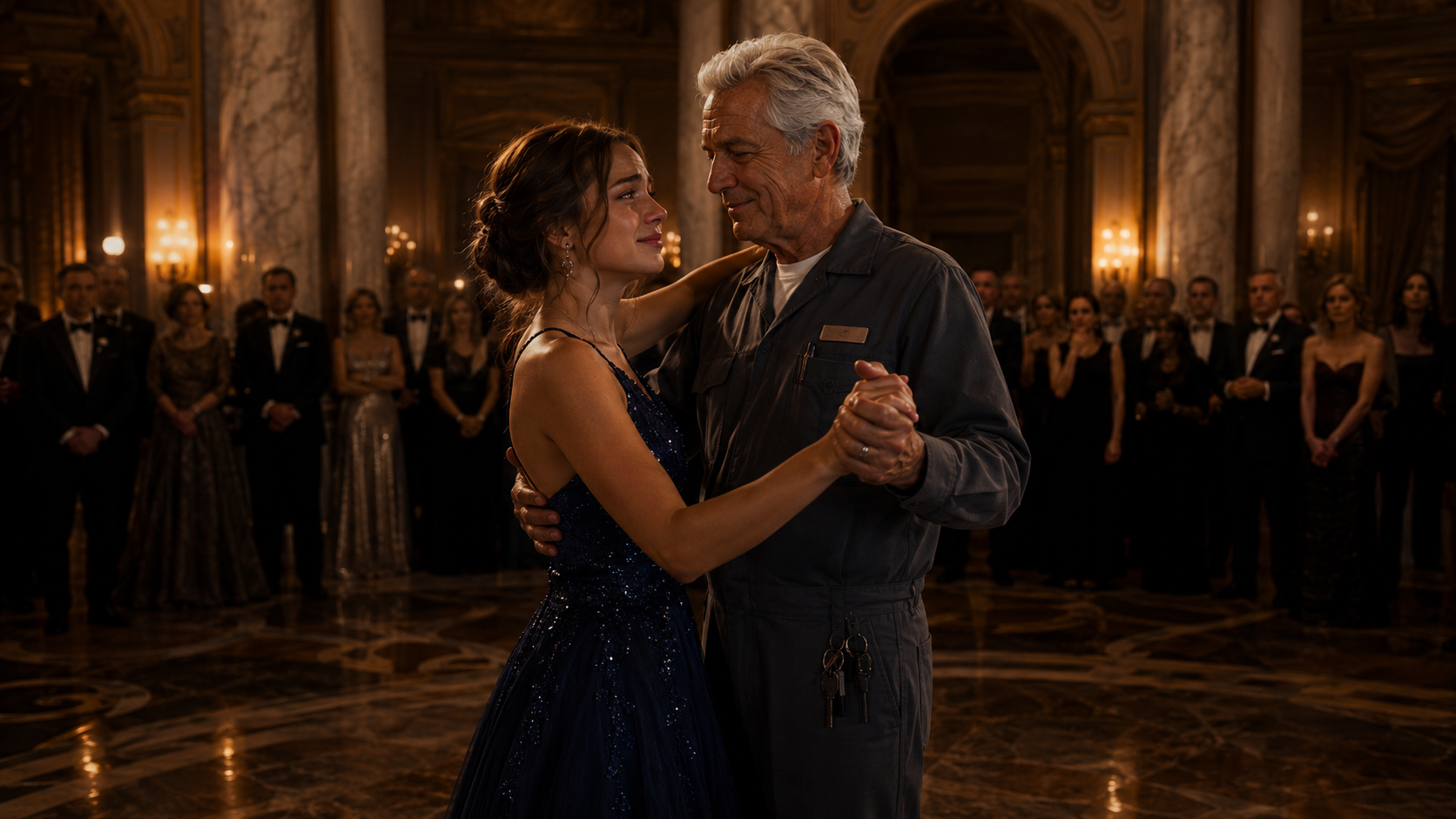
He kissed her cheek.
“You look nervous,” he murmured without moving his smile.
“I’m not.”
“Good. My father invited several journalists. Tonight matters.”
“I know that.”
Marcus turned back to the audience.
“Celeste has spent her entire life proving that our beginnings do not have to define our future.”
The sentence sounded complimentary, but something in his tone made Celeste uncomfortable.
Marcus continued.
“She came from circumstances very different from those many of us have known. Yet through ambition, discipline, and good judgment, she has earned her place among us.”
A few guests nodded approvingly.
Celeste’s smile remained in place, but her eyes changed.
Among us.
The phrase lingered in the ballroom.
Behind the service door, Daniel lowered his gaze.
Marcus had never met him properly. Their only encounter had happened months earlier, when Daniel arrived at Celeste’s apartment carrying a wooden music box that had belonged to Isabelle.
Marcus had mistaken him for a deliveryman.
Celeste had corrected him, but the embarrassment on her face had hurt Daniel more than the mistake itself.
After the speeches, the orchestra began a slow waltz. Couples entered the center of the ballroom.
Marcus led Celeste onto the floor.
“You could have chosen your words more carefully,” she said quietly.
“What words?”
“About my beginnings.”
“It was meant as praise.”
“It sounded as though I had been admitted into a private club.”
Marcus smiled toward a nearby camera.
“Please don’t create a problem where there isn’t one.”
Celeste looked at him.
“You always say that when the problem belongs to someone else.”
Before he could answer, the ballroom lights flickered.
The chandeliers dimmed, brightened, and then dimmed again.
Several guests gasped.
From behind the service door, Daniel moved immediately. He opened the electrical cabinet and examined the control system. One of the main connections had overheated.
He reached for his tools.
Inside the ballroom, the orchestra stopped.
Marcus released Celeste’s hand and looked toward the ceiling.
“This is unacceptable,” he said.
A hotel manager hurried across the floor.
“We’re addressing it, Mr. Vale.”
“You assured us the system had been inspected.”
“It was. Our technician is working on it now.”
“Which technician?”
The manager hesitated.
“Daniel Armand.”
Marcus turned toward Celeste.
“Armand?”
She did not answer quickly enough.
“Your father works here?”
“He works for the hotel’s engineering department.”
“And you didn’t think that was worth mentioning?”
“This is not the time.”
Marcus lowered his voice.
“You knew he would be here tonight?”
“Yes.”
“Why didn’t you tell me?”
Celeste stared at him in disbelief.
“Because I knew you would react exactly like this.”
Marcus looked toward the service entrance.
“A maintenance worker wandering into the ballroom during our gala would attract attention.”
“Our gala?”
“You know what I mean.”
“No,” Celeste said. “I don’t think I do.”
Before Marcus could respond, the service door opened.
Daniel entered the ballroom carrying a small tool case. He had expected to speak only with the manager, but hundreds of faces turned toward him.
Whispers moved between the tables.
Daniel stopped.
Celeste felt the old instinct rise inside her—the instinct to explain, soften, and protect the image she had spent years creating.
Then she saw her father’s expression.
He was not ashamed of his uniform.
He was ashamed that his presence might cause trouble for her.
That realization struck her harder than anything Marcus had said.
Daniel approached the manager.
“The western circuit has overheated. I need to shut down the main ballroom lights for approximately ten minutes.”
“Ten minutes?” Marcus asked sharply.
Daniel turned toward him.
“If I leave the current running, the entire system could fail.”
“Can’t you repair it without turning everything off?”
“No.”
Marcus sighed.
“Of course not.”
Celeste stepped between them.
“He knows what he’s doing.”
Marcus gave her a warning look.
“I didn’t suggest otherwise.”
“You didn’t have to.”
The orchestra conductor approached and asked whether the musicians should leave the stage.
Daniel looked toward the smaller emergency lights along the walls.
“They’ll remain on. The room won’t be completely dark.”
The manager nodded.
“Do it.”
Daniel returned to the electrical panel.
A moment later, the chandeliers went dark.
Soft amber lamps illuminated the edges of the ballroom. Without the bright lights, the enormous room became intimate and strangely beautiful. The crystal decorations above the dance floor reflected the emergency lamps like distant stars.
The guests began speaking more loudly, filling the interruption with restless conversation.
The orchestra conductor raised his hands.