“That wasn’t my question.”
Caleb stared at the floor.
“There was a woman.”
Nora’s stomach tightened.
“What woman?”
“I couldn’t see her face. She was sitting against the wall. When I came closer, she told me to take the baby.”
“Why didn’t you tell me?”
“She made me promise.”
“Caleb, where is she now?”
“I don’t know.”
“You left her there?”
“She said she was going to lead them away.”
“Lead who away?”
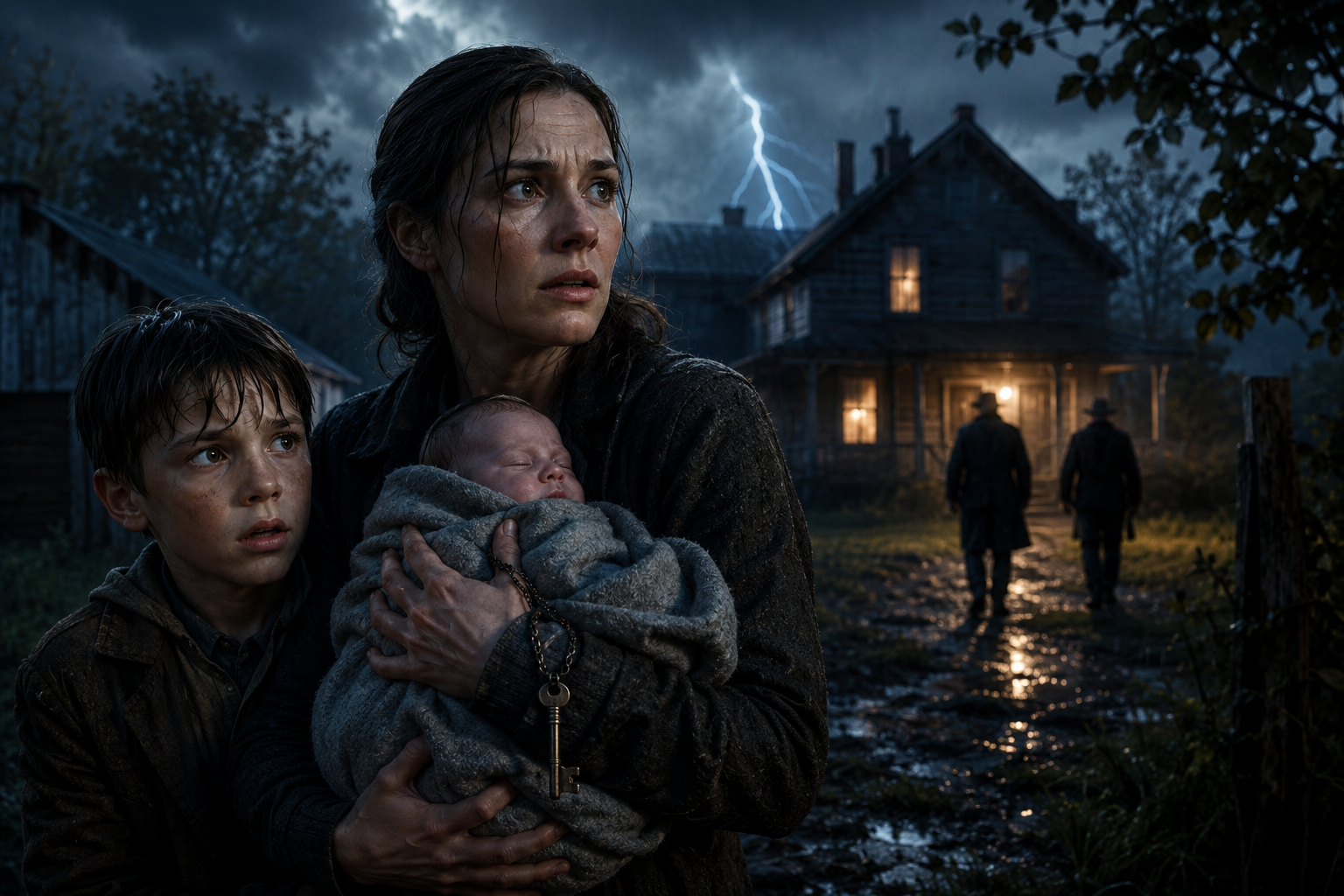
Before Caleb could answer, three knocks sounded at the front door.
Not loud.
Not hurried.
Three slow, deliberate knocks.
Caleb moved closer to Nora.
“Is it her?”
Nora handed him the baby.
“Stay here.”
She took the iron poker from beside the stove and entered the hall.
The knocking came again.
“Nora Whitmore?” a man called from outside.
She did not answer.
“We know you’re in there.”
Caleb whispered from the kitchen.
“Mom.”
Nora motioned for him to remain silent.
Another voice spoke outside, quieter than the first.
“We’re looking for a young woman. She may have crossed your land.”
Nora approached the door but did not unlock it.
“Who are you?”
There was a pause.
“County officers.”
“Show me your badges through the window.”
Neither man moved toward the window.
Instead, the first voice said, “Open the door and we’ll explain.”
Nora tightened her grip on the poker.
“The road is flooded. No county vehicle could have reached this house.”
Silence followed.
Then a fist struck the door so hard that dust fell from the frame.
“Open it.”
Caleb gasped.
Nora backed away.
The baby started crying again.
The men outside stopped moving.
“They heard,” Caleb whispered.
The door handle turned.
Once.
Twice.
Then someone threw his weight against the wood.
The lock held, but the frame groaned.
Nora ran back into the kitchen.
“Cellar,” she said. “Now.”
Caleb clutched the infant.
“What about you?”
“I’ll be right behind you.”
Nora opened the cellar door and lit a second lamp. Beneath the stairs was a narrow passage that led to the old preserving room.
Her father had built the room during years when thieves regularly targeted isolated farms. Behind its shelves was a hidden exit opening near the orchard wall.
Caleb started down the steps.
“Take the baby and wait by the hidden door.”
“Where are you going?”
“To find out why that key was brought here.”
Another impact shook the front of the house.
Nora ran to the closet, pulled the old desk away from the wall, and found the row of numbered drawers.
Twenty-seven was at the bottom.
She slipped the blackened key into the lock.
It turned smoothly.
Inside the drawer lay a photograph, a sealed envelope and a small cassette recorder.
The photograph showed Nora’s father standing beside a younger man in front of the old cider shed. Between them was a girl of about sixteen.
Nora recognized the girl.
It was her older sister, Elise.
But that was impossible.
Elise had disappeared twenty-two years earlier. The family had been told that she had run away. Nora’s father had spent years pretending not to care, though Nora often heard him walking through the house late at night.
The envelope was addressed to Nora.
She tore it open.
My dearest Nora,
If this drawer has been opened, then someone has finally returned the key.
I have lied to you for most of your life.
Elise did not run away. She discovered that a private clinic outside the county was arranging illegal adoptions. Young mothers were pressured into surrendering their children, and records were altered so no one could trace them.
The clinic paid local officials to remain silent.
Elise tried to expose them.
When they learned what she knew, I sent her away under another name. I told you she had abandoned us because I believed anger would hurt you less than fear.
I was wrong.
The cider shed became our meeting place. Drawer twenty-seven held the evidence she collected, but I moved it when I realized the house might be searched.
Elise kept the only key.
If the key returns, trust the person carrying it.
Nora read the final line twice.
The pounding at the front door stopped.
That frightened her more than the noise had.
She lifted the cassette recorder and pressed the play button.
Static filled the closet.
Then her father’s voice spoke from the tiny speaker.
“Nora, there are names in the recording. Judges, doctors, deputies and families who believed they were adopting legally. Some were guilty. Some were deceived. Elise knows which is which. If she comes back, protect her. The people behind the clinic never stopped looking for what she took.”
A floorboard creaked in the sitting room.
The men were inside.
Nora switched off the recorder.
She slipped the photograph, letter and cassette into her coat and hurried toward the cellar.
A shadow moved across the hallway.