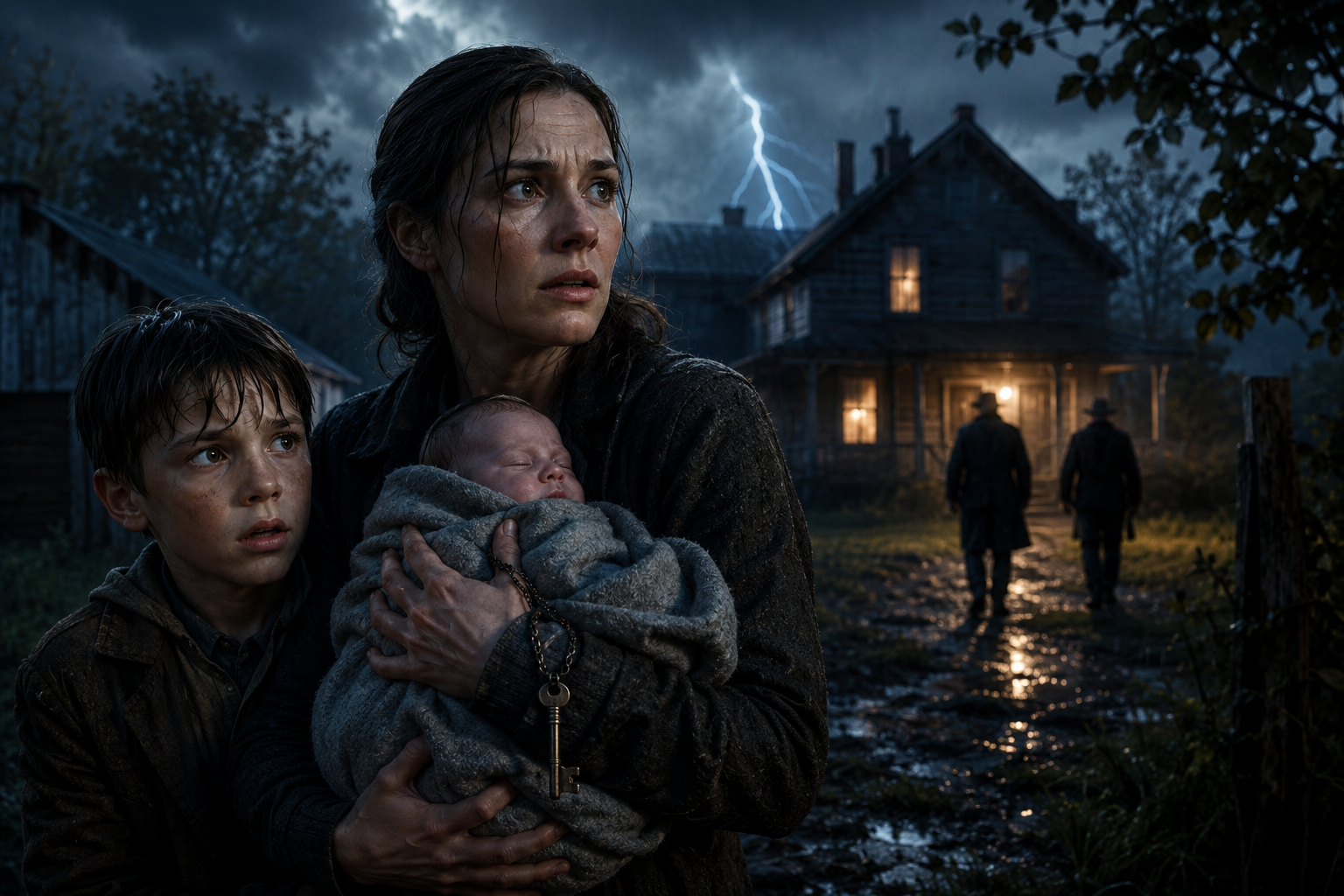
“There she is,” a man said.
Nora ran.
A hand caught the back of her coat, but she twisted free and swung the iron poker. It struck an arm with a dull crack.
The man shouted.
Nora reached the cellar door, pulled it shut behind her and dropped the wooden bar into place.
“Mom!” Caleb called from below.
“Go!”
She descended the steps as the men began kicking the cellar door.
Caleb stood near the hidden passage, the baby still wrapped against his chest.
Nora pushed aside the shelves and opened the narrow exit.
Cold rain entered the cellar.
“We’ll follow the orchard wall to the shed,” she said.
“The woman told me not to go back.”
“She was trying to protect you. Now we have to protect her.”
They crawled through the opening and emerged behind the house.
The storm had begun to move east, but rain still fell heavily. Nora took the baby while Caleb led the way through the trees.
Branches whipped at their faces. Mud pulled at their boots. Somewhere behind them, a window shattered.
The men had discovered that the cellar was empty.
They reached the cider shed minutes later.
Inside, the air smelled of wet wood and rotting apples.
A woman lay near the back wall.
Her coat was torn. Blood darkened one sleeve.
Nora held up the lamp.
The woman raised her face.
Time seemed to stop.
She was older, thinner and exhausted, but Nora recognized the shape of her eyes.
“Elise?”
The woman smiled weakly.
“You still tilt your head when you’re afraid.”
Nora nearly dropped the lamp.
She knelt beside her sister.
“You’re alive.”
“I tried to come home many times.”
“Why didn’t you?”
“Because they watched this place. They watched you.”
Nora looked at the baby.
“Is this your child?”
Elise shook her head.
“Her mother died two nights ago.”
“Who was she?”
“One of the clinic’s survivors. She had spent years searching for the daughter taken from her. When she learned the operation had started again under a different name, she stole their records.”
“And gave them to you?”
“She gave me more than records.”
Elise touched the baby’s blanket.
“This child is the granddaughter of the man who now runs the network. He wants the baby erased because her existence connects him to everything his father did.”
A vehicle engine growled outside.
Headlights swept through the gaps in the shed walls.
“They found us,” Caleb said.
Elise tried to stand but collapsed.
Nora looked around.
The shed had only one door and two narrow windows. There was nowhere to hide.
Then Caleb pointed toward the old cider press.
“Grandpa’s tunnel.”
Nora stared at him.
“What tunnel?”
“The one underneath the press. Grandpa showed me before he died. He said it was for moving barrels during winter.”
Together, they pulled aside the rotting platform. Beneath it was a wooden hatch.
Voices approached outside.
Nora opened the hatch and helped Elise into the darkness.
Caleb followed.
Nora lowered the baby into her sister’s arms, then climbed down and pulled the hatch closed above them.
The tunnel was narrow and cold, but it led beneath the orchard toward the abandoned railway station.
Behind them, boots entered the shed.
A man shouted, “Search everything.”
Nora guided her family through the darkness.
The baby remained silent, as though she understood that even a cry could betray them.
After what felt like an hour, the tunnel ended at a rusted iron door.
Nora pushed against it.
It opened into the ruins of the station’s storage room.
The storm was fading.
Beyond the broken walls, dawn was beginning to lighten the sky.
Caleb found an emergency radio inside an old maintenance cabinet. Its battery was weak, but the transmitter still worked.
Nora called the state police directly.
She did not mention the local officers.
She gave their location, described the intruders and said she possessed evidence connected to organized kidnapping and illegal adoption.
Then they waited.
The men from the farmhouse never reached the station.
Later, police found their vehicle trapped in orchard mud. One man was arrested at the wheel. The other attempted to escape across the flooded creek and was captured downstream.
The evidence on Elise’s encrypted drive led investigators far beyond the county. The network had operated under several charitable organizations, moving children between states and hiding the payments as medical expenses.
Some of the original victims were reunited with relatives.
Others finally learned the truth about what had happened to them.
The process took years.
There were trials, testimonies and long nights when Nora wondered whether opening drawer twenty-seven had saved their lives or destroyed the quiet life she once knew.
But quiet, she discovered, was not the same as peace.
Peace came later.
It came on a clear autumn morning when Elise returned to the orchard without looking over her shoulder.
It came when Caleb repaired the cider shed and painted its doors red.
It came when the baby, now named Hope, took her first steps between the apple trees.
Nora stood nearby as Hope stumbled toward Elise, laughing at the leaves beneath her shoes.
Caleb watched from the old stone wall.
“Do you ever think about that night?” he asked.
“Every day.”
“Were you afraid?”
Nora looked across the orchard, where the morning sun shone through branches heavy with fruit.
“Yes.”
“But you knew what to do.”
“No,” she said. “I simply knew who I refused to abandon.”
Hope reached Elise and raised both arms.
Elise lifted her into the air.
For more than twenty years, the old cider shed had guarded a secret built from fear, silence and regret.
Now its doors stood open.
And whenever the wind moved through the orchard, it carried no warning cries, no hidden voices and no footsteps of men coming through the rain.
Only the sound of a child laughing beneath the apple trees.