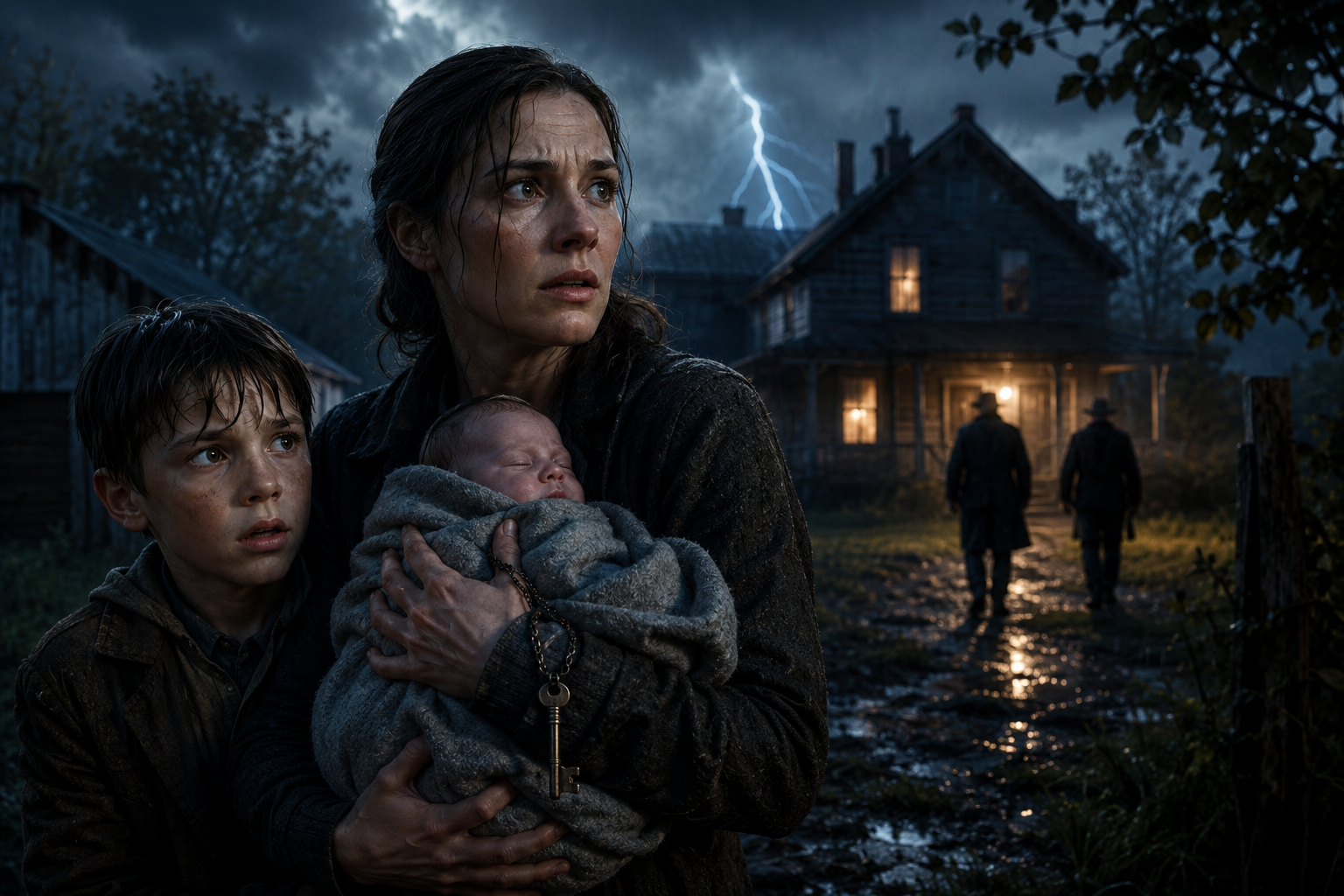
THE CRY BEYOND THE ORCHARD

The first sound came just after the storm began.

It was faint enough to be mistaken for a branch scraping against the roof, and Nora Whitmore might have ignored it if her eleven-year-old son had not suddenly stopped at the kitchen door.

Caleb stood there in a wetd. Rainwater ran from his dark hair onto his cheeks, and both of his hands were hidden beneath the front of his coat.

“Nora,” he said.

He almost never called her by her name.

Nora lowered the knife she had been using to slice bread.

“What happened?”

Caleb looked toward the hallway, as though he feared someone had followed him into the house.

“I found something.”

Thunder rolled over the hills, making the windows tremble in their frames.

Nora wiped her hands on a towel and came around the kitchen table.

“What did you find?”

Caleb slowly opened his coat.

At first, Nora saw only a bundle of gray wool. Then the bundle moved.

A small face appeared between the folds.

The baby’s skin was pale, its eyes tightly closed. A tiny mouth opened, but the sound that emerged was barely louder than a breath.

For several seconds, Nora could not move.

Then instinct took over.

She crossed the room, lifted the infant from Caleb’s arms, and pressed the child against her chest.

The baby was cold.

Not cool from the rain, but deeply cold, as though the storm had reached inside its body.

“Where?” Nora demanded. “Where did you find this baby?”

Caleb pointed toward the back of the property.

“In the old cider shed.”

The shed stood beyond the apple orchard, nearly half a mile from the farmhouse. It had not been used since Nora’s father died. Its roof leaked, its doors hung crooked, and no one had any reason to go there.

“You went all the way out there in this weather?”

“I heard crying.”

“You could have been struck by lightning.”

“I thought it was a kitten.”

The baby moved weakly against Nora.

She touched two fingers to the child’s neck and felt a rapid pulse.

“Bring every clean towel you can find,” she said. “And the blue blanket from my room.”

Caleb ran upstairs.

Nora carried the infant closer to the stove. Beneath the gray wool covering was a thin cotton gown, damp around the shoulders. There was no hat, no proper blanket and no bag of supplies.

Nothing except a narrow silver chain around the baby’s wrist.

A small key hung from it.

Nora stared at the key.

It was old, blackened around the edges and shaped like the key to a cabinet or wooden chest.

Caleb returned with the blanket.

“Is the baby going to die?”

“Not if we can help it.”

Nora wrapped the infant carefully, then reached for the telephone on the wall.

The line was dead.

She pressed the receiver button again.

Nothing.

“The storm must have taken the wires down,” she said.

“My tablet might work.”

Caleb disappeared into the sitting room and came back carrying it.

“No signal.”

A flash of lightning turned the kitchen white.

The lights went out.

For a moment, mother and son stood in complete darkness.

Then the baby began to cry.

This time, the sound was strong.

Nora released a breath she had not realized she was holding.

“That’s good,” she whispered. “Keep crying, little one.”

Caleb lit an oil lamp. The warm flame filled the kitchen with trembling shadows.

“Should we drive to town?”

“The lower bridge floods first. We would never make it across.”

“What about Mr. Danner?”

“He left for his sister’s house yesterday.”

Caleb glanced at the dark windows.

“So we’re alone.”

Nora did not answer.

She had already noticed the muddy footprint near the back door.

It was too large to belong to Caleb.

Someone else had been there.

Nora moved to the window, shielding her eyes from the reflection of the lamp. Beyond the glass, rain swept across the yard. The orchard twisted in the wind.

She saw no one.

“Caleb, lock the front door.”

He hesitated.

“Why?”

“Just do it.”

While he checked the doors, Nora examined the baby more closely. The child appeared to be only a few days old. There were no visible injuries, though one cheek was scratched.

The key around the baby’s wrist had a number scratched into its surface.

Twenty-seven.

Nora knew that number.

She looked toward the hallway.

At the far end of the house stood a narrow closet that had belonged to her father. Inside it was an old wooden desk with many small drawers. One drawer had remained locked for almost twenty years.

Drawer twenty-seven.

Her father had forbidden anyone to touch it.

After his death, Nora had searched for the key, but she never found it.

Until now.

Caleb returned.

“The doors are locked.”

Nora held up the silver chain.

“Did you put this on the baby?”

“No.”

“Was anyone in the shed?”

Caleb’s expression changed.

Nora saw it immediately.

“You said you only found the baby.”

“I did.”

“That wasn’t my question.”

Caleb stared at the floor.

“There was a woman.”

Nora’s stomach tightened.

“What woman?”

“I couldn’t see her face. She was sitting against the wall. When I came closer, she told me to take the baby.”

“Why didn’t you tell me?”

“She made me promise.”

“Caleb, where is she now?”

“I don’t know.”

“You left her there?”

“She said she was going to lead them away.”

“Lead who away?”

Before Caleb could answer, three knocks sounded at the front door.

Not loud.

Not hurried.

Three slow, deliberate knocks.

Caleb moved closer to Nora.

“Is it her?”

Nora handed him the baby.

“Stay here.”

She took the iron poker from beside the stove and entered the hall.

The knocking came again.

“Nora Whitmore?” a man called from outside.

She did not answer.

“We know you’re in there.”

Caleb whispered from the kitchen.

“Mom.”

Nora motioned for him to remain silent.

Another voice spoke outside, quieter than the first.

“We’re looking for a young woman. She may have crossed your land.”

Nora approached the door but did not unlock it.

“Who are you?”

There was a pause.

“County officers.”

“Show me your badges through the window.”

Neither man moved toward the window.

Instead, the first voice said, “Open the door and we’ll explain.”

Nora tightened her grip on the poker.

“The road is flooded. No county vehicle could have reached this house.”

Silence followed.

Then a fist struck the door so hard that dust fell from the frame.

“Open it.”

Caleb gasped.

Nora backed away.

The baby started crying again.

The men outside stopped moving.

“They heard,” Caleb whispered.

The door handle turned.

Once.

Twice.

Then someone threw his weight against the wood.

The lock held, but the frame groaned.

Nora ran back into the kitchen.

“Cellar,” she said. “Now.”

Caleb clutched the infant.

“What about you?”

“I’ll be right behind you.”

Nora opened the cellar door and lit a second lamp. Beneath the stairs was a narrow passage that led to the old preserving room.

Her father had built the room during years when thieves regularly targeted isolated farms. Behind its shelves was a hidden exit opening near the orchard wall.

Caleb started down the steps.

“Take the baby and wait by the hidden door.”

“Where are you going?”

“To find out why that key was brought here.”

Another impact shook the front of the house.

Nora ran to the closet, pulled the old desk away from the wall, and found the row of numbered drawers.

Twenty-seven was at the bottom.

She slipped the blackened key into the lock.

It turned smoothly.

Inside the drawer lay a photograph, a sealed envelope and a small cassette recorder.

The photograph showed Nora’s father standing beside a younger man in front of the old cider shed. Between them was a girl of about sixteen.

Nora recognized the girl.

It was her older sister, Elise.

But that was impossible.

Elise had disappeared twenty-two years earlier. The family had been told that she had run away. Nora’s father had spent years pretending not to care, though Nora often heard him walking through the house late at night.

The envelope was addressed to Nora.

She tore it open.

My dearest Nora,

If this drawer has been opened, then someone has finally returned the key.

I have lied to you for most of your life.

Elise did not run away. She discovered that a private clinic outside the county was arranging illegal adoptions. Young mothers were pressured into surrendering their children, and records were altered so no one could trace them.

The clinic paid local officials to remain silent.

Elise tried to expose them.

When they learned what she knew, I sent her away under another name. I told you she had abandoned us because I believed anger would hurt you less than fear.

I was wrong.

The cider shed became our meeting place. Drawer twenty-seven held the evidence she collected, but I moved it when I realized the house might be searched.

Elise kept the only key.

If the key returns, trust the person carrying it.

Nora read the final line twice.

The pounding at the front door stopped.

That frightened her more than the noise had.

She lifted the cassette recorder and pressed the play button.

Static filled the closet.

Then her father’s voice spoke from the tiny speaker.

“Nora, there are names in the recording. Judges, doctors, deputies and families who believed they were adopting legally. Some were guilty. Some were deceived. Elise knows which is which. If she comes back, protect her. The people behind the clinic never stopped looking for what she took.”

A floorboard creaked in the sitting room.

The men were inside.

Nora switched off the recorder.

She slipped the photograph, letter and cassette into her coat and hurried toward the cellar.

A shadow moved across the hallway.

“There she is,” a man said.

Nora ran.

A hand caught the back of her coat, but she twisted free and swung the iron poker. It struck an arm with a dull crack.

The man shouted.

Nora reached the cellar door, pulled it shut behind her and dropped the wooden bar into place.

“Mom!” Caleb called from below.

“Go!”

She descended the steps as the men began kicking the cellar door.

Caleb stood near the hidden passage, the baby still wrapped against his chest.

Nora pushed aside the shelves and opened the narrow exit.

Cold rain entered the cellar.

“We’ll follow the orchard wall to the shed,” she said.

“The woman told me not to go back.”

“She was trying to protect you. Now we have to protect her.”

They crawled through the opening and emerged behind the house.

The storm had begun to move east, but rain still fell heavily. Nora took the baby while Caleb led the way through the trees.

Branches whipped at their faces. Mud pulled at their boots. Somewhere behind them, a window shattered.

The men had discovered that the cellar was empty.

They reached the cider shed minutes later.

Inside, the air smelled of wet wood and rotting apples.

A woman lay near the back wall.

Her coat was torn. Blood darkened one sleeve.

Nora held up the lamp.

The woman raised her face.

Time seemed to stop.

She was older, thinner and exhausted, but Nora recognized the shape of her eyes.

“Elise?”

The woman smiled weakly.

“You still tilt your head when you’re afraid.”

Nora nearly dropped the lamp.

She knelt beside her sister.

“You’re alive.”

“I tried to come home many times.”

“Why didn’t you?”

“Because they watched this place. They watched you.”

Nora looked at the baby.

“Is this your child?”

Elise shook her head.

“Her mother died two nights ago.”

“Who was she?”

“One of the clinic’s survivors. She had spent years searching for the daughter taken from her. When she learned the operation had started again under a different name, she stole their records.”

“And gave them to you?”

“She gave me more than records.”

Elise touched the baby’s blanket.

“This child is the granddaughter of the man who now runs the network. He wants the baby erased because her existence connects him to everything his father did.”

A vehicle engine growled outside.

Headlights swept through the gaps in the shed walls.

“They found us,” Caleb said.

Elise tried to stand but collapsed.

Nora looked around.

The shed had only one door and two narrow windows. There was nowhere to hide.

Then Caleb pointed toward the old cider press.

“Grandpa’s tunnel.”

Nora stared at him.

“What tunnel?”

“The one underneath the press. Grandpa showed me before he died. He said it was for moving barrels during winter.”

Together, they pulled aside the rotting platform. Beneath it was a wooden hatch.

Voices approached outside.

Nora opened the hatch and helped Elise into the darkness.

Caleb followed.

Nora lowered the baby into her sister’s arms, then climbed down and pulled the hatch closed above them.

The tunnel was narrow and cold, but it led beneath the orchard toward the abandoned railway station.

Behind them, boots entered the shed.

A man shouted, “Search everything.”

Nora guided her family through the darkness.

The baby remained silent, as though she understood that even a cry could betray them.

After what felt like an hour, the tunnel ended at a rusted iron door.

Nora pushed against it.

It opened into the ruins of the station’s storage room.

The storm was fading.

Beyond the broken walls, dawn was beginning to lighten the sky.

Caleb found an emergency radio inside an old maintenance cabinet. Its battery was weak, but the transmitter still worked.

Nora called the state police directly.

She did not mention the local officers.

She gave their location, described the intruders and said she possessed evidence connected to organized kidnapping and illegal adoption.

Then they waited.

The men from the farmhouse never reached the station.

Later, police found their vehicle trapped in orchard mud. One man was arrested at the wheel. The other attempted to escape across the flooded creek and was captured downstream.

The evidence on Elise’s encrypted drive led investigators far beyond the county. The network had operated under several charitable organizations, moving children between states and hiding the payments as medical expenses.

Some of the original victims were reunited with relatives.

Others finally learned the truth about what had happened to them.

The process took years.

There were trials, testimonies and long nights when Nora wondered whether opening drawer twenty-seven had saved their lives or destroyed the quiet life she once knew.

But quiet, she discovered, was not the same as peace.

Peace came later.

It came on a clear autumn morning when Elise returned to the orchard without looking over her shoulder.

It came when Caleb repaired the cider shed and painted its doors red.

It came when the baby, now named Hope, took her first steps between the apple trees.

Nora stood nearby as Hope stumbled toward Elise, laughing at the leaves beneath her shoes.

Caleb watched from the old stone wall.

“Do you ever think about that night?” he asked.

“Every day.”

“Were you afraid?”

Nora looked across the orchard, where the morning sun shone through branches heavy with fruit.

“Yes.”

“But you knew what to do.”

“No,” she said. “I simply knew who I refused to abandon.”

Hope reached Elise and raised both arms.

Elise lifted her into the air.

For more than twenty years, the old cider shed had guarded a secret built from fear, silence and regret.

Now its doors stood open.

And whenever the wind moved through the orchard, it carried no warning cries, no hidden voices and no footsteps of men coming through the rain.

Only the sound of a child laughing beneath the apple trees.

THE CRY BEYOND THE ORCHARD
The Lie That Stole Four Years