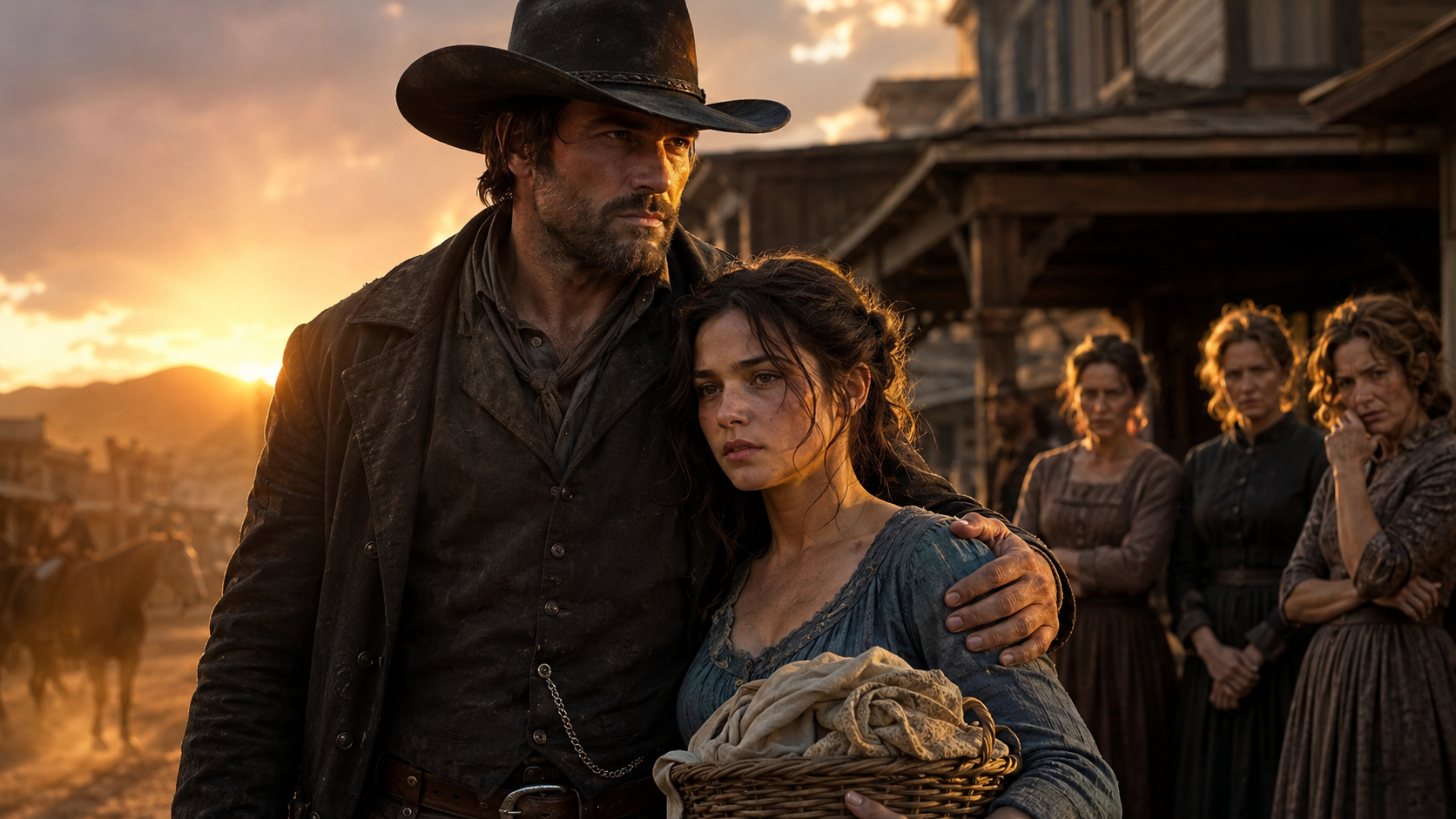
Gideon’s voice dropped. “Are you threatening me on my own road?”
“I’m explaining weather.”
“Then pray it doesn’t change.”
Victor looked past him one more time toward the house.
“Ask your cook what happens when a whole town gets tired of a person,” he said. “She knows.”
Gideon moved so fast the horses startled.
Victor’s hand went halfway to his pistol before he realized Gideon had only taken one step.
But that one step was enough.
“Leave,” Gideon said.
Victor studied him, and for the first time, Mara saw something like caution in his face.
Then he laughed softly, turned his horse, and rode away.
That night, Gideon said nothing about the visit.
Neither did Mara.
But two days later, Harlan refused to extend credit for ranch supplies.
Three days after that, the blacksmith delayed shoeing Gideon’s horses.
By the next Sunday, two ranch hands quit after receiving better offers from Sloane.
On Monday morning, someone painted a word across the side of the smokehouse.
It was meant for Mara.
Gideon found it before breakfast.
By the time the men came out, he was already scrubbing it away with lye water, his sleeves rolled up, his face carved from stone.
Mara stood in the yard and stared.
“You should have left it,” she said.
Gideon kept scrubbing. “No.”
“They’ll just do something else.”
“Then I’ll clean that too.”
“You can’t fight a whole town with a bucket.”
He stopped then and turned.
“No,” he said. “But I can decide what stays on my walls.”
Mara had no answer.
That was the thing about Gideon Vale. He rarely gave speeches. He simply planted himself between cruelty and its target as if that were the most ordinary place in the world to stand.
And without meaning to, Mara began to believe him.
The county fair came at the end of August.
Gideon did not want to go.
Mara insisted.
“You need supplies,” she said. “You need men. You need people to see you standing where they told you not to stand.”
“I need cattle to behave and fences to hold.”
“You need more than that.”
He frowned at her across the kitchen table. “Since when do you order me?”
“Since you hired me to keep people fed and alive. Morale counts.”
“Morale?”
“Yes.”
“My morale is fine.”
“You look like a funeral learned to walk.”
Boone laughed into his coffee and nearly died choking.
So Gideon went.
He rode into Mercy Crossing with Mara on the wagon seat beside him, Boone and Ben riding behind with two horses for sale. The town noticed immediately.
Of course it did.
Mercy Crossing could ignore poverty, hunger, bruises, and lies.
It could not ignore a woman sitting beside a man it had failed to control.
Mara wore a blue dress she had made from old curtain cloth, plain but clean, with her hair pinned at the nape of her neck. Gideon wore a black coat that made him look even larger than usual. Together, they drew every eye in the street.
Dorothea Pike turned pale with satisfaction, as if she had waited weeks for a chance to perform outrage.
“Well,” she said, stepping into their path. “You are bold.”
Mara climbed down from the wagon. “Good morning.”
“I was not greeting you.”
“I know. I was improving the conversation.”
A nearby man coughed.
Dorothea’s eyes hardened. “You may dress yourself up, Mara Bell, but people remember what you are.”
Mara felt Gideon move beside her.
She lifted one hand, stopping him.
“What am I?” she asked.
Dorothea smiled. “Unwanted.”
The word struck with the old force.
For one heartbeat, Mara was back in the laundry heat, twelve years old, carrying baskets too heavy for her arms while her aunt told customers not to mind the charity case.
Then Gideon’s voice came low beside her.
“Careful.”
Dorothea looked at him. “Or what?”
Mara answered before he could.
“Or nothing,” she said. “That is what frightens you, isn’t it? Nothing happens. I don’t cry. I don’t run. I don’t beg you to take the word back. You throw it, and I keep standing.”
Dorothea’s mouth tightened.
Mara stepped closer.
“You called me unwanted because it made you feel chosen,” she said. “But you were wrong. I was wanted every morning someone ate my bread. Every night a tired boy asked for more stew. Every time a man came in from the rain and found coffee hot. You don’t decide my worth anymore.”
The street went silent.
Gideon looked at Mara as if seeing her through new light.
Dorothea’s face flushed. “You insolent—”
“Enough,” said another voice.
Everyone turned.
A woman in a green traveling dress stood outside the stage office, holding a leather satchel. She was older than Mara by perhaps ten years, with sharp eyes and a posture that suggested she had spent her life refusing to bend.
Mara went still.
The woman looked directly at her.
“Mara Bell,” she said softly.
Mara whispered, “Clara?”
The satchel slipped from the woman’s hand.
And then Mara was running.