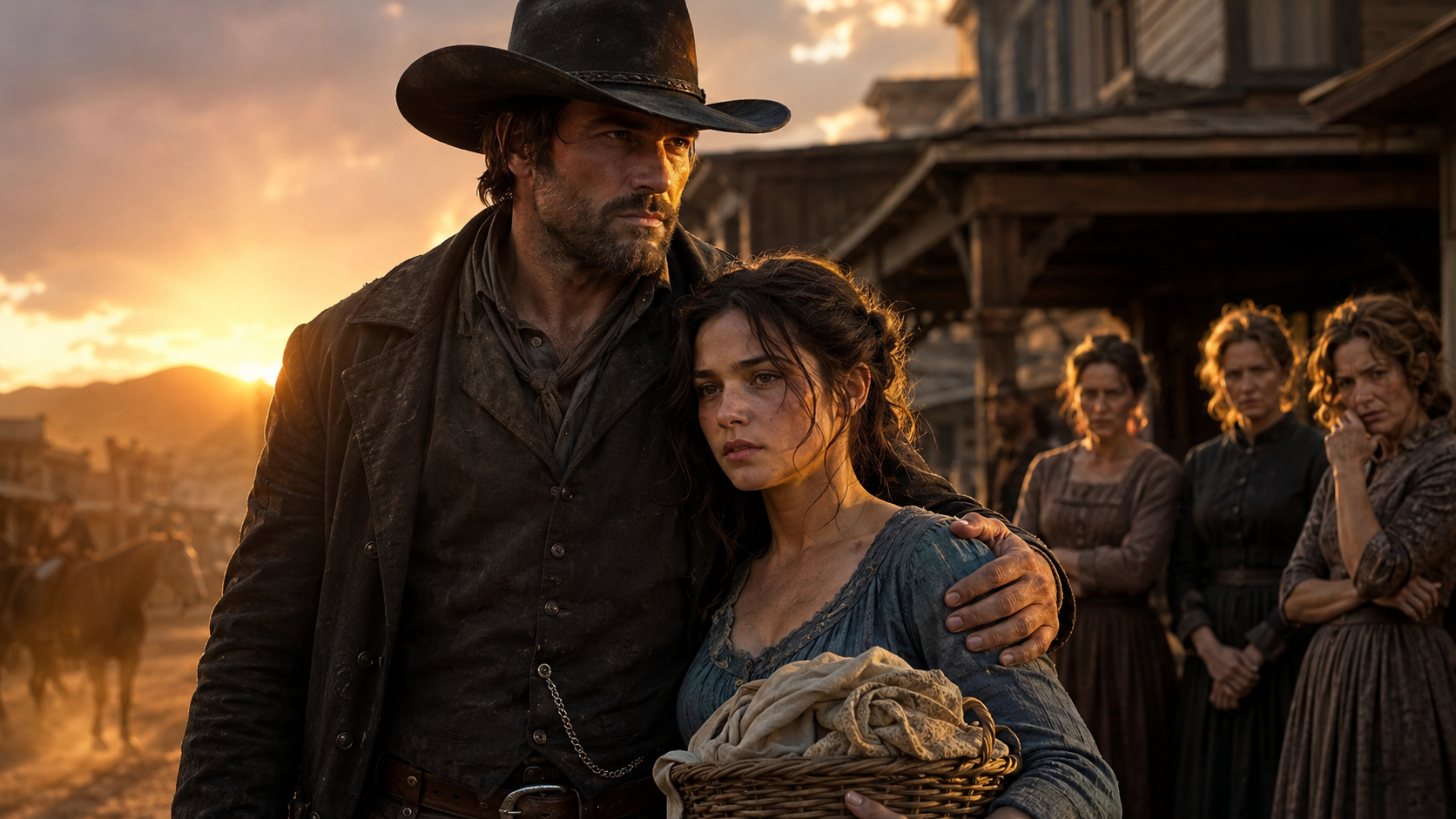
She crossed the street and crashed into the woman’s arms with such force that both of them nearly fell.
Gideon had never seen Mara break before.
Not under insult. Not under exhaustion. Not under fear.
But she broke then, silently, fiercely, clinging to the woman like someone holding the last piece of a life she thought had burned.
Later, in the shade behind the livery, Clara told them the truth.
She was Mara’s half sister.
Mara’s mother had sent Clara east before she died, hoping one child might escape the poverty that had swallowed them. Letters had been written. Money had been sent. None of it had reached Mara.
Her aunt had taken the money.
Her aunt had hidden the letters.
Her aunt had kept Mara poor, dependent, and ashamed because shame was cheaper than wages.
Clara had spent years searching.
“I thought you had refused to answer,” Clara said, wiping her eyes. “Then I thought you were dead.”
Mara sat very still.
Gideon stood a few steps away, giving them space, but every word entered him like a nail.
“How did you find me?” Mara asked.
Clara smiled through tears. “A cattle buyer passed through Abilene talking about a giant rancher who hired a woman from Mercy Crossing and nearly broke a man’s jaw when someone insulted her. I knew it had to be you.”
Mara laughed once, then covered her mouth.
Clara took her hands.
“I own a boardinghouse now,” she said. “A good one. Respectable. Warm. You can come with me. You never have to scrub another person’s floor again.”
The words landed heavily.
Gideon looked away.
He had known, of course, that Mara might leave someday.
He had not expected someday to arrive wearing a green dress and carrying proof that Mara had been loved all along.
Mara did not answer.
That night, the fair dance filled the town hall with lantern light and fiddle music.
Gideon stood outside near the hitching post while people moved and laughed inside.
He told himself he was guarding the wagon.
He was lying.
Mara found him there.
“You’re hiding,” she said.
“I’m standing.”
“With purpose?”
“With a hat.”
She smiled faintly.
For a while, they listened to the music.
“Clara wants me to go east,” Mara said.
“I heard.”
“She says I could work for her. Or not work for a while.”
“That sounds good.”
“It does.”
Gideon stared at the lanterns glowing through the windows. “You should take good when it comes.”
Mara turned toward him.
“You make that sound easy.”
“It isn’t.”
“No.”
A silence opened between them, full of all the things he would not ask and all the things she was afraid to want.
Finally, Gideon said, “You owe Iron Mesa nothing.”
Mara’s voice softened. “That isn’t true.”
“It is.”
“No. That place gave me back my name.”
Gideon looked at her then.
She stepped closer.
“And you,” she said, “were the first person in years who didn’t act like kindness was a debt I would have to repay.”
His face changed, just slightly.
“Mara…”
The hall doors burst open before he could finish.
Boone stumbled out, blood running from his nose.
Behind him came two of Sloane’s riders.
Then Victor Sloane himself appeared in the doorway, smiling like a man who had arranged a pleasant evening.
“Vale,” he called. “Your men don’t hold their liquor.”
Gideon moved toward Boone. “What happened?”
Boone spat blood. “They said Mara stole from Mrs. Pike. Said they found her aunt’s missing money in our wagon.”
Mara went cold.
Dorothea appeared behind Victor holding a small cloth purse.
“My money,” she announced. “Hidden under a sack in Mr. Vale’s wagon.”
The crowd gathered fast.
Of course it did.
Mercy Crossing loved a scandal best when it could pretend to be justice.
Victor looked at Mara with false sadness. “Old habits, I suppose.”
Gideon took one step toward him.
Mara caught his arm.
“No,” she said.
Gideon looked down at her.
Her hand trembled, but her voice did not.
“No,” she repeated. “Not this way.”
Then she turned to Dorothea.
“How much was in the purse?”
Dorothea blinked. “What?”
“How much money?”
“Seventy-two dollars.”
Mara nodded. “In what coins?”
Dorothea hesitated.
Mara’s eyes sharpened.
Clara stepped from the crowd. “Answer her.”
Dorothea flushed. “I don’t recall every coin.”
“You don’t recall because it isn’t yours,” Mara said.
Victor sighed. “This is desperate.”
Mara looked at him. “Yes. You are.”
A murmur moved through the crowd.
Mara faced the sheriff, who had arrived with his thumbs tucked in his belt and uncertainty all over his face.
“Open the purse,” she said.
Dorothea clutched it tighter. “This is improper.”
“Open it.”
The sheriff took the purse from Dorothea and emptied it into his palm.
Coins fell out.
And a folded paper.
Mara picked up the paper before anyone could stop her. She opened it.
Her face went very still.
Then she handed it to Clara.