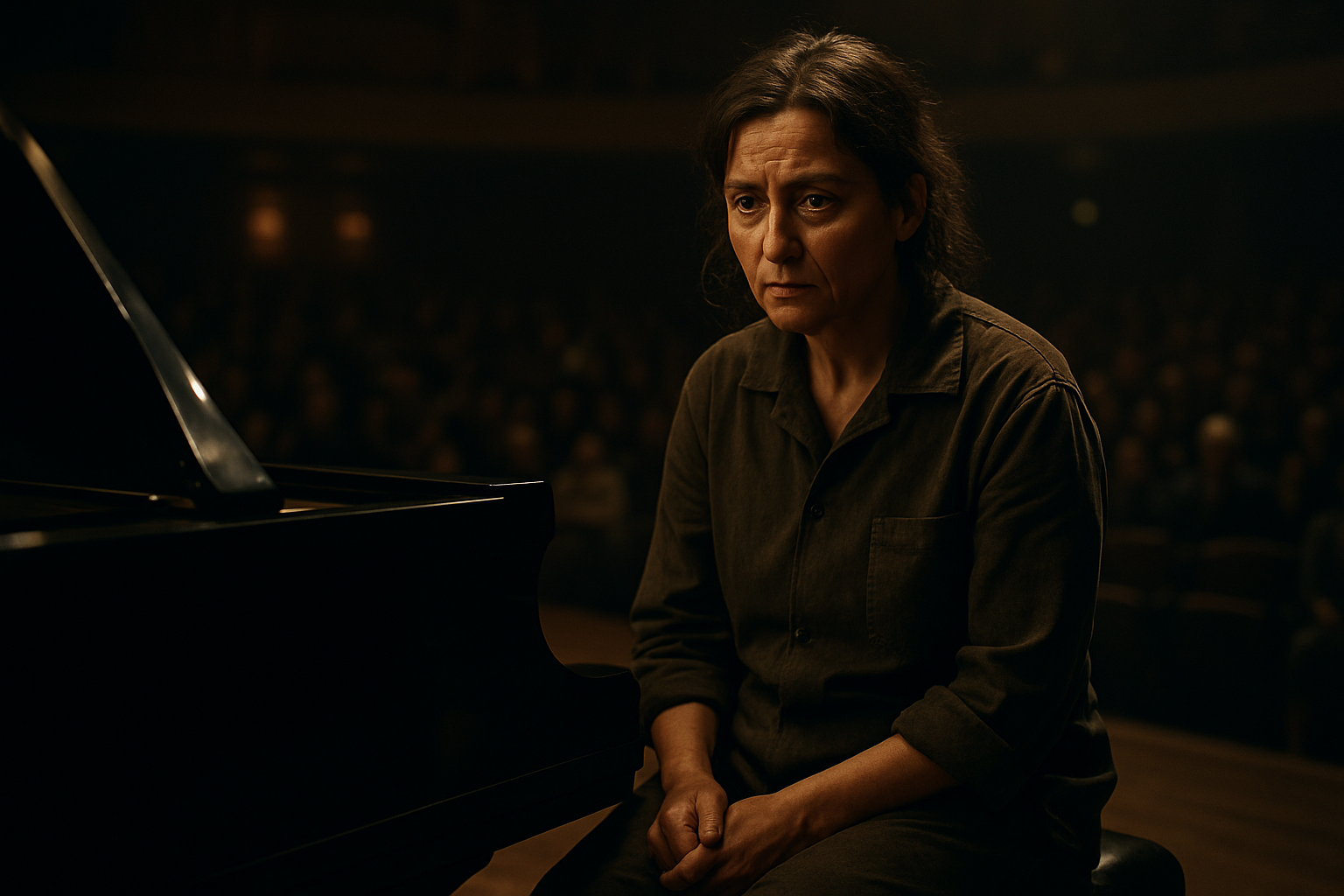
My first student was a girl named Sofía. She would not look adults in the eye. Her mother worked in a laundromat. When Sofía made a mistake, she whispered, “Sorry,” as if the piano might punish her.
I sat beside her.
“Do not apologize to the keys,” I said. “They are not rich people.”
She looked startled.
Then she laughed.
After that, she played louder.
One year after the night Sebastian called me to the stage, the benefit concert was held in the same hall.
I did not want to return.
The thought of those lights made my stomach twist.
But Father Gabriel told me, “A wound is not healed because you avoid the room where it happened. Sometimes you return with witnesses.”
So I returned.
Lucia helped me choose a deep blue gown, simple enough that I still felt like myself.
My hands were still rough.
I no longer hid them.
The hall looked the same. Marble. Lights. Polished people stepping from polished cars.
But I was not the same woman climbing those stairs.
Inside, the lobby held donors and critics, yes, but also children from the foundation. Mothers in work uniforms stood beside men in tuxedos. Grandparents took pictures beneath chandeliers. Little girls stared up as if the ceiling itself were music.
One concert could not undo the world.
But for one night, the doors were wider.
Sebastian waited backstage.
He looked thinner. The scandal had cost him. Concerts canceled. Friends gone silent. Awards reconsidered.
But he was not destroyed.
And I had never needed him destroyed.
Destruction is an easy fantasy.
Accountability is harder.
And better.
“Maria—Elena,” he said softly.
I nodded.
“Tomás.”
The name landed between us.
This time, he did not flinch.
“I’m nervous,” he admitted.
“Good,” I said. “It means you understand where you are.”
He looked toward the curtain.
“I don’t expect forgiveness.”
I appreciated that more than another apology.
“I’m still angry,” I said.
“You should be.”
“But anger is not all I have anymore.”
“What else?”
I thought of Sofía laughing at the piano. Of children carrying violins through the church basement. Of my grandmother’s notebook preserved at last. Of her name printed where it belonged.
“Work,” I said. “Memory. Music.”
The concert began with the children.
That was my condition.
Not the famous man first.
Not the donors.
Children first.
Sofía played a short piece with both hands. She made two mistakes and did not apologize to the keys.
A little boy played cello with his eyes squeezed shut. Three sisters performed a simple island folk song, and their father wept so openly that half the row passed him tissues.
Then Sebastian walked onto the stage.
The applause was complicated. Some clapped. Some did not. Some were unsure what justice required.
He stood at the microphone.
“One year ago,” he said, “I stood on this stage and used my power to humiliate a woman I believed could not answer me.”
The silence became absolute.
“I was wrong about her. More than that, I was wrong about myself. I thought I had escaped shame by hiding where I came from. Instead, I carried it into every room and called it refinement.”
His hands shook.
“The melody that made my career was not mine. Its central theme was written by Amalia Torres—a teacher, composer, immigrant, mother, grandmother, and woman of extraordinary musical gifts. She taught me when I was a boy. She fed me when I was hungry. She believed in me before anyone with money did. I repaid her by erasing her name.”
A sound moved through the crowd.
Not quite a gasp.
Not quite a sigh.
He turned toward me in the wings.
“Elena Cruz forced the truth into the light. For that, I owe her more than thanks. I owe her a changed life.”
Then he sat at the piano.
For a moment, I feared he would make the song grand again.
But he played softly.
Humbly.
Not perfectly.
Truthfully enough.
Halfway through, he stopped.
The audience shifted.
He looked toward me.
“Elena,” he said, loud enough to carry. “Will you finish it?”
I had not known he would do that.
My first instinct was no.
I did not want another spectacle. I did not want anyone to think music made everything neat.
But then I remembered my grandmother beginning a song and asking me to finish the phrase.
Inheritance, she taught me, is not something you only receive.
You carry it forward.
So I walked onto the stage.
The audience did not roar.
They simply watched.
Sebastian rose from the bench.
I sat where he had been.
For one second, our hands nearly touched above the keys. His famous hands. My working hands.
Both shaped by the same woman’s music.
Then I played.
Not for revenge.
Revenge was too small for that melody.
I played for Amalia Torres, who wrote beauty in rented rooms. For my mother, who died too young to see her mother’s name restored. For Lucia, who never let me shrink in peace. For every child in that hall who had been told art lived somewhere beyond their reach.
And, though it cost me something to admit it, I played for the boy named Tomás Calderón too.
Not to excuse the man he became.