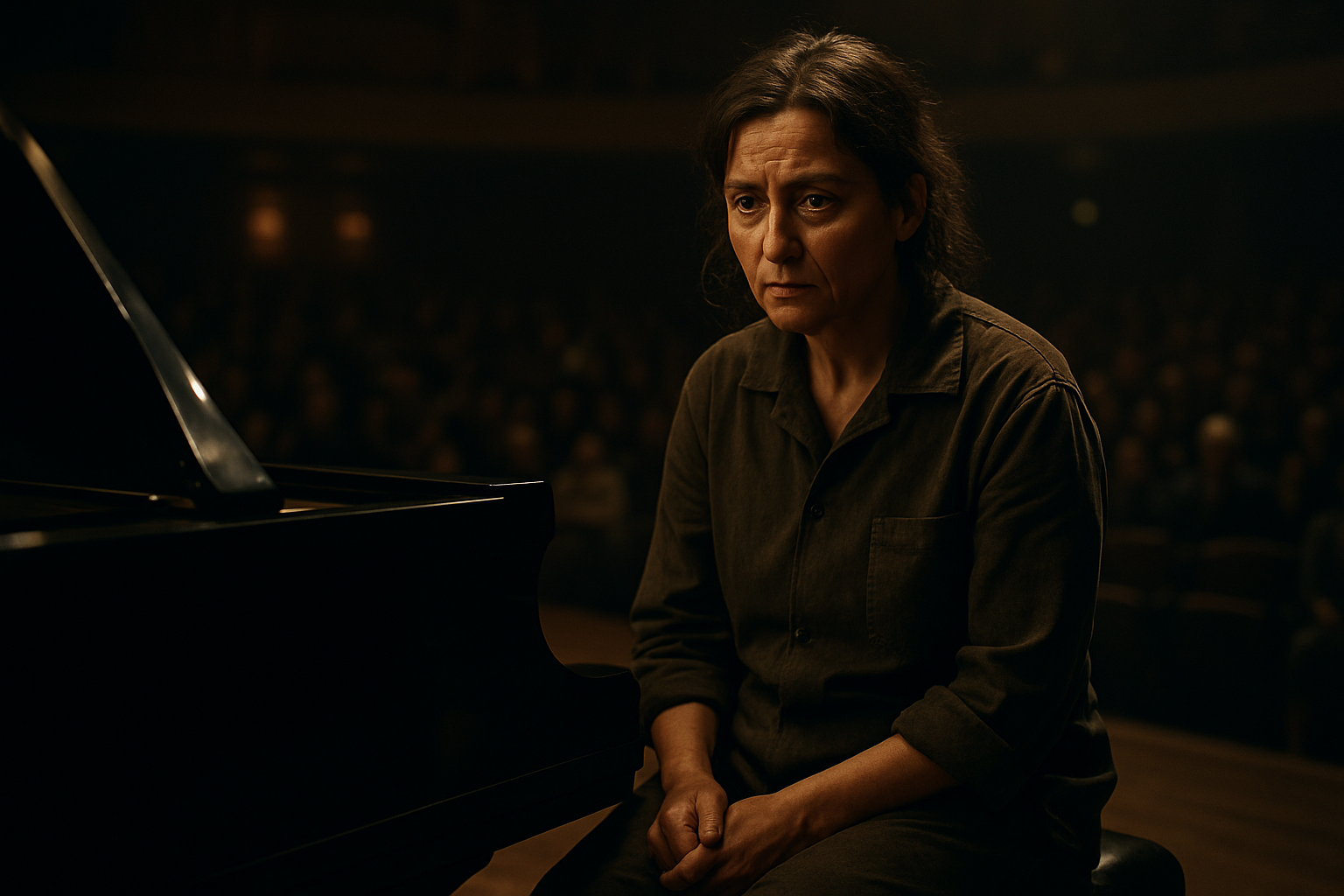
“Ladies and gentlemen, please. This misunderstanding is being encouraged by emotion. I will not stand here and have decades of work slandered by—”
He stopped.
Too late.
By a cleaning woman.
He did not say it.
Everyone heard it.
The hall changed.
The same crowd that had laughed at me now turned on him.
I knew better than to trust it fully. Crowds are easily moved. They can pity you one minute and abandon you the next.
Still, something had shifted.
I stepped toward the microphone.
Sebastian pulled it away.
A small gesture.
The whole hall saw.
Professor Harrow said, “Let her answer.”
A woman in the balcony called, “Let her speak.”
Then others joined.
“Let her speak.”
“Let her speak.”
Sebastian had built his life on applause. Now the crowd used its voice against him.
He handed me the microphone.
It felt heavier than I expected.
“My grandmother was not famous,” I said. “She had no wealthy patrons. No reviews. No grand stage. She taught children whose parents sometimes paid her with groceries. She wrote music after working all day.”
I looked at Sebastian.
“She taught me a song called ‘The Rain Song.’ She told me it was hers. She also told me about a boy named Tomás. A boy she loved like family. A boy she believed would become great if the world did not break him first.”
His jaw tightened.
“She said he disappeared with one of her notebooks. Tonight, when I played her song, you recognized it.”
“Recognition is not guilt,” he said.
“No,” I answered. “But fear is.”
A young woman in the aisle stood, holding up her phone.
“I recorded all of it,” she said. “From the moment he called her up.”
Another voice called, “I did too.”
Then someone shouted, “Play the piece again!”
The words spread.
“Play it again!”
“Let her play!”
“Play Amalia Torres’s song!”
Professor Harrow looked at me gently.
“Ms. Cruz, would you play the original as your grandmother taught it?”
Original.
The word hung in the air.
I sat again.
This time, I did not begin with a children’s song.
I began with rain.
I played it as my grandmother had taught me. Not with thunder. Not with the grand flourishes Sebastian had added for concert halls. Her song was not about victory.
It was about endurance.
A woman at a window.
A strange city.
Everything familiar gone.
And still deciding to wake up tomorrow.
By the end, even those who knew nothing about music understood.
Sebastian had not merely borrowed from her.
He had taken the bones of her song and built a mansion, then locked the door.
When I finished, I did not wait for applause.
I placed the microphone on the piano and walked offstage.
No one stopped me.
Not the ushers.
Not the donors.
Not Sebastian.
The applause rose behind me, but I could not hold it. I wanted air. I wanted the train. I wanted my grandmother, dead twelve years and suddenly nearer than anyone alive.
At my seat, I grabbed my purse.
The woman in crystals touched my arm.
“Dear,” she whispered, tears on her cheeks, “who are you?”
For most of my life, that question had felt like an accusation.
Tonight, it sounded like an invitation.
“I’m Elena Cruz,” I said.
Then I walked out.
The cold night air struck my face like mercy.
The city moved as if nothing had happened. Taxis rolled by. People laughed. A siren wailed somewhere far away.
I had no lawyer. No plan. No proof beyond memory, an old professor, and a song passed from grandmother to granddaughter.
By morning, Sebastian’s people might call me a liar.
They might call me confused.
They might bury me under expensive statements.
That should have terrified me.
Instead, I laughed.
Not happily.
But with the wild breath of someone who has fallen and found herself still standing.
My grandmother’s song had been heard.
No one could make that untrue.
I took the train home after midnight.
No limousine came.
No fairy-tale patron stepped from the shadows.
My feet hurt. A man slept across from me with his chin on his chest. A tired mother boarded with a stroller. Two teenagers argued over headphones.
The city returned me to the world I knew.
I was grateful.
When I reached my building, Lucia was waiting on the stoop in a bathrobe under her coat, her hair wrapped in a scarf.
“What happened?” she demanded. “You look like you saw a saint and punched a banker.”
I stared at her.
Then I began to cry.
She pulled me into her arms.
I cried for the girl I had buried. For my grandmother’s stolen notebook. For every night I had hummed music while emptying trash cans in offices where no one knew my name.
Only after the worst passed did I tell her.
By the end, her eyes were furious.
“That man is finished,” she said.
“No,” I whispered. “Men like him are never finished that easily.”
Lucia pulled out her phone.
“Maybe not. But Elena, you’re everywhere.”
The video had already been shared thousands of times.
The caption read:
Famous pianist invites cleaning woman to play as a joke. Big mistake.
By morning, millions had seen it.
My phone would not stop ringing. Reporters called the church. Strangers found my page. Some messages were kind. Others were cruel. People wanted proof, interviews, tears, outrage.