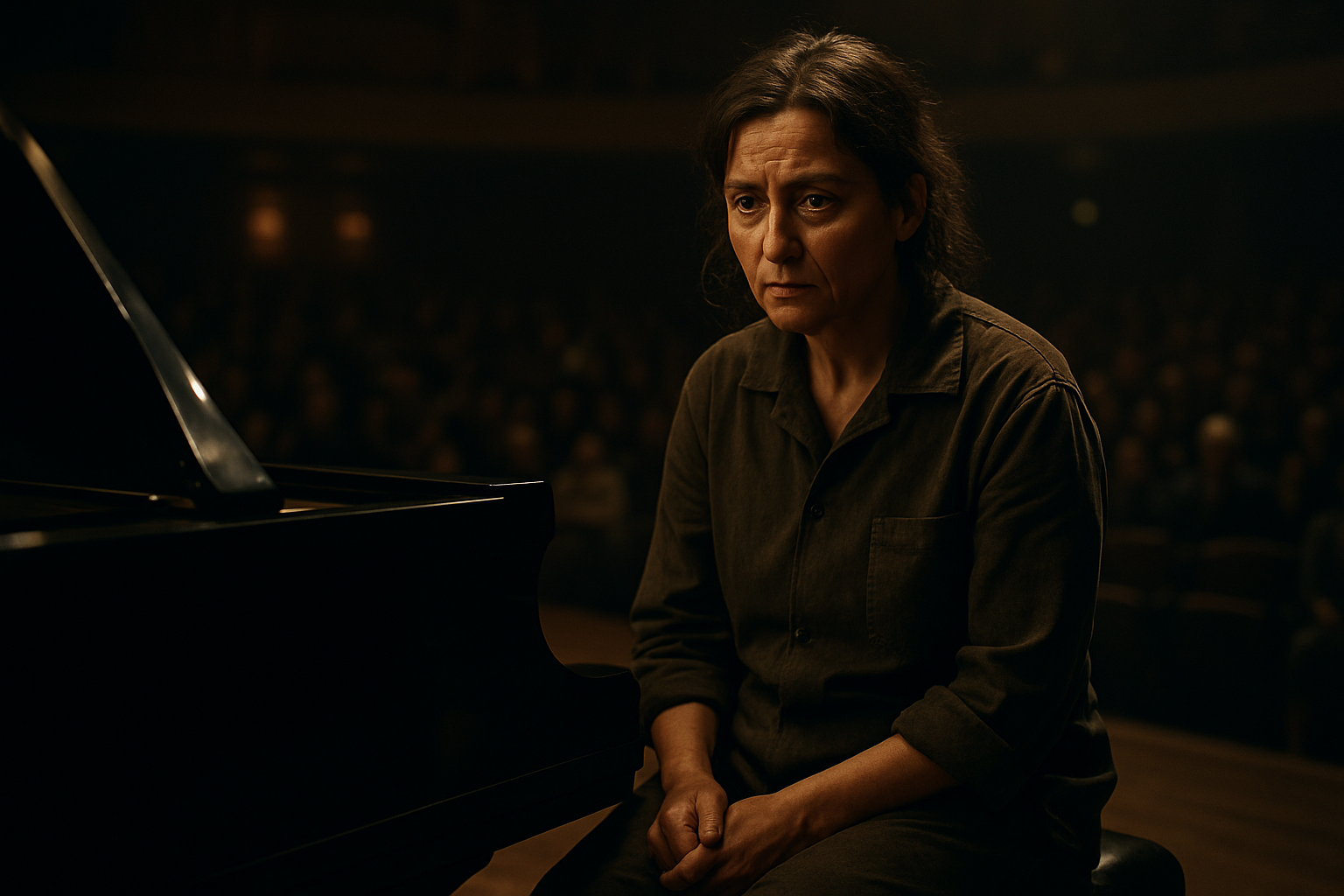
They wanted a heroine.
A victim.
A symbol.
Very few wanted a human being.
I still went to work that night.
Lucia called me crazy. Father Gabriel told me to rest.
But rent did not care about viral videos.
So at ten o’clock, I tied back my hair, put on my uniform, and took the train to the office building where I cleaned six floors every night.
For an hour, work steadied me.
Trash bins.
Conference tables.
Restrooms with stone sinks.
Then I reached the executive floor.
Mr. Whitaker, one of the senior partners, stood by the windows. I had cleaned his office for five years.
He had never learned my name.
That night he turned and said, “Elena.”
It startled me more than the concert.
“Yes, sir?”
“I saw the video,” he said. “Everyone has.”
I gripped my cleaning cart.
“I’m sorry if it causes trouble for the company.”
He looked embarrassed.
“No. That’s not what I meant.”
He handed me a business card.
“My wife sits on the board of a legal arts foundation. They handle intellectual property cases. If what you said about your grandmother is true, you should talk to them.”
I took the card slowly.
“Why would you help me?”
The question came out sharp.
He looked toward the dark windows.
“My mother cleaned houses,” he said quietly. “I spent years pretending that was not part of my story. Last night, watching that man shame you, I recognized something in myself I didn’t like.”
He swallowed.
“Take the card. You don’t owe me gratitude.”
That was the first crack in the wall.
Not justice.
Not yet.
But a crack.
The lawyers were careful at first. Memory was not enough, they said. Family stories were not enough. They needed documents, witnesses, recordings, anything linking Amalia Torres to the song before Sebastian published his famous piece.
With every explanation, hope shrank.
Then Father Gabriel called.
“Elena,” he said, voice trembling. “Come to the church.”
I found him in the basement storage room, surrounded by boxes that smelled of dust, candle wax, and old hymnals. Lucia was already there, kneeling beside a metal cabinet no one had opened in years.
Inside were programs, photographs, and notebooks bound with cracked elastic bands.
“Mrs. Navarro remembered,” Father Gabriel said. “Your grandmother donated some music materials before she died. We thought they were lesson books.”
I dropped to my knees.
The first notebook held children’s exercises in my grandmother’s careful hand.
The second had folk songs.
The third was water-stained along the edges.
Then I turned a page and stopped breathing.
There it was.
“The Rain Song.”
Written in blue ink.
Amalia Torres, 1979.
Below the title, in smaller letters, she had written:
For the children who must learn to dream in rented rooms.
I pressed my hand over my mouth.
Lucia began crying before I did.
Tucked into the back was a recital program from the Northside Community Music School. The date was April 12, 1980.
Among the students was a fifteen-year-old named Tomás Calderón.
Beside his name was the piece he performed:
“The Rain Song” by Amalia Torres.
It was not just proof.
It was my grandmother’s voice returning from a box no one had thought to open.
After that, the lawyers moved quickly.
They verified the ink, paper, and program. Professor Harrow gave a sworn statement. Two former students came forward. One had played the song as a child. Another had an old cassette, warped but usable, where my grandmother could be heard explaining the piece before a recital.
The story grew bigger than me.
Newspapers wrote about Amalia Torres.
People argued about theft, class, art, and power.
Sebastian released a statement. He regretted any “misunderstanding.” He denied wrongdoing. He claimed he had heard many melodies as a young man and any resemblance was unconscious.
He said he respected working people.
He said he respected women composers.
He said many pretty things.
But everyone had seen the video.
Two weeks later, he asked to meet me.
My lawyer warned me not to go alone. Lucia came with me, carrying pepper spray in her purse and murder in her eyes.
We met in an old rehearsal studio. Scratched wooden floors. Gray afternoon light. A small grand piano in the corner.
Sebastian arrived without cameras, assistants, or tuxedo.
He looked tired.
For the first time, I could see the boy my grandmother had described beneath the famous man’s face.
It did not soften me as much as I expected.
Pain may explain a wound.
It does not erase the blood.
“Ms. Cruz,” he said.
“Mr. Vale.”
His mouth tightened.
“My name was Tomás Calderón.”
Lucia muttered, “Was?”
He looked at me.
“I changed it when I was twenty-one.”
“Because Calderón didn’t fit on posters?” I asked.
He flinched.
“Because I thought no one would listen to a poor boy from the neighborhood,” he said. “Because teachers told me I needed polish. Because donors smiled at me like I was a charity case. Because my first manager said Sebastian Vale sounded like someone who could fill European halls.”
He looked at the piano.
“And because I was ashamed.”
The room went quiet.