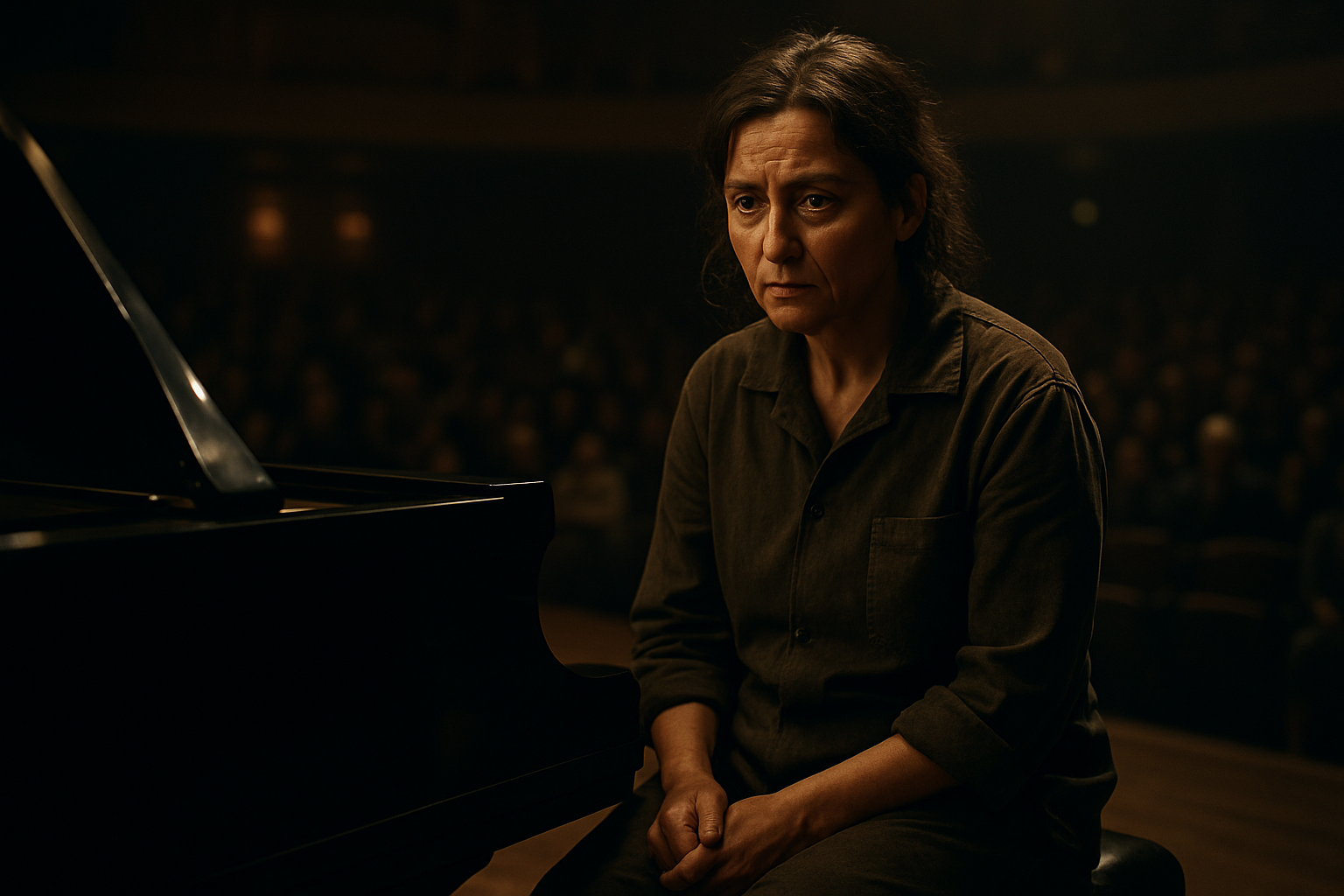
I dressed it in longing. Then joy. Then sorrow. My right hand rose in bright runs while my left hand carried the melody underneath, like a voice singing from another room.
The piano answered me.
It did not resist.
It opened.
I forgot the audience.
I forgot Sebastian.
There was only sound, and beneath it, my grandmother’s voice.
“Do not play to impress them, Elena. Play so the truth has somewhere to go.”
Then I let the melody shift.
Out of that little song came another one.
Older.
Deeper.
A song my grandmother had called “The Rain Song.”
She had written it after leaving her island, after burying my grandfather, after arriving in the city with one suitcase, one daughter, and a heart full of music no one had paid to hear.
It began with three falling notes, soft as a sigh.
Then it rose, as if grief had remembered hope.
The moment those notes entered the hall, Sebastian changed.
I saw it from the corner of my eye.
His face drained of color. His arms dropped. He stared at my hands as though they had reached into his chest and taken something from him.
He knew that song.
I kept playing.
The first part was rain on a kitchen window.
The second was a woman walking through a city that did not know her name.
The third was prayer. Not pretty prayer. The kind that comes when you have nothing left but breath.
By the final chord, my eyes burned.
The sound faded into the rafters.
No one moved.
Then someone clapped.
Slowly.
Deliberately.
Another joined. Then another.
Within seconds, the applause became a roar. People stood. A woman in the front row, glittering with crystals, was crying openly. The young couple who had leaned away from me were now on their feet, staring as if I had become someone they had failed to see.
I sat frozen.
For one impossible moment, I thought it was over.
Then Sebastian stepped forward.
He lifted the microphone over the applause.
“Remarkable,” he said tightly. “A charming little improvisation.”
The applause weakened.
Something was wrong, and the room felt it.
“A very emotional performance,” he continued. “Unexpected, certainly. But let us not get carried away. This evening still has a program to complete.”
He reached toward me as if to help me stand.
I did not take his hand.
“That wasn’t an improvisation,” I said.
The microphone caught my voice.
The hall fell silent.
Sebastian turned slowly.
“I beg your pardon?”
I stood. My legs shook, but I stood.
“That piece was written by my grandmother, Amalia Torres.”
The name moved through the hall like a match struck in darkness.
Most people did not know it. Why would they?
Amalia Torres had never played in famous halls. She had taught neighborhood children in church basements. She had written music in cheap notebooks at the kitchen table. When she died, the city did not pause.
But Sebastian knew.
I saw it.
His mouth tightened.
“I have never heard of her.”
It was a clean lie.
Before I could answer, an old man in the third row rose slowly, leaning on a cane.
“Mr. Vale,” he said, his voice thin but clear, “I have heard that name.”
Sebastian stiffened.
“Professor Harrow?”
A murmur passed through the crowd.
The old man looked at me, not with pity, but with startled respect.
“Amalia Torres taught at the Northside Community Music School in the late seventies and early eighties,” he said. “I served on a grant committee there before the funding disappeared.”
Then he looked back at Sebastian.
“And if memory serves, a young pianist named Tomás Calderón attended that program before he became Sebastian Vale.”
The hall seemed to inhale.
Tomás Calderón.
The name struck me like a bell.
My grandmother had once spoken of a boy named Tomás.
Not often.
Never without sadness.
He had been gifted, she said. Hungry in the way lonely children are hungry. His mother cleaned offices. His father was gone. He came to her with shoes too small and anger too large for his body.
She fed him.
Taught him.
Defended him.
Then one winter, he vanished.
So did one of her notebooks.
“Some people steal because they are hungry,” my grandmother once said. “Some steal because they cannot bear to be grateful.”
Sebastian’s face had gone gray.
“This is absurd,” he said. “This is a concert, not a courtroom.”
“No,” Professor Harrow replied. “But the piece she just played bears a striking resemblance to the unpublished theme you used in your first major composition, ‘Rain Over the City.’ The one that made your career.”
Whispers exploded through the hall.
I had heard that piece years ago while cleaning an office tower at two in the morning. I had frozen with a trash bag in my hand because the opening melody made my bones cold.
I told myself I was imagining it.
Music echoes music, I thought.
Maybe grief has common shapes.
But now I understood.
My grandmother had known.
Or suspected.
And she had carried that wound quietly, the way poor women carry so many wounds, because fighting would have required money, time, and a belief the world had trained out of her.
Sebastian raised a hand.