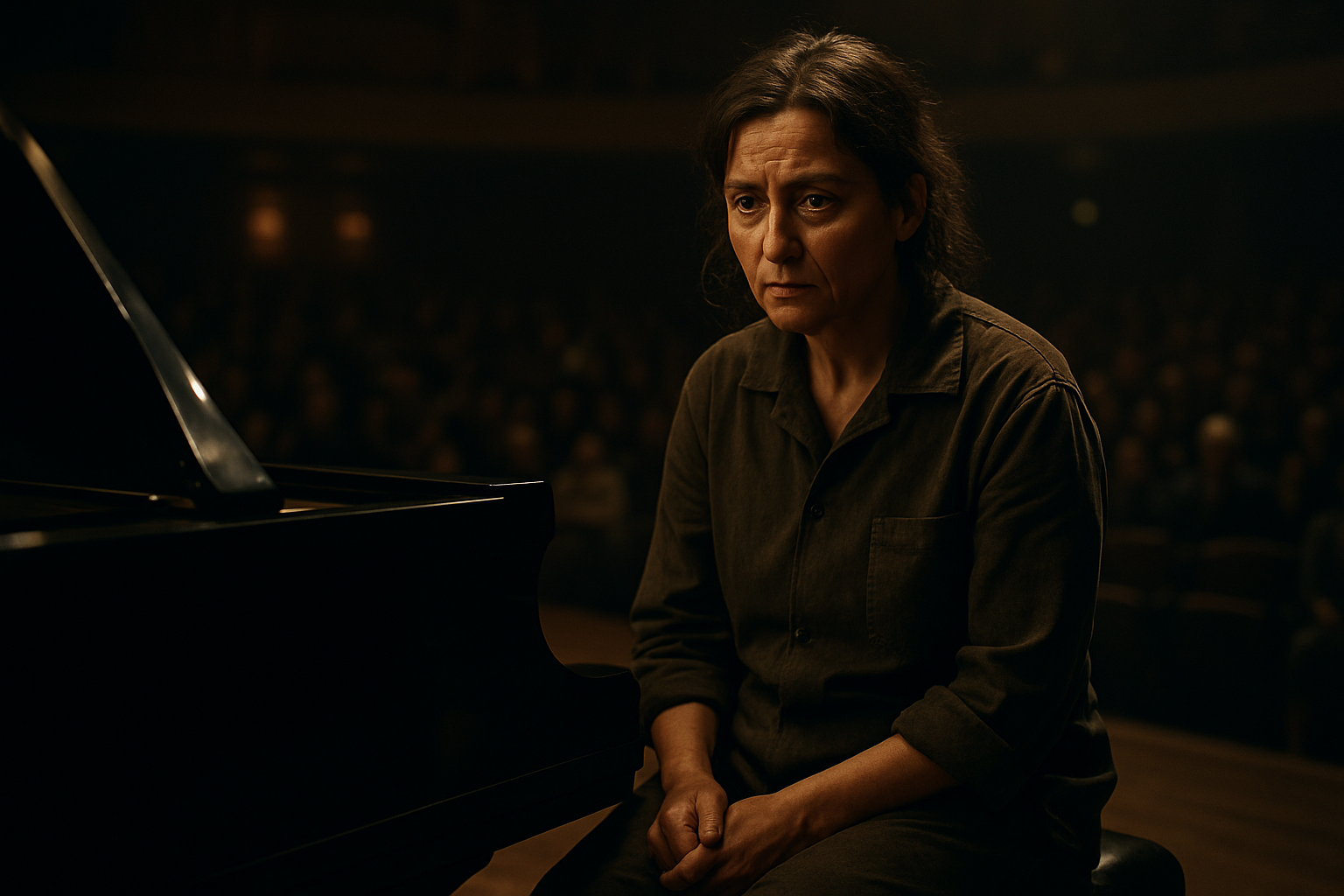
The Cleaning Woman at the Grand Piano
I felt every eye in that hall settle on me.
Heavy eyes.
Curious eyes.
Cruel eyes.
They were waiting to see how long it would take for the cleaning woman to break.
For a few seconds, I could not move. My knees felt hollow. My hands trembled in my lap. My heart beat so loudly I could barely hear the whispers rising around me.
“Is she staff?”
“Poor thing.”
“Why would he do that?”
“She won’t go up there.”
That last one hurt the most.
Not because it was unkind.
Because it was pity.
They had already decided what I was. What I could be. Where I belonged.
Sebastian Vale stood beneath the stage lights, smiling down at me as if he had offered me a gift instead of a trap. Behind him, the black grand piano shone like something sacred.
It was not the old upright my grandmother had kept in her kitchen. It was not the dusty church keyboard I sometimes touched when no one was looking.
This was a grand piano in one of the finest halls in the city.
And everything about it seemed to say, Not for hands like yours.
I looked down.
My hands were rough. Dry at the knuckles. Cracked near the nails from bleach, soap, and years of cleaning other people’s messes.
But then I remembered my grandmother’s hands.
They had looked like mine.
Hard-working hands. Laundry hands. Cooking hands. Hands that had never worn diamonds.
Yet when she sat at the piano, those hands became birds. Rain. Prayer.
“Never be ashamed of hands that have worked, Elena,” she told me when I was seven. “Hands that work know how to pray. Hands that suffer know how to make music tell the truth.”
I had not thought of those words in years.
Now they came back like a door opening.
Sebastian tilted his head, still smiling.
“Come now,” he said into the microphone. “We are all friends here.”
A soft laugh moved through the hall.
Not a warm laugh.
A laugh with teeth.
Something in me changed.
It was not courage. Not yet.
It was weariness.
I was tired of being invisible until someone needed a joke. Tired of scrubbing floors in rooms where no one learned my name. Tired of people looking past me as if my life had no music in it.
So I stood.
The hall went silent.
I stepped into the aisle. Left my purse on the seat. Walked toward the stage.
Each step felt longer than the last.
I could feel them measuring me. My plain black dress. My worn shoes. My ordinary face. But with each step, my grandmother’s kitchen grew clearer.
Coffee on the stove.
Rain against the window.
Her silver hair pinned back as she played, eyes closed, listening to something only angels could hear.
A young usher helped me up the stairs. His face was red with embarrassment. I took his hand, not because I needed it, but because he seemed to need to offer it.
When the lights hit me, I almost stepped back.
From the audience, the hall had looked grand.
From the stage, it looked endless.
Sebastian came close, lowering the microphone.
“Brave woman,” he murmured.
I said nothing.
He leaned nearer. His smile stayed in place, but his eyes were cold.
“Just press a few keys. Smile. Then sit down before you make this worse for yourself.”
There it was.
He did not want music.
He wanted surrender.
I looked at the piano.
“What would you like me to play?” I asked.
For the first time, his smile slipped.
Then he turned to the audience.
“She asks what she should play,” he announced. “How delightful.”
The crowd gave a nervous chuckle.
“Anything you know,” he said.
“Anything?”
His eyes narrowed. “Something simple.”
I nodded.
“My grandmother used to say simple songs are the hardest ones to play honestly.”
A few people shifted in their seats.
Sebastian’s smile froze.
He had expected me to tremble. To apologize. To shrink.
He had not expected me to bring my grandmother with me.
I sat at the piano.
The bench was set for him, so I adjusted it. That small scrape echoed through the hall like a secret being dragged into the open.
For thirty years, I had told myself music was over for me.
Music belonged to childhood.
To people with money.
To teachers, quiet rooms, and time.
My life had become night shifts, rent, sore knees, overdue bills, and trains before dawn. I had buried the girl who played because there was no room for her to breathe.
But she had not died.
She had been waiting.
I lifted my hands and played the first notes of “Twinkle, Twinkle, Little Star.”
The reaction came at once.
Laughter.
Relieved laughter.
Cruel laughter.
Of course, they thought.
Of course the cleaning woman knew a children’s song.
Sebastian stepped aside, folding his arms.
For four measures, I let them believe it.
Then I changed the left hand.
The little tune deepened. Warmed. Opened.
The laughter faded.
I moved into the first variation, light and quick, the melody dancing above a rolling current. My fingers felt stiff for a moment.
Then memory took over.
The body remembers what the world tries to bury.
By the second variation, the hall was still.
The children’s song had become a river.