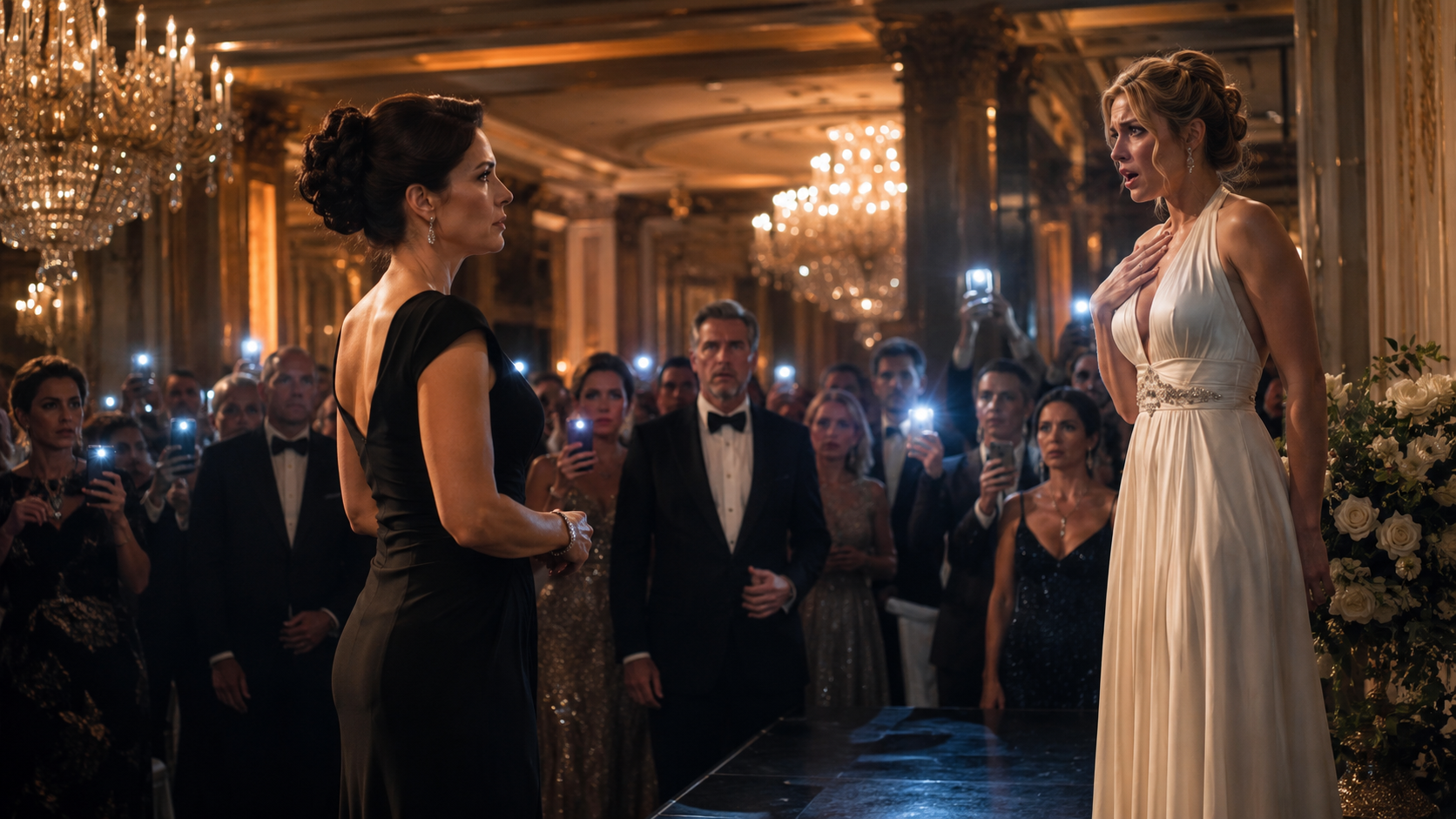
The applause began before my sister reached the stage.
It rolled across the ballroom in polished waves, rising above the music of the twelve-piece orchestra and the soft collision of crystal glasses. Nearly three hundred investors, executives, journalists, and carefully selected family friends stood beneath a ceiling painted with silver constellations.
They were celebrating the beginning of a new era for Marlowe Dynamics.
More precisely, they were celebrating my replacement.
My younger sister, Vivienne Marlowe, crossed the stage in a white evening gown and accepted the company’s ceremonial gold key from our father. Cameras flashed as she lifted it above her head.
“Tonight,” my father announced, “our family’s legacy passes into capable new hands.”
I remained seated near the rear of the ballroom.
My invitation identified me as Elena Marlowe, Strategic Consultant.
Not founder.
Not chief engineer.
Not the woman who had designed the first prototype in a rented garage while Vivienne was still posting photographs from beach resorts.
Strategic Consultant.
The title was intended to make my disappearance look voluntary.
Fourteen years earlier, I had created a system that allowed hospitals, factories, and entire municipal districts to predict energy failures before they happened. Investors had called it unrealistic. Competitors had called it impossible.
I had called it Atlas.
Atlas became the foundation of Marlowe Dynamics.
The company grew from four exhausted engineers sharing two computers into an international infrastructure firm with offices in eleven countries. Our software managed power networks, emergency systems, and transportation hubs used by millions of people.
My father supplied the family name and early introductions.
I supplied everything that made the company valuable.
For years, that distinction did not seem important.
Then our profits crossed a billion dollars.
After that, everyone suddenly became interested in deciding who deserved the credit.
Vivienne reached the microphone and smiled at the crowd.
She was excellent in front of cameras. Every movement appeared spontaneous, though I had watched her rehearse that smile in the mirrored elevator twenty minutes earlier.
“When my father asked me to lead this company,” she began, “I understood that leadership would require courage.”
Applause followed immediately.
At the table beside me, Daniel Cho, the company’s former legal counsel, shifted uncomfortably in his chair.
“Courage is a dangerous word tonight,” he whispered.
I kept my eyes on the stage.
“She hasn’t signed it yet,” I said.
“She will.”
“Yes.”
“And you’re going to let her?”
“I’m not holding the pen.”
Vivienne continued speaking about modernization, accountability, and the need to leave outdated thinking behind. She never said my name, but everyone in the room understood who represented the past.
For the previous six months, she had slowly isolated me from the company I had built.
My research division had been reassigned.
My security access had been restricted.
Senior engineers were ordered to report to executives who had never written a line of code.
Meetings were moved without telling me. Decisions were made in private. Rumors appeared in financial magazines suggesting that I was brilliant but unstable, visionary but impossible to manage.
Vivienne had learned that the cleanest way to remove someone was to convince the world that removing them had been necessary.
When she finished her speech, my father returned to the microphone.
“We have one final piece of business,” he said.
Daniel stopped breathing for a moment.
An assistant carried a black folder onto the stage.
Vivienne opened it.
“Elena,” she said.
The room became silent.
She looked directly at me for the first time that evening.
“Would you please stand?”
I rose slowly.
Every camera turned in my direction.
Vivienne waited until she was certain she had the attention of the entire ballroom.
“Marlowe Dynamics cannot move forward while certain individuals continue resisting necessary change,” she said. “Effective immediately, your consulting agreement, executive privileges, and relationship with this company are terminated.”
Several people gasped.
Most remained silent.
A few members of Vivienne’s new leadership team began to applaud. The sound was weak at first, then spread as frightened people realized they were expected to join.
My mother stared at the tablecloth.
My father stood beside Vivienne with his hands folded in front of him.
He did not look surprised.
That hurt more than the dismissal.
Vivienne lifted the termination document.
“The board has authorized me to sign this in front of our shareholders and partners,” she said. “Transparency matters.”
Daniel leaned closer to me.
“Elena.”
“It’s all right.”