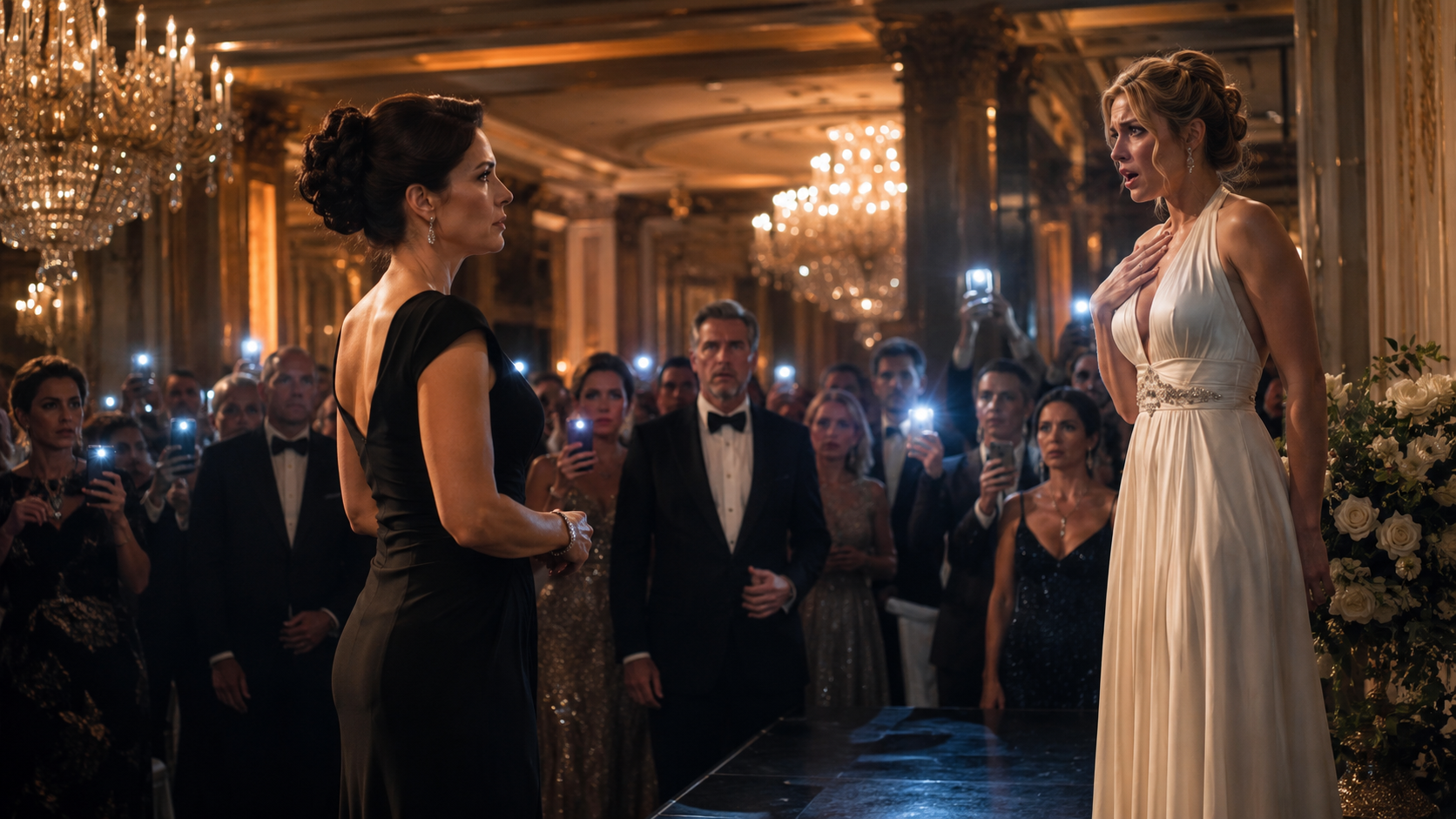
“It is very much not all right.”
Onstage, Vivienne signed the document with an exaggerated flourish.
She placed the pen beside the folder and looked toward me, waiting for anger, tears, or a desperate attempt to defend myself.
I gave her none of those things.
Instead, I asked, “Did you read the original incorporation agreement?”
Her smile tightened.
“I have reviewed every relevant company document.”
“That wasn’t my question.”
A murmur moved through the ballroom.
Vivienne placed both hands on the podium.
“This is neither the time nor the place for another one of your technical lectures.”
“It isn’t technical.”
My father finally looked at me.
There was a warning in his expression.
I ignored it.
“Did you read Section Twelve?” I asked.
Vivienne laughed, encouraging the audience to laugh with her.
A few people did.
“Our attorneys have confirmed that the board has full authority to remove you.”
“Your attorneys reviewed my employment contract,” I said. “Section Twelve isn’t in my employment contract.”
The confidence in her face flickered.
Only briefly.
Then she recovered.
“Security will escort you out.”
Two security officers approached my table. I recognized both men. I had approved the medical assistance fund that paid for one officer’s daughter’s surgery.
Neither wanted to touch me.
I picked up my coat.
As I walked toward the exit, Vivienne spoke again.
“Elena.”
I turned.
She wanted the final image to belong to her.
She wanted the cameras to record me leaving while she remained beneath the lights.
“I hope,” she said, “that one day you understand this was necessary.”
I studied her for several seconds.
Then I looked at the signed folder.
“So do I,” I replied.
Outside the ballroom, Daniel followed me into the marble corridor.
“You could have stopped her,” he said.
“She was warned.”
“Not clearly.”
“I sent her three letters.”
“Letters she probably gave to her assistants.”
“She received them personally.”
Daniel glanced back toward the closed ballroom doors.
“How long until the clause activates?”
“It already has.”
His phone vibrated.
Then mine did.
Daniel looked at the screen.
“Emergency review initiated,” he read. “Founder-control audit pending.”
“That’s the first notice.”
He looked at me with a mixture of admiration and horror.
“What comes next?”
“The patent licenses freeze.”
“All of them?”
“All core systems developed before the restructuring.”
“That’s nearly the entire company.”
“Yes.”
“Elena, the market will panic.”
“The market was always going to panic. The only question was whether it happened before or after Vivienne sold Atlas to Calder Vale.”
Daniel’s expression changed.
“You know about the sale?”
“I wrote Atlas. Did they believe they could duplicate the architecture without leaving fingerprints?”
For three months, Vivienne had been secretly negotiating with Calder Vale, a private infrastructure conglomerate known for acquiring technology firms, stripping their assets, and eliminating their research teams.
The proposed sale would have made my sister extraordinarily wealthy.
It also would have placed the emergency systems of forty-seven cities under the control of a company with a record of ignoring safety failures.
I had confronted her privately.
She denied everything.
Two days later, my access to the executive network was revoked.
Vivienne believed she was removing an inconvenient sister.
In reality, she had transformed a private concern into a mandatory legal investigation.
Section Twelve had been written during the company’s earliest days, when our first investors demanded control over my inventions. I agreed to accept outside funding on one condition: Atlas and every system derived from it would remain licensed to the company only while the founder retained independent oversight.
If I resigned voluntarily, the licenses would continue.
If I died, they would transfer to a public-benefit trust.
But if I were removed without the approval of every independent director, the licenses would automatically suspend and trigger a forensic audit of all pending transactions.
My father had called the clause paranoid.
That night, it became the only thing standing between the company and a silent takeover.
Daniel’s phone vibrated again.
“Second notice,” he said.
Behind the ballroom doors, the orchestra was still playing.
“They haven’t noticed yet,” he added.
“They will.”
We entered the hotel’s quiet library and waited.
At 10:41 p.m., the first independent director called me.
At 10:48, the chair of the audit committee requested access to my evidence.
At 11:03, the company’s outside counsel confirmed that Vivienne had never requested unanimous authorization for my dismissal.
At 11:17, Calder Vale attempted to withdraw its acquisition proposal.
The withdrawal came too late.