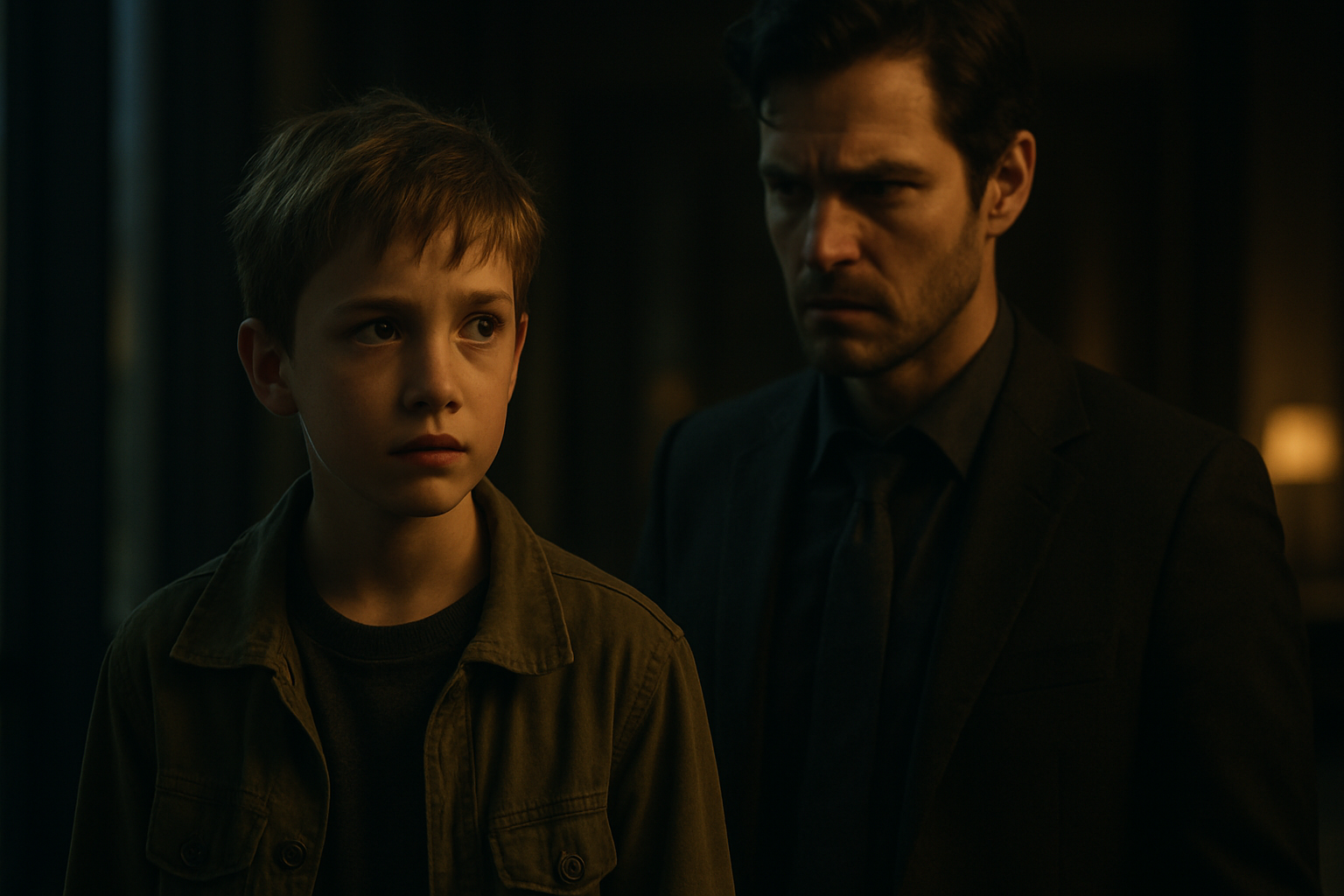
She thought of Caleb’s arm wrapped around her neck that morning. She thought of Vivienne saying the kid as if he were a spilled drink on silk. She thought of Martin Vale’s low voice from the terrace. She thought of Adrian accepting a cracker from a toddler with the grave courtesy of a man receiving a state document.
She thought of five days.
Five days was nothing.
Five days was forever.
She had survived worse stretches than that with less reason.
Danger did not disappear when poor women looked away from it. It only learned they were willing to be hunted quietly.
“Five days,” she said.
Adrian inclined his head once. “Five days.”
The first four passed like a held breath.
The penthouse continued to gleam. Flowers were replaced before they wilted. Silver was polished. Coffee appeared at the proper temperature. The staff moved in soft-soled shoes along marble floors, carrying clean towels and secrets.
But beneath the elegance, everything had sharpened.
Vanessa worked.
Vivienne watched.
Mrs. Alvarez, who had once ruled the household with the serene authority of someone who knew every stain by origin and every guest by preference, now avoided being alone with either of them. Her face had settled into careful neutrality, but Vanessa noticed how often the older woman glanced toward Caleb. Not with annoyance. With worry.
Graham moved through the penthouse with quiet urgency. He carried folders into the library and brought them out thinner. He answered calls in hallways, voice low, expression controlled. Sometimes, when he passed Vanessa, he gave the slightest nod—not enough to implicate either of them, but enough to say, I know you are standing in the storm too.
Adrian remained in the wheelchair.
He played his role flawlessly.
Some mornings he seemed distant, a man trapped in pain and silence. At dinner he allowed his hand to tremble just enough when lifting a glass. In front of Vivienne, he became slower, more withdrawn, his responses delayed by a fraction that made impatience flash across her face before she covered it.
But Vanessa no longer saw stillness as weakness.
She saw calculation.
She saw the way his eyes followed reflections in glass. The way he let people speak too long. The way silence became a net and everyone around him, believing him diminished, swam straight into it.
Caleb, mercifully unaware that adults were building a battlefield around him, developed three deep and consuming attachments: a wooden spoon from the kitchen, two blue blocks from a toy set Graham had ordered without admitting he had ordered it, and a picture book about a bear who refused to share honey.
The bear book became a moral crisis in Caleb’s small universe.
“Bear mean,” he announced the first morning.
“Yes,” Vanessa said, folding napkins. “Bear is not sharing.”
“Bear sad?”
“Maybe bear will learn.”
“Bear no learn.” Caleb frowned at the page with grave disappointment. “Bear sticky.”
Adrian, passing near the breakfast room in his chair, paused long enough to hear this verdict.
“An unforgivable flaw,” he said.
Caleb turned, saw him, and immediately toddled over with the spoon in one hand.
“Chair man.”
Vanessa closed her eyes briefly. “Caleb.”
Adrian’s mouth twitched. “It’s accurate.”
Caleb placed one small hand on Adrian’s knee.
He had begun doing that whenever Adrian stopped near him. Not roughly. Not curiously in the way adults feared children would be with injury. It was more like a check-in. A tiny palm pressing lightly against expensive fabric, confirming that the man in the chair was still there, still solid, still acceptable.
Each time, Adrian accepted the contact without flinching.
The first time, Vanessa had tensed so hard her shoulders ached.
The second, she had murmured, “Gentle.”
By the fourth, she noticed something she did not know what to do with: Adrian seemed to wait for it.
Not eagerly. Never visibly. But if Caleb was nearby, Adrian’s chair slowed. His hand remained away from the wheel. His expression softened in a way that made him look briefly less like a man orchestrating war and more like someone remembering what it meant to be trusted without condition.
On the fourth evening, Martin Vale arrived.
Vanessa saw him first in the private elevator vestibule.
The doors opened without the soft chime used for regular visitors. He stepped out as if he had been expected by the building itself: late forties, gray suit, smooth hair touched with silver at the temples, leather gloves folded in one hand. His face was pleasant in the way expensive knives were pleasant—well-made, polished, and designed for a purpose no one wanted to feel up close.
He had the soft confidence of a man who had built a career explaining ruin as strategy.
Vivienne greeted him.
No kiss.
No handshake.
Only a slight nod.
Somehow, it revealed more intimacy than either touch would have.
“Mr. Vale,” Vanessa said from the hall, because servants were expected to acknowledge arrivals without appearing to notice anything.
His gaze moved over her and dismissed her in the same motion.