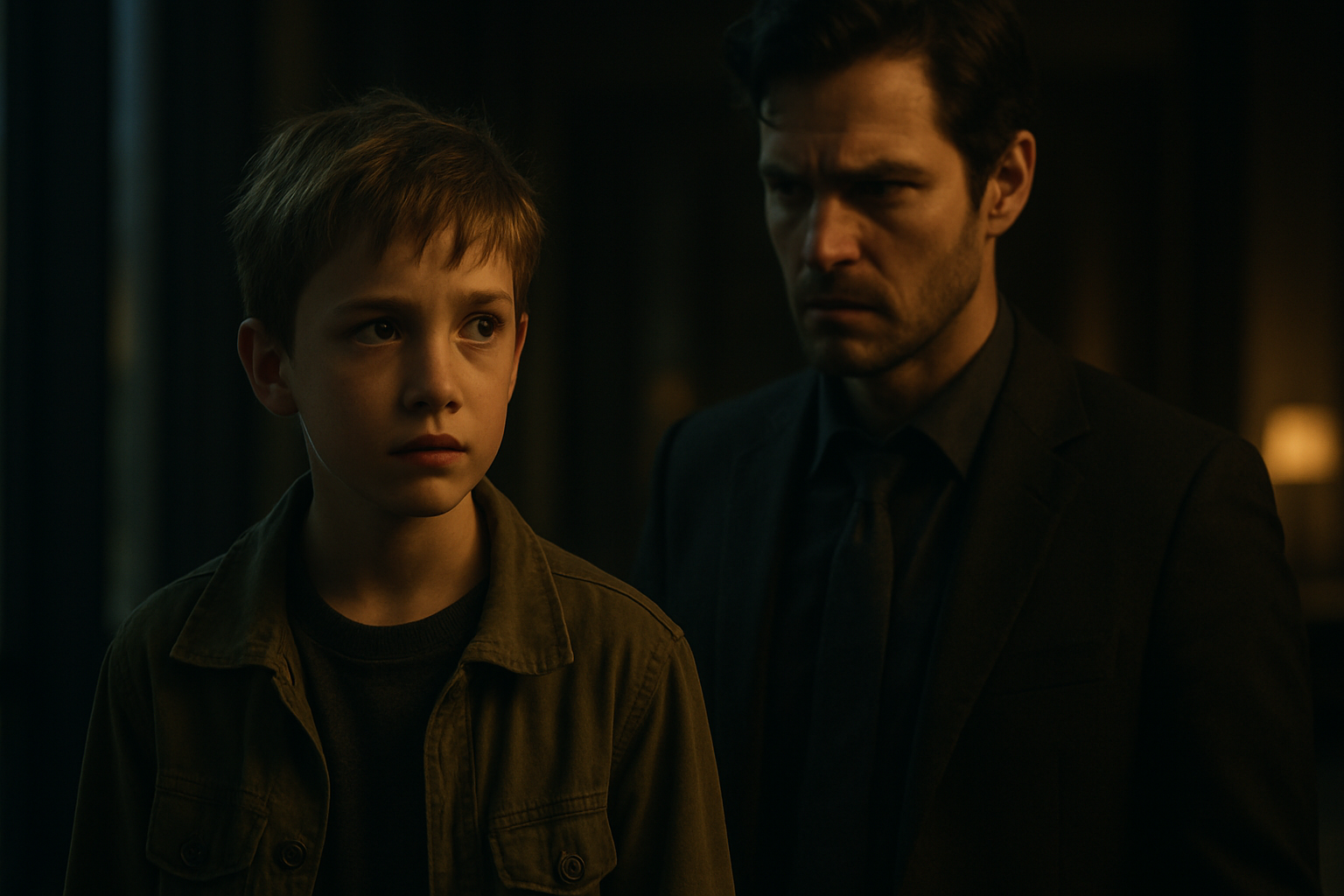
“Vanessa,” Vivienne said pleasantly. “We won’t need anything.”
The lie was obvious. People like Vivienne always needed something. Silence. Obedience. Witnesses who pretended blindness.
“Of course,” Vanessa replied.
Vivienne and Martin went to the formal sitting room, a space used rarely enough that it always smelled faintly of flowers and cold upholstery. Adrian was supposed to be in the media room with Graham. The house schedule said so. The house schedule, Vanessa had learned, was sometimes less a map than bait.
She returned to the west guest suite, where fresh linens waited in a perfect folded stack. Her hands performed the work automatically: strip, smooth, tuck, fold. Hospital corners sharp enough to satisfy Mrs. Alvarez. Pillowcases aligned. Throw blanket arranged to look carelessly luxurious, which was the most labor-intensive kind of careless.
She was halfway through replacing the duvet when she thought of the bear book.
Caleb would not sleep without it now.
The blue blocks mattered until they didn’t. The wooden spoon mattered unless someone offered him a banana. But the bear book had become essential. He needed to accuse the bear of selfishness at least twice before accepting a nap.
Vanessa checked the breakfast room first.
The small blanket was there. The spoon lay abandoned under the chair. One blue block sat on the floor beside a crumb of toast.
No bear book.
No Caleb.
For one second, her mind refused to understand the room.
Then panic arrived.
Not as a scream.
As math.
He had been in the room six minutes ago.
Maybe seven.
The door had not been fully latched because Mrs. Alvarez had come through carrying towels.
He liked the hallway rug because it had circles.
He followed voices.
The sitting room had voices.
Vanessa moved.
Fast, but not loudly. Loudness cost seconds when people stopped you to ask what was wrong. She passed the breakfast room threshold, crossed the corridor, and saw the bear book lying open in the hallway, facedown on the runner as if dropped mid-journey.
Her stomach turned to ice.
She reached the sitting room just as Caleb stepped toward the glass coffee table.
Vivienne and Martin had spread documents across it.
Not casually. Not like two people reviewing charity seating arrangements. The papers were arranged in stacks, marked with colored tabs, annotated in pen. A tablet lay awake beside them, glowing with charts Vanessa did not understand. She saw names, percentages, the sharp black lines of signatures waiting to happen.
Caleb was not grabbing anything.
He was not misbehaving.
He was two years old, approaching paper because paper could be touched and moved and folded, because sometimes paper made a satisfying sound when crumpled, because once—only once—he had chewed the corner of an electric bill while Vanessa was on the phone with the clinic and had looked deeply betrayed when she took it away.
“Caleb,” Vanessa said, already crossing the room.
Martin’s head snapped up.
His eyes did not go first to the child.
They went to the papers.
Then to Vanessa.
Then back to Caleb, as if calculating which one represented the larger threat.
“Get him out,” Martin said.
The words cracked through the room.
Caleb froze.
His lower lip trembled—not because he understood the danger, but because he understood the tone. Children always understood tone. Long before vocabulary, long before manners, long before adults taught them which rooms they were allowed to exist in, children knew when a voice had turned into a hand.
Vanessa reached him in two strides and lifted him onto her hip.
“I’m sorry,” she said automatically.
The apology tasted bitter as soon as it left her mouth.
She was sorry Caleb had wandered. Sorry she had looked away. Sorry she needed the job. Sorry the world was arranged so that a toddler standing near a coffee table could be treated like a breach of security instead of a child.
Caleb clutched her collar with one hand. His other hand held something white.
Vanessa’s breath stopped.
A paper.
No—not a full page.
A torn corner.
Small. Crumpled. Damp at one edge from his fingers.
Vivienne saw it at the same moment.
Her expression did not change much. That was the frightening part. Only her eyes sharpened, and the air in the sitting room seemed to drop several degrees.
“What is that?” Vivienne asked.
Vanessa closed her hand gently over Caleb’s.
“Probably from his book,” she said.
Vivienne stood.
“Show me.”
Caleb burrowed against Vanessa’s neck.
Martin’s chair scraped back.
For an instant, Vanessa saw the entire room as a trap: the glass table, the documents, Vivienne between her and the hallway, Martin rising with that smooth corporate menace that never looked like violence until it was too late.
Then, from behind her, came the soft mechanical sound of wheels over polished floor.
“Is there a problem?” Adrian asked.
Vanessa turned.
He sat in the doorway of the formal sitting room, one hand on the wheel of his chair, Graham standing just behind him like a shadow that had learned to wear a suit.