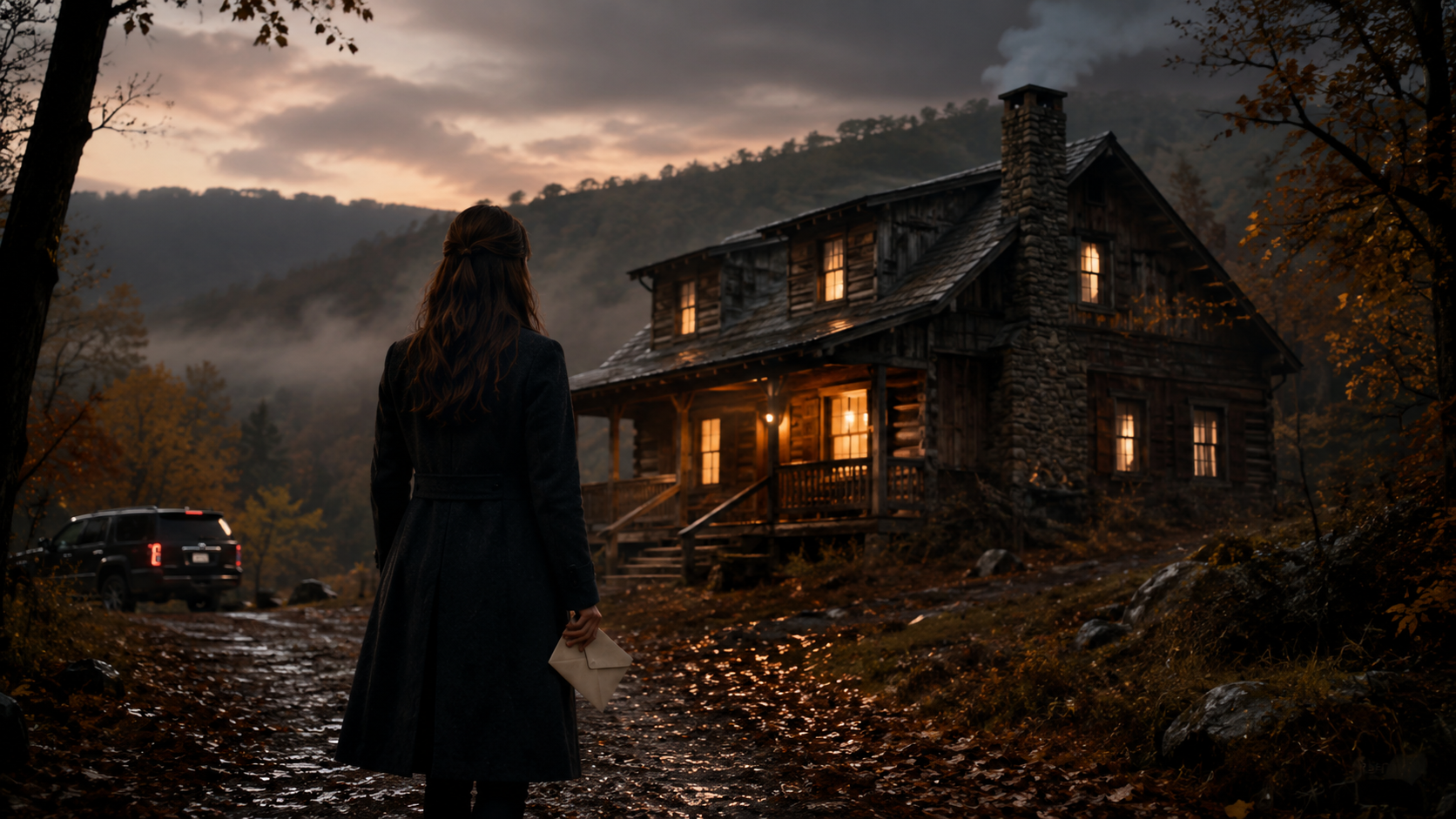
That sentence struck harder than it should have.
I opened the door wider.
Abel stepped inside slowly, wiped his boots without being asked, and set the pot on the counter.
His gaze moved to the envelope in my hand.
“So you found the first note.”
“The first?”
He nodded toward the kitchen table. “Your father liked leaving trails. Said you were the only one in the family patient enough to follow one without tearing up the woods.”
“What is under the table?”
“Not my place to say.”
“You know.”
“I do.”
“Then why come here if you won’t tell me?”
Abel’s face softened.
“Because he asked me to make sure you weren’t alone the first night the truth showed up.”
The fire cracked behind me.
I swallowed.
“My father could have told me all of this while he was alive.”
“Yes.”
“Why didn’t he?”
Abel looked toward the back room, then away.
“Some men can build bridges over rivers and still fail to cross the room where their own daughter is crying.”
I had no answer.
He turned to leave.
“Mr. Cross.”
He paused.
“Why did Dad tell me not to open the back room until morning?”
For the first time, uncertainty crossed his face.
“Because grief is louder in the dark.”
Then he stepped onto the porch and disappeared into the cold.
I locked the door behind him.
For a long time, I did not move.
The kitchen table was old pine, scarred by burns, knife marks, and years of elbows. I remembered sitting beneath it as a child during a summer storm while Dad and a very old woman’s photograph watched from the mantel.
Ruth.
The name surfaced slowly.
Not a person I had known.
A name Dad had said once.
Maybe twice.
Grandmother Ruth made these biscuits.
Grandmother Ruth hated banks.
Grandmother Ruth said a floorboard was safer than a man in a necktie.
I got down on my knees.
Beneath the table, near the back left leg, one floorboard sat a hair higher than the others. I pressed my thumb along the seam.
It shifted.
My pulse jumped.
I used my pocketknife to pry it loose.
Beneath it lay a tin box wrapped in oilcloth.
It was heavier than it looked.
I dragged it out with both hands and placed it on the table.
For a moment, I just stared at it.
Then I opened the lid.
Inside were photographs, maps, letters, old survey documents, a leather journal, and a stack of papers bound with a brass clip.
The photograph on top showed a young version of my father standing beside a woman on the cabin porch. She was small, silver-haired, and straight-backed, with work-roughened hands and eyes that looked as if they could drive a nail through a lie.
On the back, Dad had written:
Ruth Bell Whitaker. The woman who kept the mountain when every man in town told her to let it go.
I had never seen her face.
I opened the journal.
The first page read:
If you came looking for money, close this book and grow a spine first.
Despite myself, I laughed.
It came out broken.
I turned the pages.
Ruth had bought the first eighty acres in 1952 with money from sewing uniforms, teaching children, and selling canned peaches from a roadside table. People called the land useless because it was steep, rocky, and too far from town. She bought more whenever men laughed at her price.
She marked springs.
She drew maps.
She wrote down the names of everyone who offered to “help” her sell.
She refused timber companies. She refused speculators. She refused a mining agent who arrived in a shiny car and called her sweetheart.
Near the back of the box, I found a modern report.
Dated eight months earlier.
I read the first page.
Then the second.
Then I sat down because my legs had gone weak.
The land contained significant deposits of lithium-bearing clay and rare earth minerals.
Not rumor.
Not guesswork.
Documented.
Mapped.
Valuable.
The “rotting cabin” sat above a mountain worth more than every polished thing Maribel had inherited.
My mouth went dry.
I kept reading.
Dad had not planned to sell outright. He had hired environmental consultants. He had prepared conservation restrictions. He had formed the skeleton of a trust. He had negotiated nothing, signed nothing, but studied everything.
Every paper led to another paper.
Every map led deeper.
At the bottom of the box was one final envelope.
Read after the mountain speaks.
I almost could not open it.
But I did.
My Rowan,
Now you know why I left you what looks like less and weighs like more.
This land belonged to Ruth before it belonged to me. She raised me here after my parents died. She taught me that poverty is not shame, but letting greedy people name your worth is.
For years, I thought protecting you meant keeping you away from family conflict. I let your mother call you difficult. I let Maribel call you cold. I told myself you were strong enough not to need defending.
That was cowardice dressed as confidence.