I looked at her then.
Really looked.
At the perfect hair, the flawless makeup, the diamonds, the grief she wore like a costume that had been tailored to flatter her.
“You should enjoy what he gave you,” I said.
She blinked. “Excuse me?”
“It may be the last thing you ever get from him.”
For once, she had no answer.
I left before my voice could break.
That night, I sat in my motel room with Dad’s envelope in my hands.
I opened it at 2:13 a.m.
Rowan,
If you are reading this, your sister has probably already laughed.
Let her.
People laugh loudest at what they cannot see.
I am sorry I did not speak more clearly while I was alive. I was a coward in certain rooms. I thought quiet protection was still protection. It was not.
Go to the cabin.
Spend one night.
Do not sell.
Do not sign anything Maribel brings you.
And do not let your mother convince you that peace means surrender.
When you arrive, look for the place where Ruth hid winter money.
You will remember.
I love you more than I ever managed to say.
Dad
I read the letter until dawn.
Then I packed my bag.
The drive into the Ozarks took most of the day.
The highway narrowed into county roads, then gravel, then a rutted track that climbed between black oaks and hickory trees. November hung heavy over the hills. The sky was low and gray, and the wind dragged dead leaves across the road like nervous hands.
My truck complained over the last mile.
I had not been to the cabin since I was twelve.
After that, Mom refused to go. Maribel said the place made her hair smell smoky. Dad stopped asking. Eventually, the cabin became a word people used when they wanted to make him sound foolish.
Your father and that cabin.
As if loving one old place proved something embarrassing about him.
The trees opened suddenly.
My headlights swept over a clearing.
There it was.
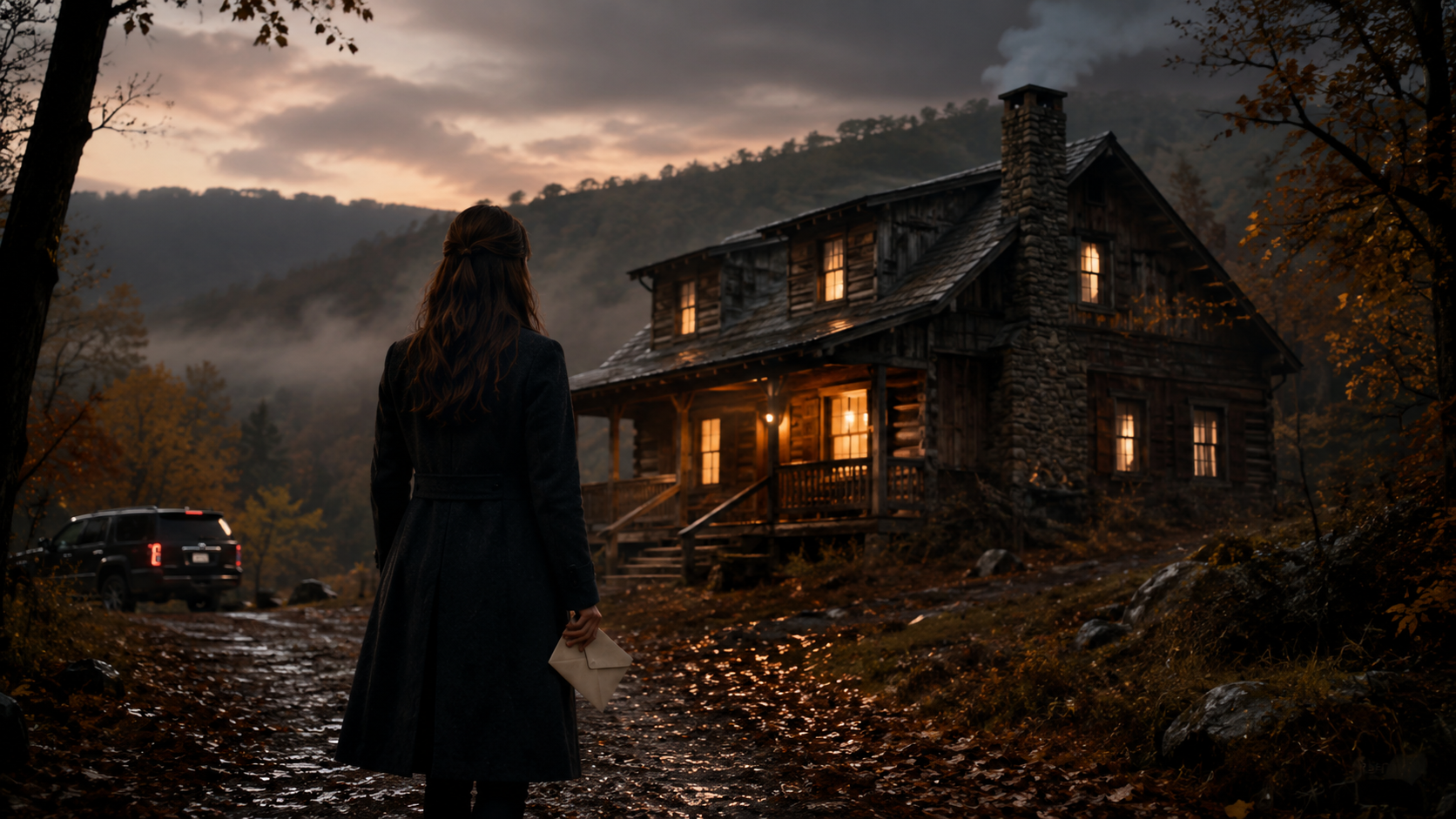
The cabin sat with its back to the ridge and its face toward the valley, built from dark logs and fieldstone, broad-shouldered and low beneath the trees. The porch leaned a little. One shutter hung crooked. Moss climbed the stone chimney.
But it was not collapsed.
It was not dead.
I cut the engine.
Silence gathered around me.
Then I saw it.
Smoke.
A thin gray ribbon rose from the chimney into the cold dusk.
Every part of me went still.
No one was supposed to be here.
I reached automatically for the pistol that was not on my hip. Old training, useless habit. I had flown in for the funeral and borrowed my truck from a friend; my weapon was locked away two states behind me.
I took the tire iron from behind the seat instead.
The porch groaned under my boots.
A lamp glowed behind the front curtains.
Not bright.
Not careless.
Waiting.
I unlocked the door with the key Russell had given me.
Before I turned the knob all the way, the door opened inward by itself.
Warmth touched my face.
The cabin smelled of woodsmoke, coffee, and cedar.
Not rot.
Not mold.
Not abandonment.
A fire burned low in the stone hearth. The floor had been swept. Fresh wood was stacked beside the fireplace. A kettle sat on the iron stove. A quilt lay folded over the back of a worn leather chair.
On the kitchen table sat an envelope.
My name was written across it.
Rowan.
My knees nearly failed.
For one impossible second, I expected Dad to come out of the back room with that quiet half-smile of his, as if death had been another one of his practical jokes.
But the hallway stayed dark.
The cabin held its breath.
I set down my bag, kept the tire iron in one hand, and opened the envelope with the other.
If you came armed, good.
If you came afraid, better. Fear notices what pride misses.
If you came because you still trust me, look under the table where Ruth hid winter money.
Do not open the back room until morning.
Dad
A knock struck the door.
I spun so fast the chair behind me scraped the floor.
A man stood on the porch, broad as an old fence post, white beard trimmed close, canvas coat dusted with wood ash. He raised both hands where I could see them.
“Rowan Whitaker?” he called through the glass.
“Who are you?”
“Name’s Abel Cross. I live beyond the north creek. Your father told me you’d arrive after dark and scare yourself half to death.”
“I’m not scared.”
His eyes dropped to the tire iron in my hand.
“Ma’am, I was in the Marines for twenty-two years. That there is a scared-person object.”
I did not lower it.
“Why is there a fire in my cabin?”
“Because your father paid me six months ago to keep it ready. Said when you came, you’d be angry, tired, and too stubborn to admit you were cold.”
My grip loosened.
Abel held up a covered pot.
“Brought chicken stew. That part was not in the contract.”
I opened the door three inches.
“You knew my father?”
“Long enough to know he carried too much and confessed too little.”