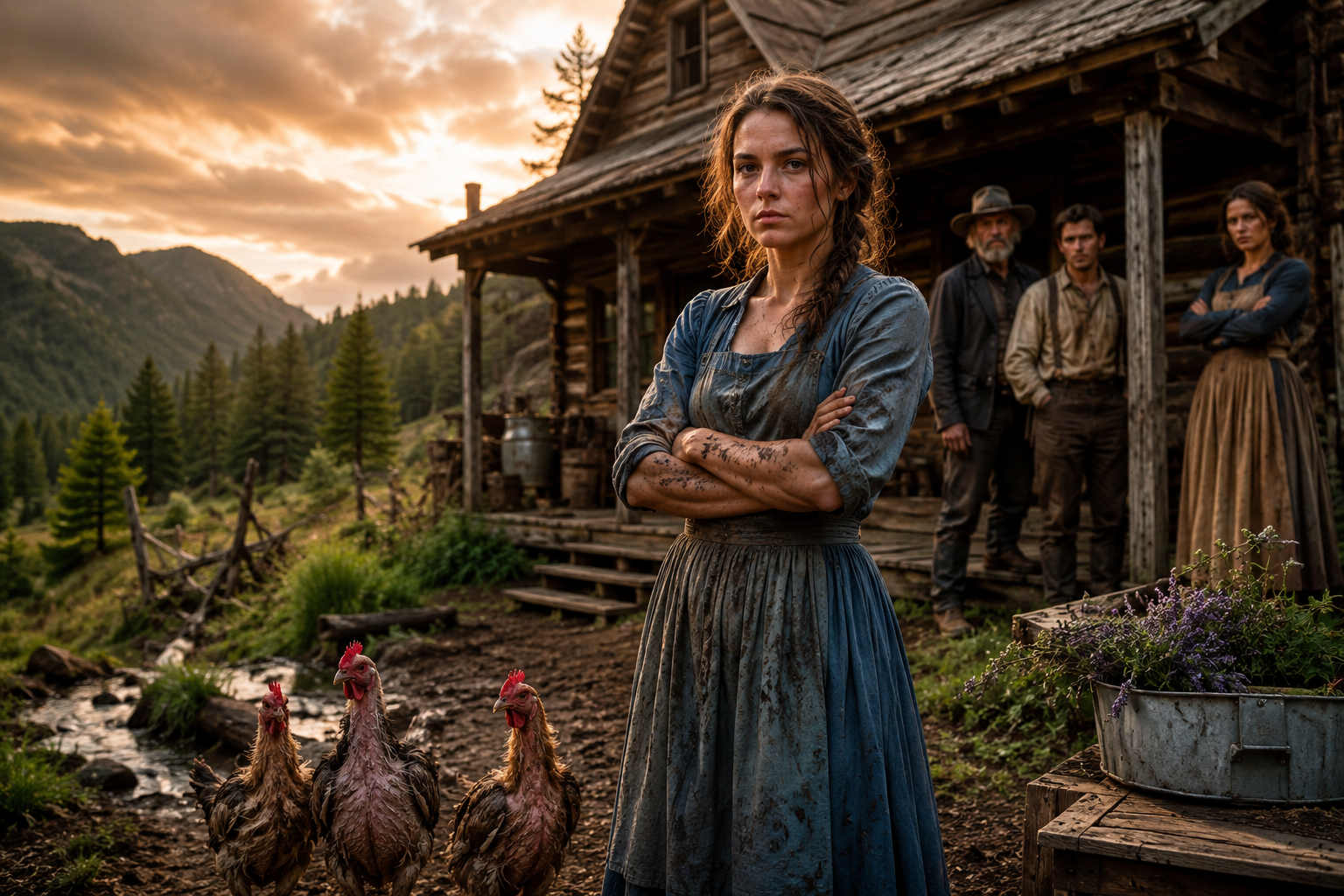
Liora slid down from the horse and ran to her. The girl wrapped both arms around Mara’s waist and buried her face against her apron.
Mara froze.
Then slowly, carefully, she placed one hand on the child’s hair.
Liora whispered, “Don’t go back.”
Mara’s throat closed.
“I won’t.”
That was the day the ridge stopped being a place of exile.
It became home.
The years that followed did not turn into a fairy tale.
Fairy tales were too clean.
Mara’s life remained full of mud, splinters, broken tools, failed crops, sick animals, cold mornings, and worry. But now the labor belonged to her. That changed everything.
She sold eggs in Bell’s Crossing.
Then greens.
Then preserves.
Then lavender soap wrapped in brown paper, because the small lavender bed she planted near the spring grew wild and fragrant enough to make the whole cabin smell like summer after rain.
People who once looked past her began greeting her by name.
Some did it because they respected her.
Some did it because success made them forget their own silence.
Mara knew the difference.
She was polite to both and trusted only the first.
Silas and Liora remained part of the ridge as naturally as the spring.
Liora learned to collect eggs, plant beans, and sit quietly without being lonely. She began speaking more, first to the hens, then to Mara, then to other people when she felt safe.
One evening, while Mara was kneading bread, Liora said, “Mama used to sing when she made dough.”
Mara slowed her hands.
Silas, sitting near the hearth, went very still.
“What did she sing?” Mara asked.
Liora hummed a broken piece of melody, too soft to catch fully.
Mara listened.
Then she hummed it back, not perfectly, but gently.
Liora’s eyes filled.
“She would have liked you,” the child whispered.
Mara looked at Silas.
His face was turned toward the fire, but tears shone in his eyes.
After that, something changed between them.
Not all at once.
Love did not arrive for Mara like lightning.
It arrived like spring.
Quietly.
Then everywhere.
It was in Silas fixing a gate and asking where she wanted the hinge, not assuming. It was in the way he listened when she said no. It was in the way he taught Liora to admire Mara’s strength without demanding it from her. It was in evenings where they sat on the porch after work, saying little, watching the ridge darken blue.
One night, a storm rolled over the mountains, and Silas stayed late because the road was too dangerous.
Liora slept in the small room Mara had prepared for her months before.
Mara and Silas sat by the hearth while rain struck the roof.
A roof that did not leak.
That still felt like a miracle.
Silas stared at the fire for a long time before speaking.
“I need to say something before cowardice talks me out of it.”
Mara’s hands stilled around her cup.
“All right.”
He looked at her.
“I love you.”
The words were plain.
That made them harder.
No decoration. No performance. No trap.
Mara felt the old fear rise anyway.
“You shouldn’t.”
“I know why you’d say that.”
“No,” she said. “You don’t. I come with trouble.”
“So does weather.”
“I don’t trust easily.”
“I’m not asking for easy.”
She stood and crossed to the window, though there was nothing to see but rain and dark glass.
“You have a child.”
“Yes.”
“She already lost one mother.”
Silas’s voice softened. “I’m not asking you to replace anyone.”
Mara closed her eyes.
That was the sentence that broke through.
Because everyone else had always wanted her to become something useful to them. A servant. A burden. A grateful dependent. A quiet woman. A convenient shame.
Silas was asking her to remain herself and be loved anyway.
“I don’t know how to do this,” she whispered.
He came no closer.
“Then we learn slow.”
She turned.
His face was steady, but not fearless. That mattered too. Courage without fear was just ignorance. Silas knew what could be lost, and still he stood there.
Mara looked down at her hands.
Scarred. Strong. Rough. Alive.
“These hands don’t know how to hold something without working to keep it,” she said.
Silas smiled sadly. “Then let mine work too.”
From the doorway came Liora’s sleepy voice.
“Are we staying here?”
Mara and Silas both turned.
The girl stood wrapped in a quilt, curls wild, eyes half closed.
Mara looked at her, then at Silas, then around the cabin.
The hearth. The table. The shelves. The dry roof. The seed jars. The life she had built plank by plank, row by row, breath by breath.
“Yes,” Mara said softly. “We’re staying.”
Liora nodded as if that settled the matter and went back to bed.
The following spring, Mara married Silas beside the spring.
Not in a church.
Not under polished glass.
Under pine branches, with Abel Crowe as witness, Magistrate Bellamy reading the vows, and Liora holding the rings in a little cloth pouch Mara had sewn from her mother’s old handkerchief.