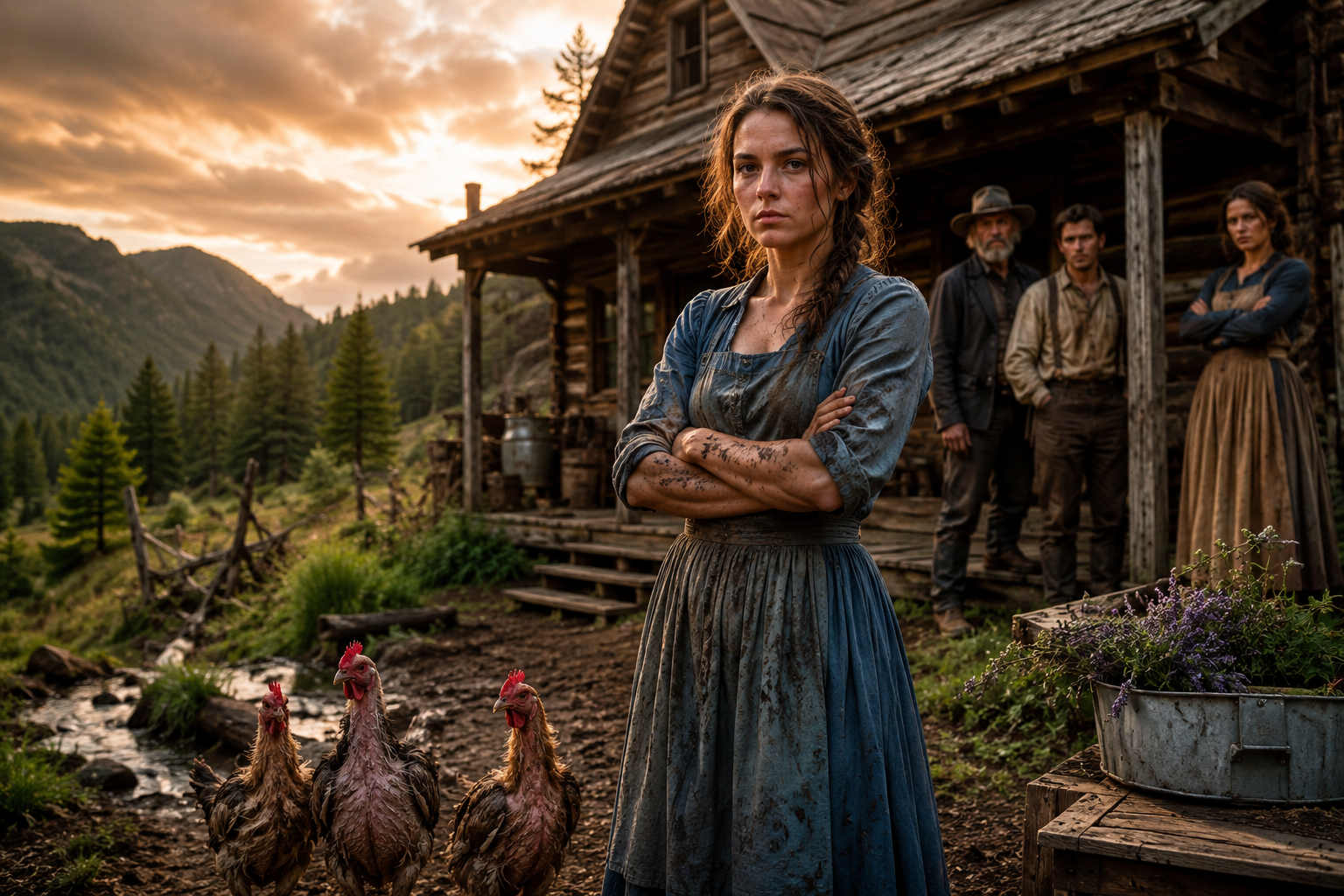
Mara wore a plain blue dress.
Her hands trembled only once.
When Bellamy asked if she took Silas Reed as her husband, Mara looked at the cabin that had once been her punishment. She looked at the hens scratching beneath the porch, fat and glossy now. She looked at the garden waking under sun. She looked at Liora, who watched her with open hope.
Then she looked at Silas.
“I do,” she said.
And for once, those words did not mean obedience.
They meant choice.
Years passed.
The ridge place grew.
The cabin became a farmhouse. The barn stood straight again. Apple trees took root on the lower slope. Lavender spread along the path. The spring was lined with stone and shaded by a bench Silas built for Mara after their first son was born.
Queenie lived long enough to become a family legend.
Duchess became round and lazy.
Mercy remained mean until the end, which everyone agreed was proof of character.
Liora grew tall. She laughed more. She still went quiet sometimes when grief came near, but she no longer vanished inside it. She called Mara by her name for years, until one winter morning, while helping with bread, she said “Mama” by accident.
Both of them froze.
Then Mara kept kneading because some sacred things survived better when not stared at directly.
Later, behind the smokehouse, Mara cried into her apron.
Not from pain.
From the strange mercy of being chosen slowly and completely.
Jonah Whitlow died bitter.
Garrett tried twice to stir legal trouble and failed both times. Elspeth once sent a letter asking for forgiveness without quite admitting wrong. Mara read it, folded it, and placed it in the stove without anger.
Some debts did not need collecting.
Some doors did not need reopening.
One summer evening, many years after the wagon left her on the ridge with three starving hens and a broken kettle, Mara stood beside the spring holding her youngest daughter on her hip.
The farm glowed gold around her.
Silas was in the field with their son, setting fence posts. Liora, nearly grown, walked up from the henhouse with a basket of eggs. Apple leaves flashed in the wind. Lavender moved in purple waves along the path. Smoke rose from the chimney of a house that no longer leaned.
The little girl in Mara’s arms pointed at the cabin.
“Is that where you came when you had nothing?”
Mara looked at the house.
She thought of the first night, the rain, the cold, the broken roof.
She thought of Jonah’s hand on the papers.
Garrett’s laugh.
Elspeth’s false pity.
She thought of Aunt Willa’s letter and the line that had saved something inside her.
The one girl who knows how to make broken things useful again.
“I had more than nothing,” Mara said.
Her daughter frowned. “What did you have?”
Mara lifted one hand.
The hand was older now. The scars had faded. The fingers were strong, the nails short, the palm lined by years of work and love.
“These,” she said.
Liora came to stand beside her, basket on her hip.
“And three terrible hens,” she added.
Mara laughed.
Silas heard it from the field and turned toward the sound, smiling as if after all these years he still could not believe he got to come home to it.
The child looked around at the farm.
“And you made all this?”
Mara looked at the spring, the garden, the barn, the porch, the family, the life that had risen from insult and mud.
“No,” she said softly. “We did.”
But deep in her bones, she knew the first truth.
No one had given her a home.
They had given her ruin.
And with her own hands, she had taught it how to live.