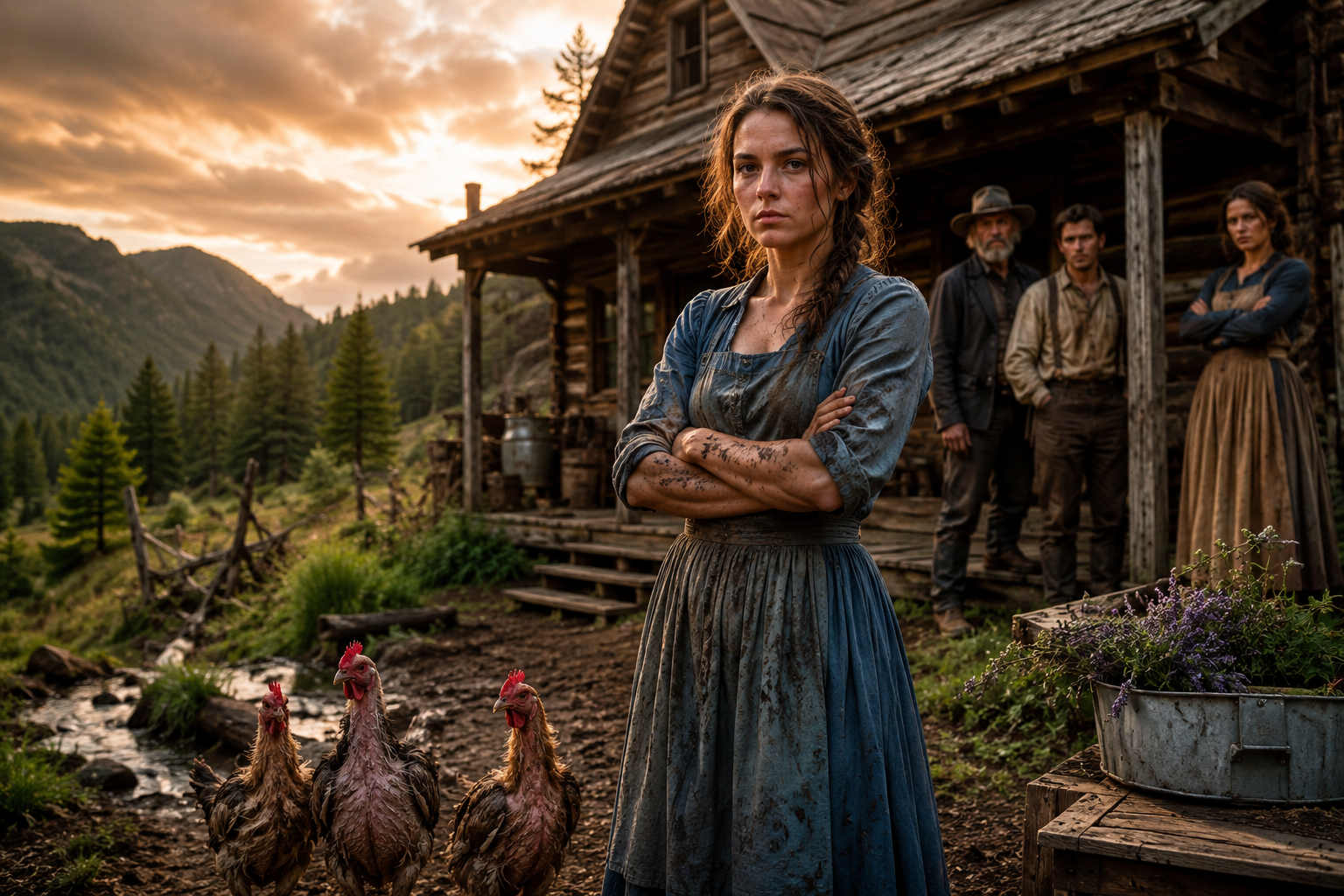
The hens watched with cautious interest.
On the fourth morning, the crooked-footed hen laid an egg.
Mara stared at it like it was gold.
“Well,” she said, picking it up carefully, “look at you.”
She named that hen Queenie.
The bare-necked one became Duchess.
The suspicious one became Mercy, because Mara thought it might improve her character.
It did not.
By the second week, Mara found the spring.
She discovered it by accident while fighting through a wall of thorn and dead leaves behind the collapsed barn. Her boot sank into soft mud, and when she pulled it free, she heard water.
Not the tired drip of a broken roof.
Real water.
Cold, clear water bubbling between two flat stones beneath the brush.
Mara dropped to her knees.
The spring was half buried, clogged with leaves and roots, but it was alive.
She put her hands into it.
The cold shocked her wrists. She laughed softly, then covered her mouth because the sound was too close to crying.
“There you are,” she whispered.
After that, everything changed.
Not easily.
But truly.
Mara cleared the spring. She lined it with stone and dug a shallow channel so overflow would run toward the lower patch of earth instead of the cabin. The soil near the water was black and rich beneath the weeds. She turned it over one small square at a time.
Her hands blistered. Then split. Then hardened.
She planted beans first. Then turnips. Then onion. She saved the corn for a warmer patch near the fence line. She spoke to the rows as she worked, not because she believed seeds needed conversation, but because she did.
For years, Mara’s words had been measured, corrected, punished, or ignored.
In the garden, no one told her to be quiet.
By late autumn, the cabin still looked poor from the road.
But from inside the clearing, it had begun to breathe.
Smoke rose from the chimney without choking the room. The porch no longer sagged as badly. The spring ran clear. The hens had grown glossy from scraps, grain, and freedom. Mara had beans drying near the hearth, turnip greens under cloth, and three jars of eggs packed in limewater.
Her dresses were patched.
Her face was thinner.
Her eyes were different.
She noticed that most when she caught her reflection in the spring.
The woman looking back at her was not soft in the old way. Not worn down. Not waiting to be chosen.
She looked like someone who had survived being thrown away and had taken root out of spite.
One cold morning, while Mara was repairing the fence with strips of wire, she heard a horse on the ridge road.
She straightened, hammer in hand.
A man appeared between the pines on a dark bay mare. He was broad-shouldered, maybe thirty-five or forty, with a weathered face and quiet eyes. A little girl sat in front of him on the saddle, wrapped in a brown coat too large for her. She had black curls, solemn eyes, and the stillness of a child who had learned to disappear while present.
The man lifted a hand.
“Morning.”
Mara did not lower the hammer. “You’re on my land.”
His mouth twitched. “Then I’ll apologize from your land.”
She almost smiled. Almost.
He dismounted carefully, lifting the girl down before tying the mare to a pine.
“Name’s Silas Reed,” he said. “My place sits two ridges east.”
Mara looked from him to the child. “That doesn’t explain why you’re here.”
“No,” he said. “It explains why I noticed smoke from a cabin that’s been dead ten years.”
The girl looked at Mara’s hands.
Mara noticed and curled her fingers against the hammer handle.
Silas saw the motion but did not comment.
“This is my daughter, Liora.”
The child gave the smallest nod.
Mara nodded back. “Mara.”
Silas looked around the clearing. His gaze moved over the patched roof, the cleared spring, the turned soil, the hens scratching near the fence.
“You did all this alone?”
Mara’s chin lifted. “Does that trouble you?”
“No,” he said. “It impresses me.”
Compliments made Mara suspicious. They often came before requests.
Silas reached into his saddlebag and pulled out a small sack.
“I brought nails. And salt. Thought whoever was up here might need both.”
Mara stared at the sack.
“Why?”
He looked confused. “Because I had extra.”
“That’s not a reason.”
“Where I come from, it is.”
Mara almost handed it back.
Pride rose in her like a match flame.
But then Duchess scratched near the empty grain pan, and the wind slipped through the patched window, and Mara remembered how foolish it was to refuse help only because cruelty had taught her help was dangerous.
She took the sack.
“Thank you.”
Silas nodded once.
The little girl stepped closer to the hens. Mercy stared at her with open distrust.
Liora whispered, “That one looks mean.”
Mara glanced at Mercy. “She is.”
The girl’s mouth moved slightly. Not a smile. The ghost of one.
Silas saw it.