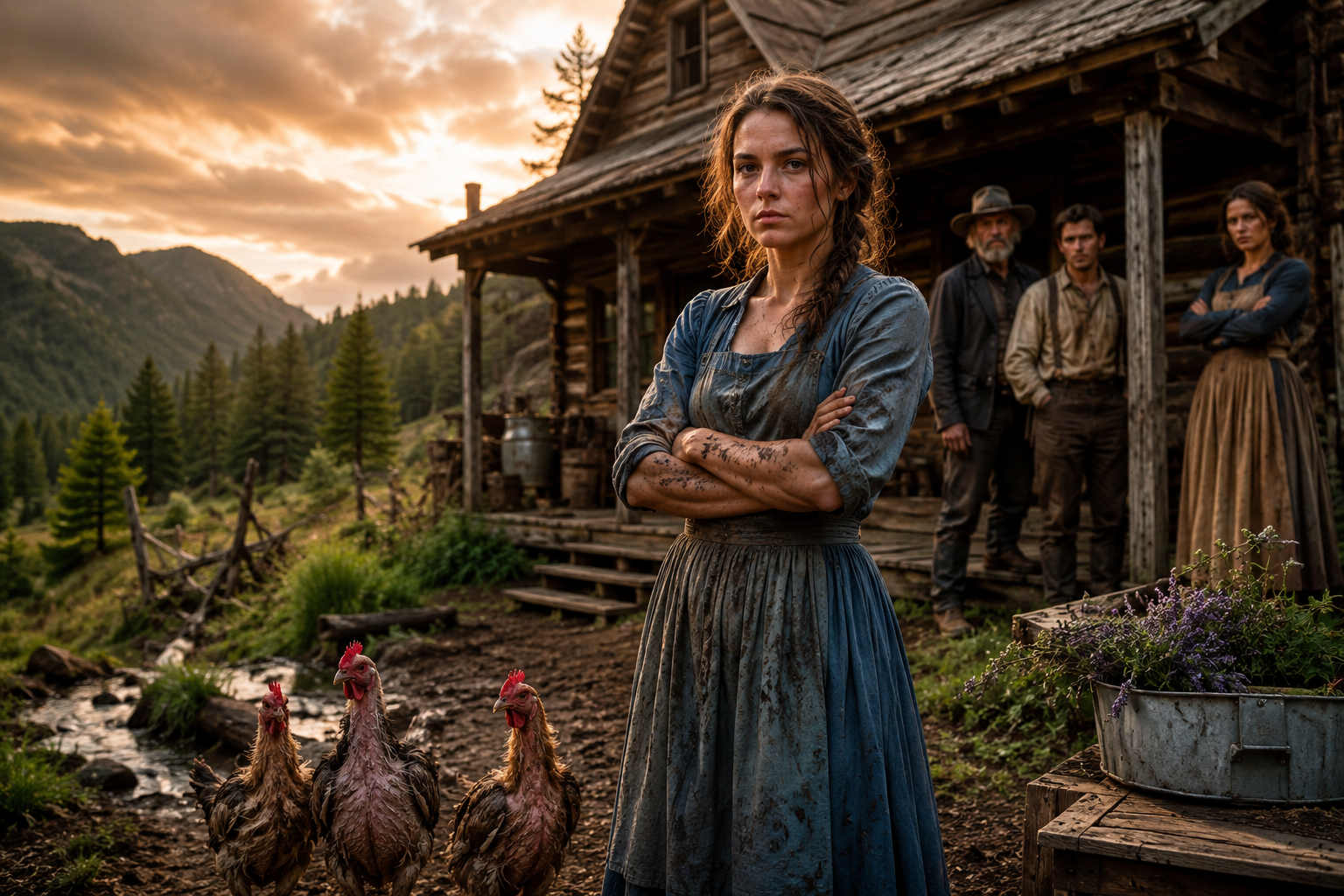
His face changed so quickly Mara almost missed it. Grief passed through him like a shadow over water.
Mara knew that look.
She had seen it in mirrors.
“How old is she?” Mara asked softly.
“Seven.”
Liora crouched near Queenie, careful not to touch.
Silas lowered his voice. “Her mother died last spring.”
The clearing seemed to still.
Mara looked at the child again. At the too-large coat. At the careful silence. At the way she stayed near her father but not close enough to ask for comfort.
“I’m sorry,” Mara said.
Silas accepted the words with a small nod, as if they were too heavy to hold for long.
Liora pointed at the garden. “Did you wake it up?”
Mara blinked. “What?”
“The ground,” the girl said. “It was sleeping.”
Mara looked at the black rows, the pale turnip leaves, the bean poles tied with twine.
“Yes,” she said after a moment. “I suppose I did.”
Liora nodded, satisfied.
Silas looked at Mara then, and something unspoken passed between them.
Not romance.
Not yet.
Recognition.
The knowledge that some people were not living so much as learning how to continue.
After that, Silas and Liora came often.
Never too often.
Never without a reason.
One week he brought a saw blade he said he no longer needed. Another time he left two jars of molasses on the porch because “trade is easier when both parties pretend it was business.” Mara sent him home with eggs, greens, and a repaired tear in Liora’s coat.
At first, Mara watched him for the hook.
There had to be one.
People did not give without wanting.
But Silas did not press. He did not ask questions she refused to answer. He did not walk into her cabin without permission. He did not laugh at her repairs or make himself large in her small space.
He simply showed up when showing up mattered.
When the first hard frost came, he and a carpenter named Abel Crowe repaired the worst part of the roof. Abel was a square man with a crooked nose and hands like mallets. He climbed onto the cabin, examined the beams, and shouted down, “This place is stubborn.”
Mara looked up from the yard. “That makes two of us.”
Abel grinned. “Then it might survive.”
They worked all day while Mara cooked beans, cornbread, and fried eggs. No one complained. No one called the meal plain. No one acted like helping her gave them ownership over her gratitude.
That evening, after Abel left, Silas lingered by the porch while Liora fed crumbs to Queenie.
Mara stood beside him, watching smoke twist from the chimney.
“It looks less dead,” he said.
“It was never dead,” Mara answered before thinking.
Silas looked at her.
She swallowed. “Just neglected.”
His voice softened. “There’s a difference.”
“Yes,” she said. “There is.”
Winter came down hard after that.
Snow sealed the ridge road. Ice thickened along the spring stones. The pines cracked under cold nights. Mara slept close to the hearth and woke before dawn to break water for the hens.
Loneliness changed shape in winter.
In summer, it spread wide.
In winter, it sat close.
Some nights, the silence in the cabin grew so deep Mara thought she could hear every year she had lost. She would sit by the fire with her mother’s sewing chest open beside her and repair things that did not urgently need repair just to keep her hands moving.
Then one afternoon, while searching beneath a loose board for a dropped needle, she found the tin.
It was hidden under the floor near the old bed frame, wrapped in oilcloth and tied with string gone brittle from age.
Inside were three silver dollars, a yellowed map, two property receipts, and a letter.
Mara knew the handwriting at once.
Aunt Willa.
She sat back on her heels.
Her hands began to tremble before she unfolded the page.
The letter was short, but it struck harder than any speech.
Willa wrote that the ridge place was not worthless. The spring had never run dry. The lower slope held rich soil. The timber, if managed well, could pay for roof, fence, livestock, and seed. She wrote that Jonah Whitlow had tried twice to convince her to sell it cheap, and she had refused because she knew greed when it wore family skin.
Then came the line that made Mara stop breathing.
I leave this place to the one girl in our bloodline who knows how to make broken things useful again.
Mara read it once.
Then again.
Then a third time through tears that blurred the ink.
All those years, she had believed no one saw her.
But someone had.
Aunt Willa had seen her hands.
Not soft hands. Not pretty hands. Not hands admired at church or kissed in courtship.
Working hands.
Hands that lifted, planted, mended, washed, carried, soothed, and built.
Hands everyone else had used.
Hands one woman had trusted.
Mara pressed the letter to her chest and wept harder than she had wept the day she left the Whitlow house.
Not because she was broken.