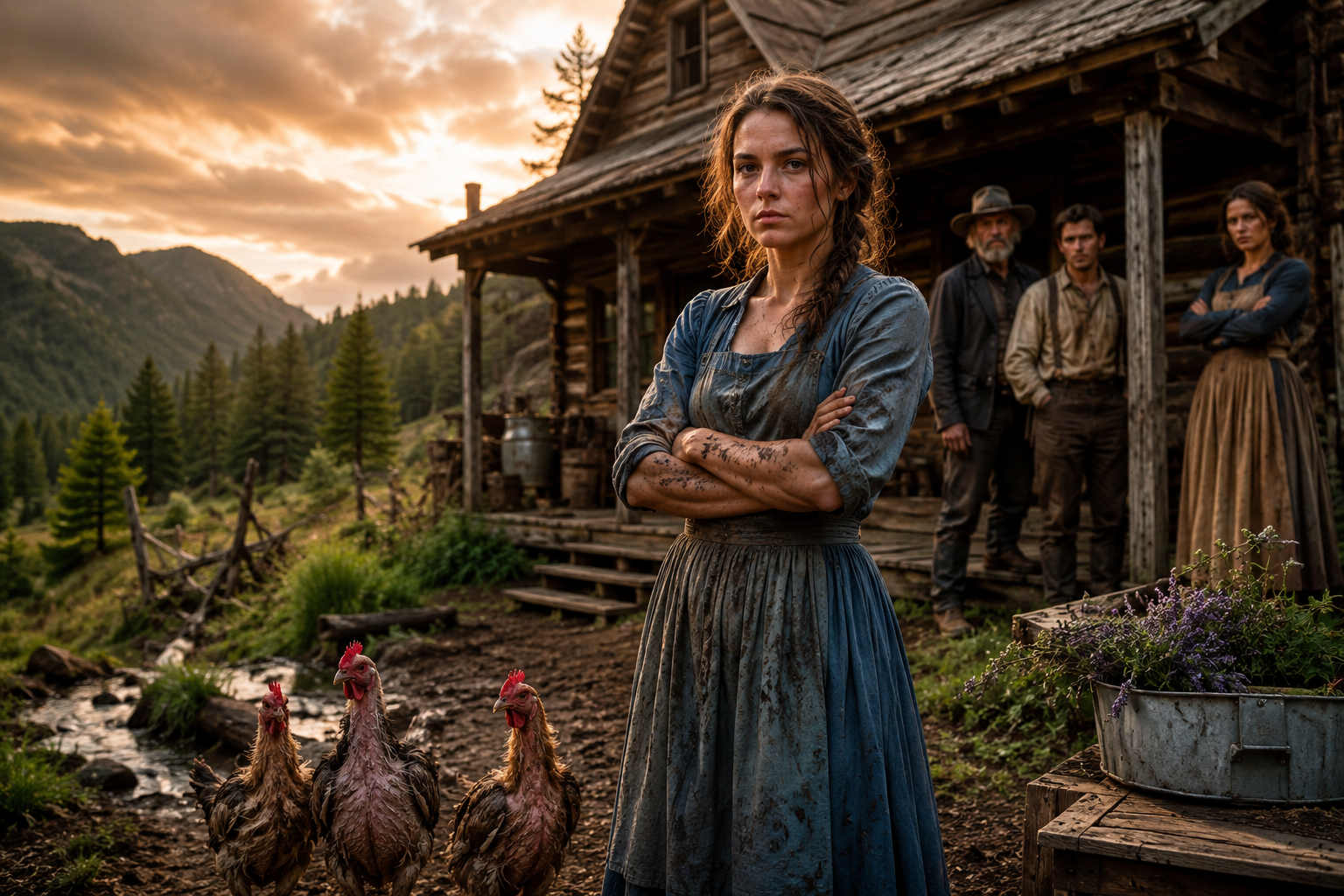
Instead he leaned close enough for her to smell tobacco on his breath.
“Don’t make this harder than it needs to be.”
Mara looked at the house around her, at the walls that had held her like a box for half her life.
Then she turned and walked out.
She did not cry in front of them.
She would not give them that.
She cried later, behind the smokehouse, where the cold wind could tear the sound apart before anyone heard it.
By sunrise, Mara had packed everything she could call her own.
Two dresses. A patched shawl. Her mother’s sewing chest. A blue kettle with a dent near the handle. A loaf of bread wrapped in cloth. Six jars of seeds she had saved year after year in secret: beans, squash, corn, onion, turnip, and lavender.
The three hens came last.
They looked insulted by life itself.
Their feathers stuck out in sad, uneven clumps. Their bones showed under skin. One had a bare neck, one had a crooked foot, and one simply stared at the world with the weary suspicion of a creature that had seen too much.
Mara placed them gently in a crate.
Garrett came out onto the porch just as the hauler’s wagon rolled up.
“Don’t get too comfortable up there,” he called. “Winter takes what pride leaves behind.”
Mara lifted the crate into the wagon and climbed after it.
She did not answer.
The hauler, a quiet man named Otis Bell, glanced at her once and said nothing. Mara appreciated that. Some silences were kinder than questions.
They left the Whitlow house behind in a ribbon of dust.
At first, Mara stared straight ahead.
Then the road curved through the trees, and the roof disappeared.
Only then did she breathe.
The ride took nearly two hours.
The north ridge road was less road than memory. The wagon jolted through ruts, over stones, and past pines that leaned close as if trying to listen. Fog hung low in the hollows. Crows crossed the gray sky. The higher they climbed, the colder the air became.
When Otis finally stopped, he did not say, “We’re here.”
He said, “I’m sorry.”
Mara looked.
The cabin leaned at the edge of the clearing like a tired animal waiting for permission to fall. Half the roof sagged. The porch dipped in the middle. The chimney had lost stones near the top. One window was boarded. The other had no glass. Briars had swallowed the fence, the path, and most of the yard. The small barn behind the cabin had collapsed on one side, leaving broken beams clawing at the air.
For a moment, Mara could only stare.
Then one of the hens sneezed.
Mara laughed.
It was not happiness. It was not amusement.
It was the sound a woman made when the world had become so cruel it had accidentally become ridiculous.
Otis unloaded her things onto the porch.
“You got family nearby?” he asked.
Mara looked at the dead cabin, the dead yard, the dead garden, the three nearly dead hens.
“No.”
Otis shifted his hat. “You need help, you send word down to Bell’s Crossing. I pass through every Thursday.”
That nearly undid her.
Kindness was harder to receive than insult. Insult had familiar edges. Kindness had no handle.
“Thank you,” she said.
He nodded, climbed back into the wagon, then paused.
“Miss Whitlow?”
“Yes?”
He looked at the cabin. “A place can be ugly and still be waiting.”
Then he drove away.
Mara stood alone in the clearing until the wagon sound faded.
The wind moved through the pines.
The hens muttered in their crate.
The cabin watched her with its empty window.
Mara wiped her face with the back of her hand.
“All right,” she whispered. “Let’s see which one of us gives up first.”
The first night, rain came through the roof in eight places.
Mara found two buckets, one cracked basin, and a cooking pot. That still left four leaks to fall freely onto the floor. She pushed the bed frame into the driest corner, dragged her trunk onto boards that seemed less rotten than the rest, and sat awake listening to water hit wood.
By morning, her hands were stiff from cold.
She built a fire with damp kindling and stubbornness.
Smoke filled the room before it found the chimney. Mara coughed until her eyes watered, then laughed again because there was no one there to complain.
The cabin did not become livable in a day.
Or a week.
It fought her.
The door stuck. The floor splintered. The hearth smoked. The roof leaked. The yard scratched her arms bloody. The well rope snapped the first time she tried it. The barn shed a beam in the middle of the night with a crash loud enough to make her reach for a knife.
But Mara had lived under Jonah Whitlow’s roof.
A broken cabin had nothing new to teach her about endurance.
She worked from dawn until dark.
She cleared the porch first, cutting back briars with a dull blade until her wrists shook. She swept out nests, leaves, mouse droppings, and old dirt. She patched the window with oiled cloth. She dragged stones to strengthen the hearth. She fixed the door latch with wire and a bent nail. She dug a trench to carry rainwater away from the foundation.