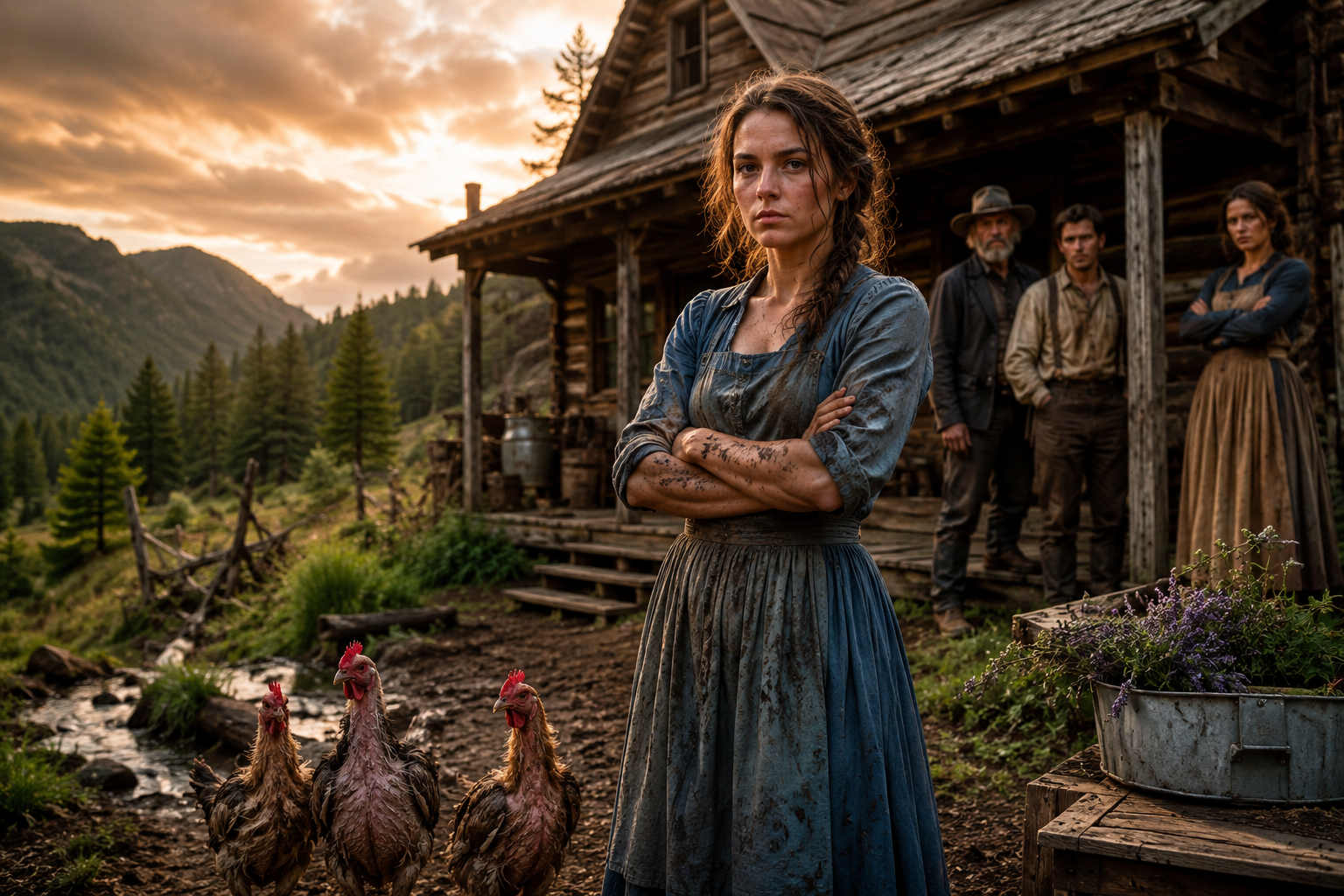
For one long breath, Mara Whitlow stood in the kitchen doorway and listened to her own life being divided without her.
Her uncle Jonah sat at the head of the table, his thick fingers resting on the deed papers as if the wood beneath them belonged to him by birthright. Beside him, his wife Elspeth wore her Sunday collar and the careful face she used whenever she wanted cruelty to look like duty. Their son Garrett leaned against the stove with one boot crossed over the other, smiling like a man watching a dog learn it was no longer welcome indoors.
Mara had washed that stove.
She had scrubbed that floor.
She had baked bread in that oven, mended shirts by that window, nursed Elspeth through winter fever, and spent twelve years being called “family” only when there was work too heavy for anyone else to carry.
Now the house was warm with lamplight and meat gravy, and Mara was standing outside the circle of it.
“You heard your uncle,” Elspeth said, folding her hands. “It’s only sensible.”
Mara looked at the papers. “Sensible for whom?”
Garrett laughed under his breath.
Jonah’s jaw hardened. “Don’t start.”
That was what he always said when she was close to telling the truth. Don’t start. Don’t make trouble. Don’t speak above your place. Don’t remember too loudly what we owe you.
Mara stepped farther into the room. She was twenty-seven years old, but in that house, they still spoke to her as if she were the hungry girl they had taken in after her mother died. They liked that version of her best. Small. Grateful. Easy to command.
“I have worked here since I was fifteen,” she said. “I never asked for wages. I never asked for my mother’s share. I never asked for anything because you told me this house was my home.”
Elspeth’s mouth tightened. “And we gave you shelter.”
“You gave me work.”
Jonah slapped his palm against the table. The plates jumped.
“You’ll watch your tone.”
Mara did not flinch. That surprised all of them. It surprised her too.
Garrett pushed off the stove. “The old ridge cabin is better than most women in your position could expect. You’ll have a roof.”
“A roof?” Mara almost smiled. “Last I heard, that roof had holes big enough to let the stars visit.”
“It was your great-aunt’s place,” Jonah said. “And now it can be yours, if you stop acting proud.”
There it was. The gift with teeth.
Everyone in the county knew the ridge cabin was dead land. A leaning shack above the north road, abandoned after Aunt Willa passed, surrounded by bramble, mud, and timber too hard to cut without money. No one wanted it. No one had wanted it for years.
So they were giving it to Mara.
Not because they were generous.
Because they wanted her gone.
Elspeth rose and crossed the kitchen. Her perfume smelled of rosewater and judgment. “You should be grateful, child. A woman alone needs somewhere to go.”
Mara looked at her. “I am not a child.”
“No,” Garrett said softly. “Just dependent.”
The words struck, but they did not pierce as deeply as they once might have.
Something inside Mara had gone strangely quiet.
For years, she had survived by swallowing what hurt. She had swallowed insults, hunger, exhaustion, loneliness. She had swallowed the ache of watching cousins inherit rooms while she inherited chores. She had swallowed every reminder that mercy, in that house, came with a chain around its ankle.
But there was a limit to what a body could hold.
Mara looked at her uncle. “If I go, I take what belongs to me.”
Jonah scoffed. “You own nothing.”
“I own my mother’s sewing chest. My blue kettle. The seed jars in the pantry. The hens behind the shed.”
Garrett laughed. “Those hens? They’re half dead.”
“Then you won’t miss them.”
Elspeth stared. “You can’t be serious.”
Mara met her eyes. “For the first time in years, I am.”
No one spoke for several seconds.
Then Jonah pushed the papers toward her.
“Sign. Or stay and remember who feeds you.”
Mara looked down at the ink, at the blank line waiting for her name. The room smelled of roast pork and lamp oil. Somewhere outside, the wind dragged bare branches against the side of the house like fingernails.
She picked up the pen.
Garrett’s smile widened.
But Mara did not sign where Jonah pointed.
She turned the sheet around, wrote one careful line beneath his terms, and signed her name under that.
Jonah snatched the paper back.
His face darkened.
“What is this?”
Mara set the pen down. “A receipt. It says the ridge place, the well road, and everything standing on it is mine from this day forward. You signed the transfer. You wanted me gone badly enough to put it in writing.”
Elspeth went pale.
Garrett stepped closer. “You think you’re clever?”
“No,” Mara said. “I think I learned from thieves.”
Jonah rose so fast his chair scraped across the floor.
For one terrible second, Mara thought he would strike her.