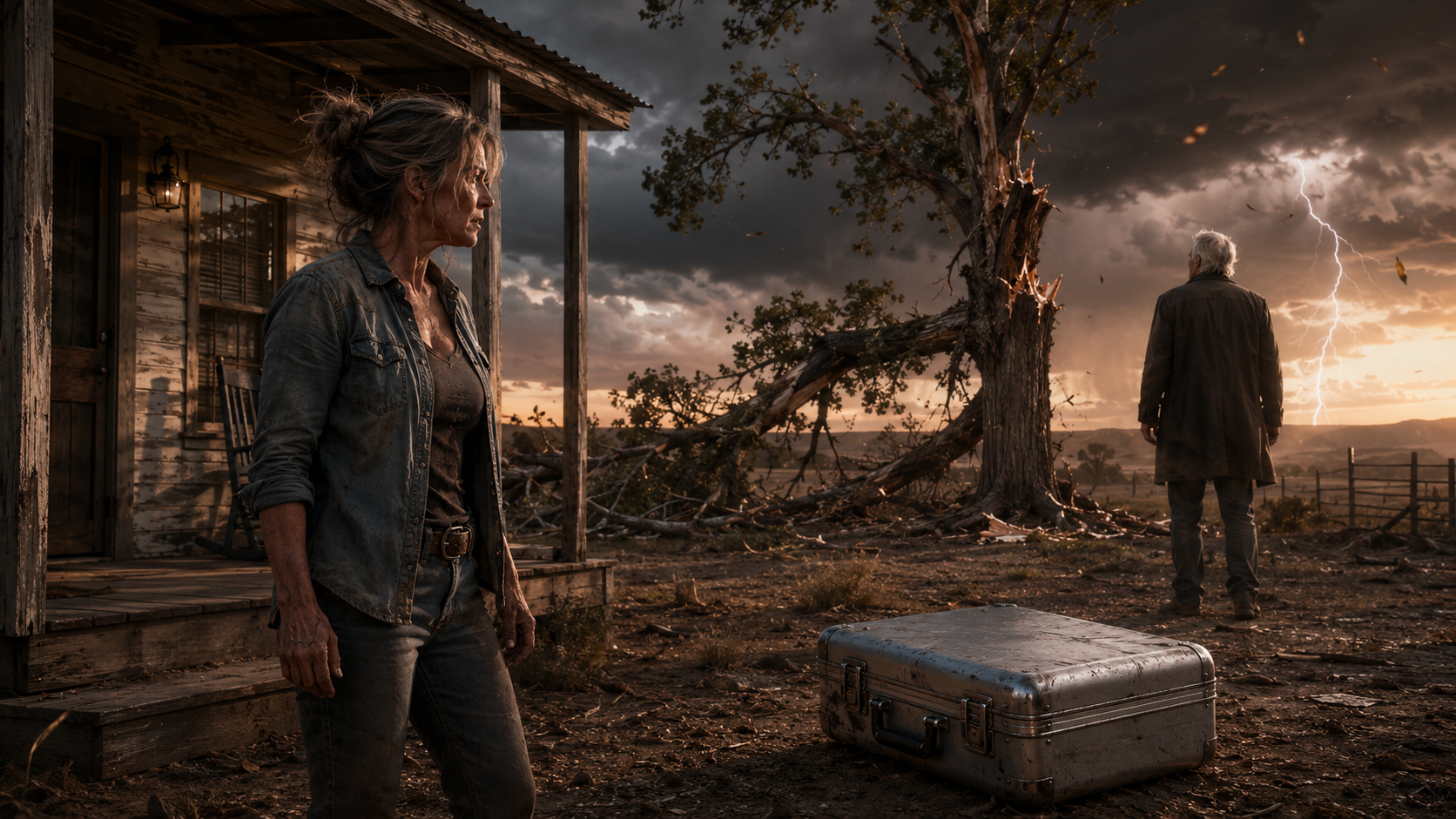
“Before leaving Stanton,” Leah said, “I called a colleague at the environmental office. I also called a reporter who has been investigating Vantage acquisitions.”
Silas stepped out of his truck carrying a heavy red toolbox.
Behind him, two environmental inspectors began photographing the broken cottonwood and the disturbed ground around its roots.
Conrad turned toward the door.
The second man moved with him.
Mara picked up the revolver.
“Leave the way you came in,” she said. “Slowly.”
Conrad stopped on the porch.
“This sale is your last chance, Mara. Once these accusations become public, the ranch may be declared contaminated. Its value could fall to nothing.”
Mara looked across the dry pastures, the weathered barn, and the hills Daniel had loved badly but completely.
For years, she had measured the ranch by what it was worth.
Now she understood that value and price were not the same thing.
“Then nothing is what I’ll keep.”
Conrad entered the SUV.
Both vehicles disappeared down the road.
Silas came into the kitchen after the inspectors began working.
Leah stood with her arms crossed.
“You helped Northstar hide the drilling accident.”
“Yes.”
“And you waited more than twenty years to speak publicly.”
“Yes.”
“Why should anyone trust you?”
“They shouldn’t,” Silas replied. “They should test the water, examine the documents, and verify every word I say.”
He placed the red toolbox on the floor.
“Inside are the original drill heads and the field notebook I kept during the operation. The metal contains residue from the formation.”
Leah studied him.
“Why now?”
Silas looked toward the split cottonwood.
“Because Daniel believed the roots would eventually expose the monitoring shaft. And because Vantage found me last month.”
“What did they want?”
“The case.”
“Did they threaten you?”
“They offered me enough money to disappear comfortably.”
Mara watched him.
“And you refused?”
“Not immediately.”
Silas gave a humorless smile.
“I stared at their offer for three days.”
“What changed your mind?” Leah asked.
“I visited Daniel’s grave.”
Mara’s expression tightened.
Silas continued.
“I told him I was still a coward. Saying it aloud made the money impossible to accept.”
The inspectors found the shaft shortly after sunrise.
The cottonwood’s roots had cracked the circular concrete cap exactly as Daniel predicted. Beneath it, a narrow steel pipe descended into darkness.
Leah put on gloves and protective glasses. She helped lower sterile sampling equipment into the shaft while Mara watched from behind the temporary barrier.
The first container emerged with clear water.
It looked harmless.
Leah held it toward the rising sun.
“Poison rarely announces itself,” she said.
“How long before you know?” Mara asked.
“Preliminary results may take a day. A complete analysis will take longer.”
“And if Daniel was right?”
Leah looked toward the ranch house.
“Then Vantage will have far more to worry about than losing a land deal.”
News traveled through the valley before noon.
Families who had lost wells after Daniel diverted the creek arrived at the ranch. Some came angry. Some came curious. Others simply stood near the gate, uncertain whether they wanted Daniel Bell’s name cleared after carrying resentment for two decades.
Mara did not ask them to forgive him.
She played the recording.
When it ended, an elderly orchard owner named Tomas Reed removed his hat.
“Daniel should have told us,” he said.
“Yes,” Mara replied.
“My wife died believing he destroyed everything we built.”
“I’m sorry.”
“Sorry doesn’t return those years.”
“No.”
Tomas looked toward Leah, who was sealing another sample.
“But if the creek had carried that water into the reservoir…”
“Hundreds of people might have been exposed,” Leah said.
Tomas stared at the ground.
“So he saved us and ruined us at the same time.”
Mara nodded.
“That sounds like Daniel.”
One week later, the preliminary tests confirmed elevated concentrations of arsenic, lead, and industrial drilling compounds beneath the northern pasture.
Vantage publicly denied responsibility.
The company suspended its local land acquisitions.
State and federal investigators secured the drilling site and seized records from two regional offices. Former Northstar employees began contacting Leah. Some wanted immunity. Others wanted, after decades of silence, to tell the truth.
The sale of Blackthorn Ridge was canceled.
The ranch did not suddenly become prosperous.
Its debts remained. Several pastures were placed under environmental restrictions. Reporters crowded the road for weeks. Lawyers sent letters filled with threats. Mara slept badly and learned to ignore unfamiliar vehicles.
But she was no longer alone.